
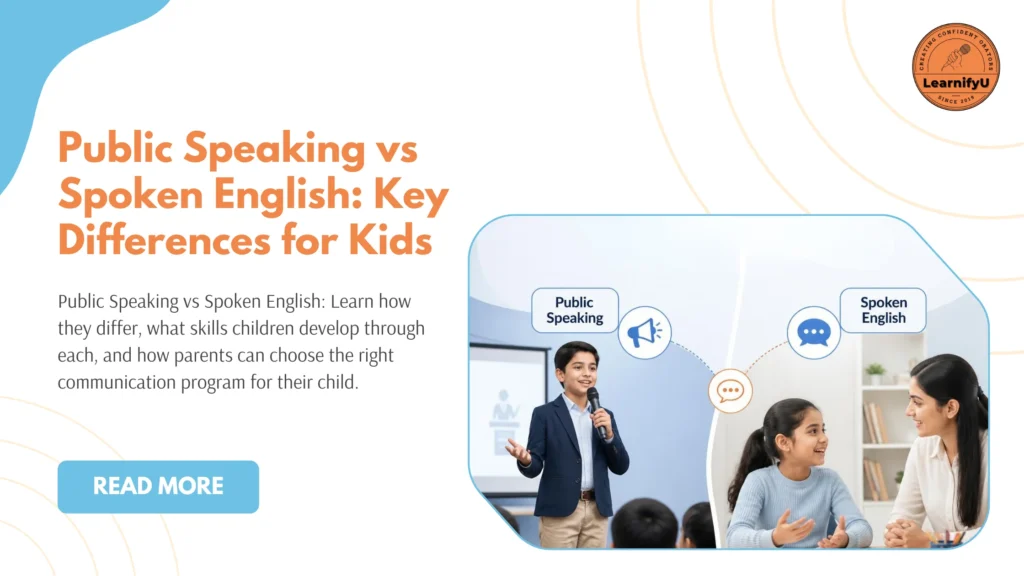
Public Speaking vs Spoken English: How Are They Different?
Parents often use public speaking and spoken English interchangeably because both involve helping children speak with greater confidence. But they are not the same skill.
A child may speak English comfortably at home – but feel nervous “when asked to present in front of a class.” Another child may confidently participate in a school presentation – but struggle to form sentences or hold a conversation in English.
So, when comparing public speaking vs spoken English –– the real question is not which one is better. It is about understanding – “what each skill teaches, where they overlap, and which one your child may need right now.”
What Is Spoken English for Kids?
Spoken English focuses on helping children use English naturally in “everyday communication.”
The goal is not simply to “memorise vocabulary or grammar rules.” Children need regular opportunities to – “listen, understand, respond, ask questions, describe experiences & express themselves in English.’
For example, a child learning spoken English may practise:
- Introducing themselves
- Talking about their family and hobbies
- Describing their day
- Asking and answering questions
- Building complete sentences
- Learning vocabulary in context
- Improving pronunciation and fluency
- Participating in conversations
- Expressing likes, dislikes and opinions
Good spoken English practice should help children move from knowing English to actually using English.
LearnifyU’s Spoken English Classes for Kids in India focus on practical communication through – conversations, vocabulary activities, storytelling, pronunciation practice and age appropriate speaking exercises.
What Is Public Speaking for Kids?
Public speaking is about communicating ideas clearly & confidently “when speaking to an audience.”
The audience does not necessarily have to be large. It could be – a classroom, a small group of classmates, teachers, judges or even family members.
Public speaking activities can include:
- Short speeches
- Storytelling
- Debates
- Presentations
- Elocution
- Extempore speaking
- Role play
- Group discussions
- Question-and-answer sessions
- School stage activities
Children also learn skills – such as voice clarity, body language, eye contact, speech organisation, expression and stage confidence.
LearnifyU’s Public Speaking for Kids program focuses on areas such as speech structure, voice modulation, overcoming stage fear, body language and creative thinking.
Public Speaking vs Spoken English: The Main Difference
The simplest way to understand public speaking vs spoken English is to – look at the purpose behind each skill.
Spoken English asks:
Can your child communicate comfortably in English?
Public speaking asks:
Can your child communicate an idea clearly and confidently to an audience?
There is certainly an overlap. Both require listening, vocabulary, sentence formation, confidence and clear expression.
However, their learning goals are different.
|
Spoken English |
Public Speaking |
|
Focuses on everyday English communication |
Focuses on communicating to an audience |
|
Builds conversational fluency |
Builds speaking confidence and presentation skills |
|
Develops vocabulary and sentence formation |
Develops speech structure and delivery |
|
Includes conversations and role play |
Includes speeches, presentations & debates |
|
Improves pronunciation and language clarity |
Develops voice modulation and stage presence |
|
Helps children communicate in English |
Helps children communicate ideas effectively |
Neither skill replaces the other.
Does a Child Need Spoken English Before Public Speaking?
Not necessarily.
A child does not have to become completely fluent in English before beginning public speaking activities.
In fact, age appropriate public speaking practice can help children become better communicators – while they are still developing their English skills.
However, the level of language support should match the child’s ability.
A younger child may begin with:
- Picture descriptions
- Show and tell
- Simple storytelling
- Short introductions
- Question-and-answer activities
An older child may progress towards:
- Presentations
- Debates
- Opinion based discussions
- Impromptu speaking
- Structured speeches
This is why choosing a program based on age, confidence and current communication ability is often more useful – than simply choosing based on a label.
When Should Parents Consider Spoken English Classes?
Spoken English classes for kids may be helpful when a child understands English – but struggles to use it naturally.
Parents may notice that their child –
- Knows many English words but speaks in short sentences
- Understands questions but hesitates to answer
- Avoids conversations in English
- Makes frequent pauses while speaking
- Has difficulty finding the right words
- Needs more pronunciation practice
- Feels uncomfortable speaking English outside familiar situations
Regular speaking practice can give children a safe environment to – experiment with language, make mistakes & gradually become more comfortable.
For younger children –– activities such as storytelling, picture talk, role play and vocabulary games can make English speaking practice more natural.
For older children –– discussions, explanations, presentations and opinion-based conversations can encourage more independent communication.
When Should Parents Consider Public Speaking Classes?
Public speaking classes may be a better fit when a child can communicate reasonably well – but struggles to speak in front of others.
For example, your child may:
- Know the answer but avoid raising their hand
- Become nervous during presentations
- Speak too softly
- Forget what they wanted to say
- Struggle to organise their thoughts
- Avoid school debates or competitions
- Feel uncomfortable speaking to a group
- Need help with stage fear
- Find it difficult to express an opinion clearly
These challenges are not necessarily signs of poor English.
A child can have good English skills & still need help developing public speaking confidence.
Can Spoken English Improve Public Speaking?
Yes, & this is where the two skills complement each other.
A child who has stronger spoken English – may find it easier to:
- Find the right words
- Form sentences quickly
- Explain an idea
- Answer questions
- Take part in discussions
- Speak spontaneously
But language ability alone does not automatically create a confident speaker.
Public speaking adds another layer.
Children need to learn how to organise their ideas, use their voice effectively, maintain eye contact, use appropriate body language and stay composed when speaking before an audience.
So, when thinking about public speaking vs spoken English –– it is more useful to see them as connected communication skills rather than completely separate abilities.
Can Public Speaking Improve Spoken English?
It can certainly provide additional opportunities to use English.
Storytelling, presentations, debates and discussions – require children to put vocabulary and sentence structures into practice.
For example, a child might learn the word environment during a spoken English activity. In a public speaking activity, they may then use that vocabulary to explain why protecting the environment matters.
That transition from learning language to expressing ideas is valuable.
Public speaking can therefore give children a meaningful reason to practise English beyond worksheets and memorisation.
Which Is Better for a Shy Child?
This depends on why the child is shy.
If your child is hesitant because they are unsure about speaking English –– spoken English practice may be the better starting point.
If your child speaks comfortably in familiar situations but becomes nervous when speaking before a group – public speaking activities may be more appropriate.
Some children need both.
For example, a child may understand English well – but lack confidence in conversations. Once they become comfortable speaking English – they may still need structured practice to present ideas before others.
The right approach should therefore address the actual communication challenge rather than simply choosing the most popular course.
Public Speaking vs Spoken English for Different Age Groups
Children’s communication needs change as they grow.
Ages 4–5
Younger children benefit from playful activities such as:
- Picture talk
- Storytelling
- Show and tell
- Simple conversations
- Vocabulary games
- Role play
At this stage, the focus should be on making communication comfortable and enjoyable.
Ages 6–8
Children can gradually work on complete sentences, everyday conversations, storytelling, descriptions and simple presentations.
This is also a good stage to introduce structured speaking activities without creating pressure.
Ages 9–11
Children can begin handling longer conversations, explanations, opinions, discussions and more structured presentations.
They can also start learning how to organise ideas before speaking.
Pre Teens and Teens
Older children can work on more advanced communication skills – such as discussions, presentations, impromptu speaking, debates, mock interviews and respectful disagreement.
At this stage, spoken English and public speaking can work particularly well together – because children are expected to communicate in increasingly academic, social and real world situations.
How Can Parents Decide Which One Their Child Needs?
Start with a simple observation.
Ask yourself ––
Does my child struggle mainly with English, or with speaking in front of others?
If the problem is vocabulary, sentence formation, pronunciation or everyday conversation –– consider spoken English.
If the problem is stage fear, presentation anxiety, organising thoughts or speaking before an audience, consider public speaking.
If your child experiences both challenges, a combination of communication and speaking practice may be more appropriate.
You can also look at the activities offered by the program. A good children’s communication program should provide opportunities for children to speak rather than relying mainly on worksheets, memorisation or passive lessons.
Why Communication Skills Matter Beyond School
The value of these skills extends beyond marks and school presentations.
Children communicate when they:
- Make new friends
- Ask teachers for help
- Explain their ideas
- Work in groups
- Participate in activities
- Express disagreement respectfully
- Introduce themselves
- Answer unexpected questions
- Take leadership roles
This is why communication skills for kids should be viewed as a long-term development area rather than simply another extracurricular activity.
Parents can explore LearnifyU’s Communication Skills for Kids resources for more guidance on – helping children become confident communicators.
FAQs – Public Speaking vs Spoken English
No. Spoken English focuses primarily on using English comfortably in “conversations and everyday situations.” Public speaking focuses on communicating ideas clearly & confidently to an audience. The two skills overlap -but have different goals.
It depends on the reason for the hesitation. If the child struggles with “sentence formation, vocabulary or fluency” – spoken English practice may help. If the child speaks comfortably one to one but becomes nervous in front of a group – public speaking practice may be more appropriate.
Yes. Children can begin with age appropriate public speaking activities – using language that matches their current ability. Simple storytelling, show and tell and short presentations – can be introduced before progressing to more advanced speaking tasks.
Yes. Stronger spoken English can make it easier for children to find words, form sentences and explain ideas. However – presentation skills also require practice in speech structure, delivery, voice, body language and audience awareness
Some children may benefit from both. Spoken English can strengthen everyday language use – while public speaking can develop presentation, stage and audience facing skills. The right combination depends on your child’s current “abilities and goals.”
Observe where the difficulty occurs. If your child hesitates even during simple English conversations, language practice may be needed. If they communicate comfortably but become nervous during presentations or group speaking, confidence and public speaking practice may be more relevant.
Public Speaking and Spoken English Can Work Together
The public speaking vs spoken English comparison does not have to end with choosing one over the other.
A child who develops spoken English can gain the language confidence needed for everyday conversations. A child who develops public speaking skills can learn how to organise ideas, present them clearly and speak with greater confidence before an audience.
Together, these skills can support stronger communication skills for kids — from classroom conversations and group activities to presentations, debates and future real-world situations.
The most important question is therefore not “Which course is better?”
It is:
“What does my child need help with right now?”
Once parents identify that need, choosing the right type of communication practice becomes much easier.