
Communication Skills for Kids – Build Confidence & Expression
Does your child hesitate to speak up, struggle to explain their thoughts or find it difficult to express themselves in conversations?
Communication is more than speaking. It involves listening, understanding, organising thoughts, expressing ideas & interacting confidently with others.
At LearnifyU, our Communication Skills Classes for Kids help children aged 4–14+ develop the confidence and ability to communicate more effectively. Through live online learning and guided speaking activities children get opportunities to –– practise expressing themselves, sharing ideas, participating in conversations and communicating with greater clarity.
Whether your child is naturally shy, needs encouragement to participate in discussions or wants to become a more confident communicator, developing these skills can support their learning and everyday interactions.
Give your child the confidence to express themselves.
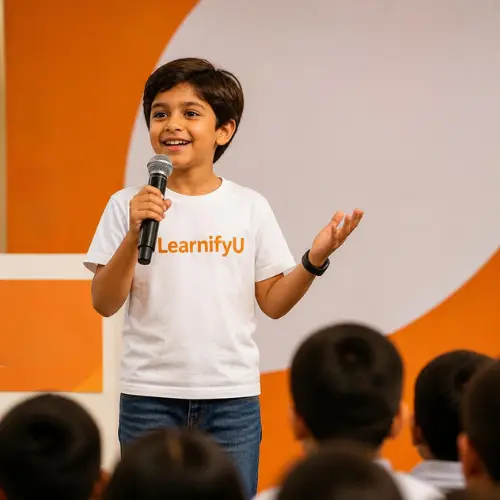
Does Your Child Struggle to Express Their Thoughts?
Every child has ideas, opinions & experiences worth sharing. However – not every child finds it easy to communicate them.
You may notice that your child ––
- Knows the answer but hesitates to speak in class.
- Finds it difficult to explain thoughts or ideas clearly.
- Gives very short answers even when they know more.
- Feels uncomfortable starting or participating in conversations.
- Struggles to organise thoughts while speaking.
- Avoids speaking in group activities or discussions.
- Finds it difficult to express opinions or ask questions.
- Feels nervous – when interacting with unfamiliar people.
These challenges do not necessarily mean a child lacks knowledge or ability. Sometimes – children simply need opportunities, encouragement and guided practice – to develop their communication skills.
The ability to communicate confidently develops over time. With the right learning environment – children can become more comfortable expressing their ideas and interacting with others.
Help Your Child Become a Confident Communicator
We believe that every child should have the confidence to express their thoughts and the ability – to communicate them effectively.
Our communication skills programme focuses on helping children become better communicators through – guided learning, speaking opportunities and practical activities.
Children get opportunities to practise how to ––
- Express thoughts & ideas in clear language.
- Listen carefully & respond appropriately.
- Participate in conversations and discussions.
- Organise their thoughts – before speaking.
- Share opinions and communicate their viewpoints.
- Build confidence while interacting with others.
- Communicate more comfortably in academic and everyday situations.
Rather than focusing only on speaking in front of an audience – the broader goal is to help children communicate confidently in different situations.
Why Communication Skills for Kids Matter
Strong communication helps children express their thoughts clearly, form meaningful relationships & handle school challenges with ease. Kids who learn to communicate well stand out in:
- Group discussions
- School presentations and storytelling
- Leadership activities and student council
- Friendships and social dynamics
- Future interviews and public speaking
Unlike traditional classrooms where only academic performance is measured, we nurture real life skills that empower children to speak, listen & connect with confidence.
Powerful Stats to Know 📊
- 83% of teachers say – communication issues affect classroom performance.
- Kids with strong communication skills are 58% more likely to take on leadership roles.
- 80% of emotional intelligence (which starts with communication) is built before age 15.
- In our LearnifyU review, 92% of parents reported a positive shift in their child’s confidence after 5–6 sessions.
What Will Your Child Learn in Our Communication Skills Classes?
Communication involves several interconnected abilities. Our programme is designed around – developing these important areas through age appropriate learning and guided practice.
Verbal Communication and Clear Expression
Children practise expressing their thoughts, experiences and ideas using clear and meaningful language. They learn to communicate what they want to say - instead of struggling to find the right words.
Active Listening and Responding
Good communication begins with listening. Children learn the importance of paying attention, understanding what others are saying & responding appropriately - during conversations.
Vocabulary and Sentence Formation
Children get opportunities to develop their ability to communicate using - appropriate words and well structured sentences. This supports clearer expression and more meaningful conversations.
Conversation and Interpersonal Skills
Everyday interactions require children to initiate conversations, take turns, share opinions and respond to others. Guided practice can help children become more comfortable - interacting with people.
Storytelling and Creative Expression
Storytelling encourages children to organise their thoughts, describe experiences and communicate ideas in an engaging way. It also gives them a creative opportunity - to practise verbal expression.
Public Speaking and Presentation Skills
Public speaking is an important part of communication development. Children can practise organising ideas, delivering short speeches and presenting information - with greater confidence.
Confidence and Body Language
Communication is not limited to words. Children also learn to become more aware of their posture, facial expressions, eye contact and overall presentation - while interacting with others.
Organising and Expressing Thoughts
Children practise thinking about - what they want to communicate and presenting their ideas in a logical sequence. This can help them explain their thoughts more effectively in conversations and classroom activities.
Communication Skills Development for Different Age Groups
Children develop communication abilities at different stages. Their learning needs, interests and confidence levels change as they grow.
LearnifyU’s programme caters to children aged 4–14, with learning activities suited to their developmental stage.
Communication Skills for Kids Aged 4–6
At this age – children are developing their ability to express needs, describe experiences and participate in simple conversations.
Learning can focus on:
- Expressing thoughts through simple sentences.
- Listening and responding to questions.
- Describing objects, experiences and activities.
- Building confidence while speaking.
- Storytelling and imaginative expression.
Communication Skills for Kids Aged 7–10
Children in this age group – are increasingly expected to explain ideas, participate in classroom discussions and communicate with peers.
Learning can focus on:
- Expressing opinions and sharing ideas.
- Developing clearer verbal expression.
- Participating in conversations.
- Storytelling and describing experiences.
- Organising thoughts before speaking.
- Building confidence in classroom participation
Communication Skills for Kids Aged 11–14+
Older children benefit from opportunities – to communicate more independently, express viewpoints and participate in discussions.
Learning can focus on:
- Structuring and presenting ideas.
- Communicating opinions confidently.
- Participating in discussions and debates.
- Improving presentation skills.
- Developing interpersonal communication.
- Expressing thoughts with clarity and confidence.
The objective across all age groups – is to help children become more comfortable, thoughtful and effective communicators.
How LearnifyU's Online Communication Classes Work
LearnifyU offers live online learning – that gives children opportunities to practise communication skills from the comfort of home.
Our approach focuses on participation and guided practice – rather than simply asking children to memorise information.
Children get opportunities to:
- Participate in live learning sessions.
- Practise expressing their ideas.
- Engage in guided speaking activities.
- Develop their listening and response skills.
- Share thoughts and participate in discussions.
- Build confidence through regular opportunities to communicate.
Online learning also allows children from different cities and regions to access the programme without travelling to a physical learning centre.
Parents looking for communication skills classes for kids in India or live online learning from other countries can explore LearnifyU’s programme.
Why Choose LearnifyU for Your Child's Communication Skills Development?
Choosing a communication programme is about – finding the right environment for your child to learn, practise and grow.
Here is what parents should look for in a meaningful communication learning experience:
A Focus on Overall Communication
Communication involves listening, understanding, speaking & responding. Children need opportunities to develop these abilities together.
Learning for Children Aged 4–14+
Children at different stages have different communication needs. Learning activities should be appropriate to their age, confidence and ability.
Live Online Learning
Children can participate in live online classes from home – making communication learning accessible to families in different locations.
Opportunities to Practise
Communication skills develop through participation. Children need opportunities to – speak, listen, respond, share ideas and practise expressing themselves.
Skills That Extend Beyond the Classroom
The ability to communicate clearly – can support children during classroom discussions, group projects, friendships, presentations & everyday interactions.
Communication Skills vs Public Speaking vs Spoken English
Parents often come across different programmes – when looking for ways to improve their child’s communication abilities. Although communication skills, public speaking and spoken English are connected – they do not mean exactly the same thing.
Communication skills cover the broader ability to express ideas, listen actively, understand others, participate in conversations and interact effectively.
Public speaking focuses more specifically on communicating with an audience. It includes –– speech preparation, presentations, audience engagement & confident delivery.
Spoken English focuses on using the English language in conversations. It may include –– vocabulary, pronunciation, sentence formation, fluency and everyday language use.
These skills complement one another. A child may have good English vocabulary – but still hesitate during conversations. Another child may communicate naturally – but need more practice with structured presentations.
Understanding the difference – can help parents choose the right learning support for their child’s needs.
Related Resources to Explore:
What Do Parents Say About Us 🗣️


 Trustindex verifies that the original source of the review is Google.
 Trustindex verifies that the original source of the review is Google.
 Trustindex verifies that the original source of the review is Google.
 Trustindex verifies that the original source of the review is Google.
 Trustindex verifies that the original source of the review is Google.
 Trustindex verifies that the original source of the review is Google.
Before LearnifyU
- Shy and Nervous
- Interrupts or Zones out
- Hesitates to Speak
After LearnifyU
- Confident and Clear
- Listens Actively and Responds
- Leads Class Discussions
FAQs About Communication Skills for Kids
Communication skills classes help children develop the ability to express thoughts, listen actively, participate in conversations and interact confidently with others. They may include “activities involving verbal expression, storytelling, discussions, listening & presentation skills.”
Children can begin developing communication skills from an early age. LearnifyU’s programme is designed for children aged 4–14, with learning opportunities suited to different stages of development.
Yes. Guided speaking activities and regular opportunities to express thoughts – can help shy children gradually become more comfortable communicating. The aim is to encourage participation without putting unnecessary pressure on the child.
Communication skills involve “expressing ideas, listening, understanding & interacting with others.” Spoken English focuses specifically on using English in conversations – including vocabulary, pronunciation, sentence formation and fluency. A child can benefit from developing both.
No. Public speaking is one part of communication. It focuses on speaking before an audience and delivering presentations – while communication skills cover a wider range of abilities, including listening, conversations, responding and expressing everyday thoughts.
Live online classes can provide opportunities for children to participate in “conversations, practise speaking, listen to others & express their ideas.” Their effectiveness depends on the quality of – instruction, interaction and opportunities for active participation.
Developing communication skills – can help children become more comfortable answering questions, participating in classroom discussions, sharing ideas and presenting their work. The skills can support their overall classroom participation.
Children have different levels of language ability and confidence. Parents should discuss their child’s current communication needs with LearnifyU to understand – whether the programme is an appropriate fit.
Yes. LearnifyU offers live online learning, allowing children to participate from home. Offline classes are available only in Faridabad, India.
Parents can contact LearnifyU to understand the programme and enquire – about the available learning options. You can begin by booking a demo class and discussing your child’s learning needs.
General Q&A – Parents Often Ask
Important communication skills include clear verbal expression, active listening, understanding others, asking questions, responding appropriately, sharing opinions and participating in conversations. As children grow – presentation skills, structured discussions & confident expression also become valuable.
You may consider additional communication practice – if your child frequently “hesitates to speak, struggles to explain ideas, avoids conversations, finds it difficult to participate in discussions or feels uncomfortable expressing opinions.” These behaviours do not automatically indicate a problem – but they can highlight areas where guided practice may help.
Parents can encourage children to “describe their day, share opinions, tell stories, ask questions & participate in everyday conversations.” Listening patiently, allowing children time to respond and encouraging them to explain their thoughts – can also help. Structured classes can provide additional guided practice.
Children may feel more comfortable speaking in familiar surroundings – than in a classroom or unfamiliar social setting. They may worry about making mistakes, being judged or speaking in front of a group. Gradual exposure, encouragement and opportunities to practise – can help them become more comfortable in different environments.
Communication practice can support confidence by giving children opportunities to “express themselves, share opinions & interact with others.” As children become more familiar with speaking and responding in different situations – they may feel more comfortable communicating.
Both matter – but they serve different purposes. Academic knowledge helps children understand subjects and concepts – while communication helps them explain what they know, ask questions, share ideas and collaborate with others. Developing both can support a child’s learning & overall development.
Communication skills involve expressing and understanding messages through speaking, listening and responding. Social skills include a broader set of behaviours involved in interacting with people – such as cooperation, empathy, sharing, taking turns and building relationships. The two areas are closely connected.
Absolutely. A child does not need to be extroverted – to become a confident communicator. Communication is a skill that can be practised and developed. Children can learn to express themselves comfortably – while retaining their individual personalities.