
Public Speaking Classes for Kids & Teens in Germany
Live online public speaking classes for kids & Teens in Germany help children develop the confidence to express ideas, speak clearly, organise their thoughts, participate in discussions and present in front of others. LearnifyU offers instructor-led communication and public speaking programmes designed for children and teenagers –– who want to become more comfortable and capable communicators.
A child may know exactly what they want to say but hesitate when asked to speak in front of classmates. Another may be comfortable talking at home –– but become nervous during a presentation. Some children speak confidently but need help organising their thoughts or listening to others.
Public speaking is not about turning every child into an extrovert. It is about giving children opportunities to practise expressing themselves –– clearly & confidently.
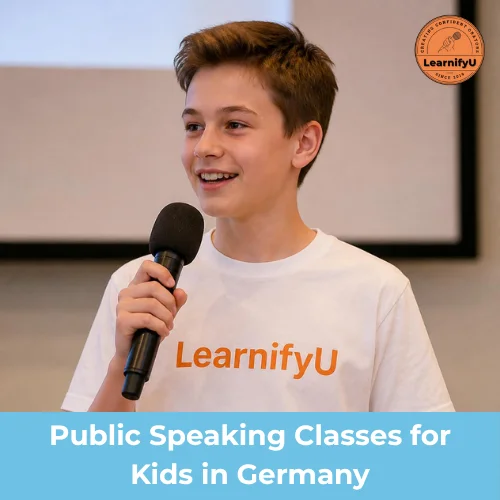
Why Public Speaking Skills Matter for Children Growing Up in Germany
Children today communicate in many different settings. They may –– speak with parents at home, participate in classroom discussions, work on group projects, give presentations, interact with teachers, and communicate with children from different cultural and linguistic backgrounds.
For families living in Germany, these experiences can be particularly varied. International, multicultural and bilingual families may use more than one language –– across home, school and social environments.
Being able to understand a language is not necessarily the same as feeling comfortable using it –– in front of other people.
A child may have good vocabulary –but hesitate to raise their hand. They may understand a topic but struggle to explain it. They may know their presentation well but become nervous when classmates start asking questions.
Structured public speaking classes for children can give them –– a supportive environment in which to practise these situations.
The goal is not to promise that –– a child will never feel nervous. Even experienced speakers can feel nervous. Instead, children can learn –– how to organise their thoughts, prepare appropriately, use their voice effectively, and continue communicating when a situation feels unfamiliar.
These skills can be useful in school & can continue to support children as –– they take on more academic, social and professional responsibilities.
Evidence reviewed by the Education Endowment Foundation shows that oral-language approaches can have a positive impact on children’s learning, particularly when they involve meaningful speaking and listening.
That’s why our programmes give children opportunities not just to speak, but to listen, organise ideas, respond and communicate with others.
Is Your Child Comfortable Speaking in Front of Others?
Parents are often the first to notice –– when a child has difficulty communicating in certain situations. Perhaps your child:
- Knows the answer but rarely raises their hand.
- Speaks freely at home but becomes quiet in groups.
- Finds classroom presentations stressful.
- Needs considerable prompting to explain an idea.
- Speaks too quickly or too softly when nervous.
- Has good ideas but struggles to organise them.
- Avoids situations where they need to speak in front of others.
- Becomes uncomfortable when asked an unexpected question.
- Is confident with friends –but hesitant with unfamiliar people.
These behaviours do not automatically indicate a lack of confidence or communication ability.
Children develop at different rates –– and some simply need more opportunities to practise speaking in structured situations.
A supportive programme can provide those opportunities without making a child feel that –– every mistake is a problem.
Confidence grows through practice & not pressure.
What Children Learn in Public Speaking Classes
Public speaking involves much more than memorising & delivering a speech.
A well rounded programme can help children develop several connected communication skills.
Speaking Clearly
Children learn to communicate their thoughts in a way that is easier for others to understand. This can include –– practising appropriate volume, pace, pronunciation, sentence structure and pauses. The objective is not to make every child speak in exactly the same way –but to help them become more aware of how they communicate.
Organising Ideas
Having an interesting idea is only the beginning. Children also need to know –– how to introduce a thought, explain it logically, provide supporting details and bring their message to a clear conclusion. This skill can be useful for classroom answers, presentations, storytelling and everyday conversations.
Presentation Skills
Presentations give children an opportunity to practise speaking to an audience with a clear purpose. Depending on age and ability –– children may learn how to introduce a topic, structure information, maintain audience awareness, use appropriate body language and respond to questions. These are transferable presentation skills for kids that can become increasingly important as schoolwork becomes more demanding.
Storytelling
Storytelling gives younger children a natural way to practise communication. They can learn how to describe events, sequence ideas, use expression and keep an audience interested. For younger learners –– storytelling can make speaking practice feel more natural than asking them to deliver formal speeches.
Listening and Responding
Good communication involves listening as well as speaking. Children can practise –– listening to questions, understanding another person's point, waiting for their turn, asking follow up questions & responding appropriately. This is particularly important in group discussions & collaborative activities.
Confidence Through Practice
Confidence should not be treated as something that can simply be "taught" in one lesson. Children can, however, receive repeated opportunities to –– speak, make mistakes, receive constructive feedback and try again. That process can help them become more familiar with speaking situations.
Impromptu Speaking
Not every speaking situation gives a child time to prepare. Impromptu speaking activities can give children short, age-appropriate opportunities to think about a topic and respond without memorising a complete answer. With practice, children can become more comfortable organising thoughts quickly.
Voice, Pace and Body Language
What a child says matters but so does how they say it.
Children can become more aware of –– Speaking too quickly, Speaking too softly, Pausing between ideas, Making appropriate eye contact, Using natural gestures, Standing or sitting comfortably.
The purpose is not to teach children to perform a rehearsed set of gestures. It is to help them become more comfortable using their voice & body –– while communicating.
Public Speaking Classes for Different Age Groups
Children’s communication needs change as they grow. Public speaking activities should therefore be appropriate to their age and level of development.
Elementary School Children
Younger children can begin with activities such as –– storytelling, introductions, simple presentations, describing experiences, speaking in small groups and expressing opinions.
At this stage, the focus can be on helping children:
⚪️ Express complete thoughts
⚪️ Speak audibly
⚪️ Tell stories
⚪️ Listen to others
⚪️ Participate in discussions
⚪️ Become comfortable presenting simple ideas
Middle School Students
Middle school students can gradually work with more structured communication challenges.
Activities may include –– presentations, group discussions, persuasive speaking, impromptu responses & handling questions.
The emphasis can shift toward structured thinking, audience awareness and expressing an opinion with supporting reasons.
High School Students & Teens
Older students can work on more advanced communication and leadership skills.
This may include persuasive presentations, formal speaking, interviews, group leadership, structured arguments and communicating ideas in academic or professional-style situations.
Live Online Public Speaking Classes for Kids in Germany
Families do not always have easy access to a specialised English-language public speaking programme in their local area. Online learning can provide another option.
LearnifyU’s classes are live and instructor-led, allowing children to participate in communication activities rather than simply watching recorded lessons.
Children can join from home in Germany and practise speaking in a structured online environment. The online format can be particularly convenient for families who:
- Prefer learning from home
- Want an English-language programme
- Have busy school and extracurricular schedules
- Live away from major cities
- Prefer not to spend time travelling to classes
- Want access to a specialised communication programme
Online learning is not automatically suitable for every child. Children learn differently –– which is why a free demo can give families an opportunity to understand whether the format works well for their child.
What Parents Say About LearnifyU
Posted on Google
 Udit Rana
Trustindex verifies that the original source of the review is Google.
We enrolled our nephew in LearnifyU to improve communication and public speaking skills, and the transformation has been amazing. The sessions are interactive, engaging, and designed in a way that keeps children comfortable while encouraging them to speak confidently. My nephew has become more expressive, confident while speaking in English, and much more active in school presentations and conversations. The mentors are supportive, patient, and give personal attention to every child. What we really appreciate is that the classes focus not only on speaking English but also on confidence building, stage presence, vocabulary, and overall communication skills. Highly recommended for parents looking for online public speaking and communication classes for kids.Posted on Google Mitha PouloseI enrolled my son for public speaking classes and I am truly happy with the experience. The classes have been excellent and I can see a great improvement in his speech.Posted on Google
 Rathana AroulI had enrolled my kid (6 years old)in LearnifyU for Public speaking classes. He used to be shy and finding it difficult to speak up. Thanks to Urvashi Mam's friendly approach and effective coaching, he has improved now... Improvement started showing up after 3 classes and he is progressing well...Still a long way to go..but tremendous improvement...Posted on Google
 preethiba mahendran"Your patience and dedication have helped my child feel so confident in her skills"."You bring such creativity to the subject, making it easy to learn and enjoyable".Posted on Google
 Nithu MahendranBest platform for kids to boost up their confidence, personalised curriculum so that each kids get prior importance, gamified learning and Flexible with scheduling.Posted on Google
 Vasudha RathiA very unique blend of classes - where one can learn, have fun activities and improve your speaking skills.Posted on Google
 Tulika SharmaGreat place for kids to build confidence in English! The teachers are really friendly and patient, and they make learning fun with lots of interactive activities. I’ve seen a big improvement in communication skills, especially in speaking and confidence. Overall, a very positive and encouraging environment for kids.Posted on Google
 rupali lohaniHighly experienced teachers with great technique to make kids learn English in a interesting way. My son has shown significant improvements in his English speaking and writing capabilities.
What Happens in a LearnifyU Public Speaking Session?
The exact activities can vary according to the child’s age, level and programme.
A typical learning experience may involve several stages.
Warm-up:
A short communication activity helps children become comfortable participating.
Speaking practice:
Children work on a specific speaking or communication activity.
Guided presentation:
Students have opportunities to express and organise their ideas.
Interaction:
They may respond to questions, participate in discussions or communicate with other learners.
Feedback:
The instructor identifies strengths and areas for improvement in an –– age-appropriate way.
Reflection and practice:
Students can think about what they learned and apply it during future activities.
The important part is that –– children get opportunities to speak, listen, respond and practise rather than passively consume content.
Can Public Speaking Classes Help a Shy Child?
They can provide useful opportunities for practice –– although every child’s experience will be different.
A shy child does not necessarily need to become outgoing.
Instead, the aim can be to help them communicate when communication is necessary.
A child who initially avoids speaking in a group may begin by answering a simple question. Later, they may participate in a short discussion, tell a story or present a prepared idea.
A gradual approach can make speaking feel –– more manageable.
Parents should also remember that nervousness is normal. Public speaking classes should not shame children for feeling nervous or force them into situations –– that are inappropriate for their age or readiness.
The objective is supported practice and gradual development.
Public Speaking for Indian & International Families in Germany
Germany is home to families from many cultural & linguistic backgrounds. Children may grow up navigating different languages, cultures & communication environments.
For Indian families living in Germany –– an English-language online programme can be a convenient way to give children additional opportunities to practise communication from home.
A child may use one language with family, another at school, and communicate with friends from different backgrounds.
In such environments, being able to explain ideas clearly, participate in discussions and speak confidently can be –– “valuable”.
LearnifyU’s programmes are designed around communication skills rather than a particular nationality. This makes them relevant to Indian, international, multicultural and other families living in Germany who want their children to develop stronger public speaking and communication abilities in English.
Public Speaking, Communication & Leadership — How They Connect
Public speaking, communication & leadership are related but they are not the same skill.
Public speaking focuses on communicating ideas to an audience.
Communication involves exchanging information, listening, understanding and responding.
Leadership involves using communication alongside skills such as –– collaboration, decision-making, responsibility and problem-solving.
For younger children, public speaking may begin with storytelling and expressing an opinion.
As children grow, communication activities can become more complex. Teenagers may eventually work on persuasion, leadership communication, presentations and group decision-making.
This is why –– public speaking can be a useful component of broader communication and leadership development for children and teenagers.
Why Parents Choose LearnifyU
Live, Instructor-Led Learning
Children participate directly with an instructor rather than relying entirely on recorded material.
Communication Through Practice
Students receive opportunities to –– speak, present, listen, respond and interact.
Age-Appropriate Activities
Speaking activities can be adapted to children's age & communication level.
Confidence Without Pressure
The focus is on supportive practice and constructive feedback rather than making children feel uncomfortable about mistakes.
Online Access From Germany
Families can access the programme from home without being limited by the availability of a suitable local public speaking class.
Skills Your Child Can Develop
By participating in communication and public speaking activities, children can work on:
🗣️ Confident Speaking
Communicating ideas more comfortably in different situations.
💡 Clear Expression
Turning thoughts into understandable messages.
🎤 Presentation Skills
Organising and delivering information to an audience.
🧠 Structured Thinking
Connecting ideas logically and explaining reasoning.
👂 Active Listening
Listening carefully & responding appropriately.
🤝 Communication & Leadership
Working with others, participating in discussions & gradually taking responsibility.
These are not skills limited to speeches. They can be useful in –– classrooms, group projects, presentations, extracurricular activities and everyday interactions.
How the Learning Journey Works
LearnifyU takes a structured approach to communication development.
1. Understand
The child's existing communication abilities and learning needs are considered.
2. Practise
Children participate in age-appropriate speaking and communication activities.
3. Present
They get opportunities to communicate ideas to an audience.
4. Receive Feedback
Constructive guidance helps children understand –– what they are doing well and where they can improve.
5. Build Consistency
Regular opportunities to communicate allow children to keep practising skills rather than treating public speaking as a one time activity.
The goal is not instant transformation. It is steady development through meaningful practice.
Get to Know Our Coaches
The instructor plays an important role in creating an environment in which children feel comfortable participating. LearnifyU’s coaches focus on communication development through –– encouragement, interaction and age-appropriate activities.
Our teaching approach emphasises:
- Child-friendly communication
- Interactive speaking activities
- Storytelling and presentation practice
- Constructive feedback
- Encouragement rather than intimidation
- Personalised attention where appropriate
📘 Learn more in our section: About Our Trainers ↗️
Learning From Germany, Without Leaving Home
Whether your family lives in –– Berlin, Munich, Hamburg, Frankfurt, Stuttgart or another part of Germany, your child can access LearnifyU online from home.
There is no need to travel to a specific training centre.
All families need is a suitable internet connection and a device that supports the live online class.
For families managing school, activities and other commitments, online learning can provide an additional level of flexibility.
What Parents Should Look for in a Public Speaking Programme
Choosing a public speaking class for a child involves more than looking at the programme title.
Parents can ask:
Is the programme live or recorded?
Live instruction allows children to interact and practise communication in real time.
Does my child actually get to speak?
A public speaking programme should provide meaningful opportunities for students to communicate.
Is there feedback?
Constructive feedback can help children understand how they can improve.
Is the content age appropriate?
A four-year-old and a sixteen-year-old should not be expected to learn public speaking in exactly ––the same way.
Does the programme focus only on memorised speeches?
Children also need opportunities to think, respond, listen and communicate spontaneously.
Is the environment supportive?
Children should be encouraged to participate without being embarrassed for making mistakes.
These questions can help parents evaluate –– whether a programme is genuinely designed around communication development.
Trusted by Parents Globally
LearnifyU’s communication and public speaking programs are trusted by parents across multiple countries. Our approach remains consistent—focused on building confidence, clarity, and real-world communication skills through live, interactive sessions.
All programs are designed with the same structured and confidence-first methodology.
FAQs – Public Speaking Classes for Kids & Teens in Germany
Children can begin developing communication and speaking skills from an early age through –– age-appropriate activities. Younger children may focus on –– storytelling, expression and simple presentations, while older students can work on –– structured presentations, persuasion and leadership communication.
Yes –– provided the programme uses a supportive and age-appropriate approach. Shy children do not need to become extroverted. They can gradually practise expressing themselves in situations –– where they may previously have hesitated.
Yes. LearnifyU provides live online programmes that children can access from home in Germany.
No. Children do not need to be experienced public speakers to begin. Activities can be introduced according to age and current communication ability.
Children may develop skills including –– clear speaking, organising ideas, storytelling, presentation skills, listening, responding to questions, body language, impromptu speaking and confidence through practice.
Public speaking practice can support broader communication development by giving children opportunities to organise thoughts, express ideas, listen to others, respond to questions and communicate with an audience.
Yes. LearnifyU’s online English-language programmes can be relevant to Indian families and other international families living in Germany. The programmes focus on communication & public speaking rather than a child’s nationality.
Public speaking generally involves communicating with an audience –– while communication skills cover a broader range of abilities including listening, conversation, expressing ideas, asking questions and responding to others. Public speaking is one part of broader communication development.
Questions Parents Often Ask Before Enrolling
Speaking a language and communicating confidently are different abilities. A child may have good English –– but still struggle to organise ideas, present information, participate in discussions or speak comfortably before a group. Public speaking practice focuses on those communication situations.
It may provide additional opportunities to practise speaking outside the home. Children sometimes behave differently in familiar and unfamiliar environments. A structured programme can give them a –– supportive setting in which to practise communicating with others.
Public speaking education should be age-appropriate and supportive. Activities can include many forms of communication rather than requiring children to deliver formal speeches in every session.
Live online learning can be interactive when children are actively participating rather than simply watching a lesson. The suitability of online learning varies by child –– which is why experiencing a demo can be useful for parents.
No. Effective communication is not dependent on having an extroverted personality. Quiet and reflective children can also become capable speakers and leaders –– while retaining their individual personalities.
Help Your Child Become a More Confident Communicator
Public speaking is not simply about –– standing in front of a room and delivering a speech.
It is about learning to think, express, listen, respond and communicate.
For children living in Germany, these skills can support classroom participation, presentations, group activities and everyday communication. For families from international and multicultural backgrounds, regular opportunities to practise English communication can also provide valuable additional experience.
LearnifyU’s live online programmes give children a structured environment in which they can practise communication skills with guidance and encouragement.
Ready to explore whether LearnifyU is right for your child?