What Happens in an Online Public Speaking Class for Kids?
Online public speaking classes for kids are designed to give children regular opportunities to – speak, present ideas, listen to others, respond to questions, and become more comfortable communicating in front of an audience.
For a parent considering an online class, however, an important question often comes first: what actually happens during the class?
Is the child simply asked to give speeches? Does the teacher correct pronunciation? Do children participate in group discussions? Are there public speaking activities and games? How does an online class help a child “who is shy or nervous?”
A well structured online public speaking class can involve much more than memorizing and delivering speeches.
Children may practise – storytelling, presentations, spontaneous speaking, opinion sharing, question and answer sessions, voice modulation, audience awareness, listening, and organizing their thoughts. The exact activities can also vary depending on the – child’s age, confidence, communication level & learning environment.
For children in India – the focus may sometimes include classroom participation, English communication, presentations, and expressing ideas confidently in academic settings. For Indian children living abroad or children studying in international school environments – communication may involve different classroom expectations, multicultural interactions, presentations, and adapting communication to different audiences.
The most useful approach is therefore not simply teaching children how to speak – but helping them understand how to communicate clearly and confidently in different situations.
What Happens in an Online Public Speaking Class for Kids?
A typical online public speaking class may combine instruction, guided practice, speaking activities, feedback, and interaction with other “students.”
Rather than spending the entire session listening to a teacher – children should have opportunities to actively communicate.
Depending on the age and level of the student, a class might include:
- A short warm up speaking activity
- Storytelling
- Picture based speaking
- Short presentations
- Opinion based questions
- Spontaneous speaking
- Question and answer practice
- Group discussions
- Voice and expression exercises
- Listening activities
- Presentation feedback
- Confidence building exercises
For younger children, activities may be shorter and more playful. Older children may gradually move toward – structured presentations, persuasive speaking, discussions, interviews, & more spontaneous communication.
The objective is not to make every child sound like a professional speaker.
It is to help children become clearer, more organized, thoughtful and confident communicators.
How Does an Online Public Speaking Class Work?
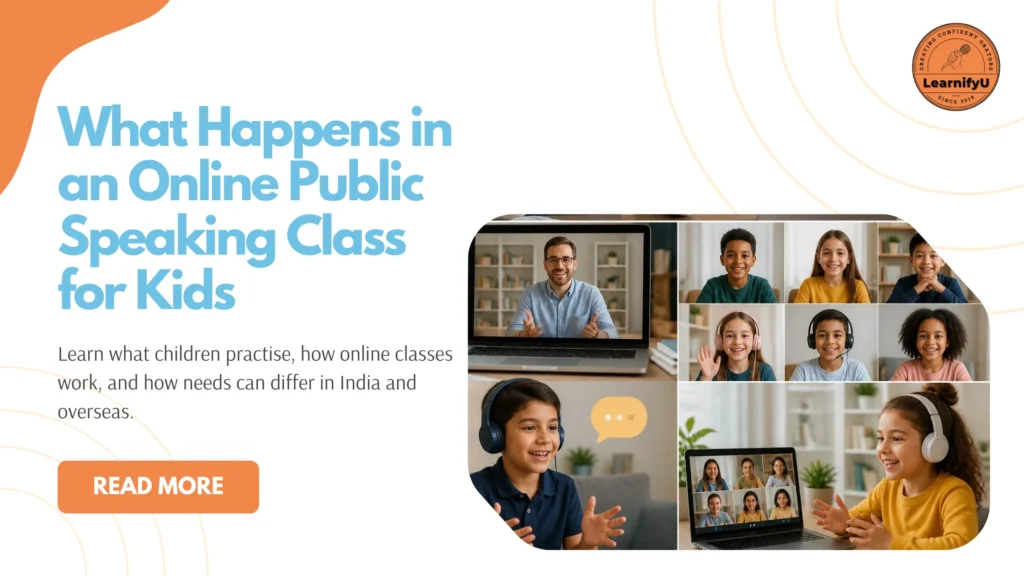
An online class usually takes place through a live virtual classroom – where students can interact with an instructor &, depending on the program, other children.
The child may be asked to speak directly to the “teacher, participate in a group activity, present something they have prepared, or respond to an unexpected question.”
A useful session often follows a simple progression –
Learn → Practise → Speak → Receive Feedback → Try Again
This repeated cycle matters.
A child may understand that they should speak slowly, make eye contact, or organize their ideas. But understanding the concept is different from – being able to use it naturally.
Regular speaking practice gives children opportunities to apply “what they have learned.”
For example, a child who frequently rushes – while speaking may first learn about pacing. They can then practise using pauses during a short activity and gradually apply the same skill during a presentation.
That makes online public speaking practice more practical than simply explaining communication techniques.
What Do Kids Practise in an Online Public Speaking Class?
1. Organizing Ideas
Children often know “what they want to say” but struggle to put their thoughts into a logical order.
Public speaking activities can help them identify a main idea, choose supporting points, and create a simple beginning, middle, and conclusion.
For example –
Introduction → Main Idea → Supporting Details → Conclusion
This can be useful – when a child needs to explain a school project, describe an experience, answer a question, or give a presentation.
2. Speaking Clearly
Children can practise pronunciation, pace, volume, pauses, sentence delivery, & vocal expression.
The objective is not to remove a child’s natural personality or accent.
Instead – the focus is on “making their message easier for other people to understand.”
3. Storytelling
Storytelling is a useful way to develop public speaking skills – without making every activity feel like a formal speech.
A child might be asked to describe a picture, tell a personal story, create an ending to a story, or explain what happened during an experience.
These activities can encourage children to think about – sequence, description, expression, & audience interest.
4. Presentations
Children can gradually learn how to prepare and deliver presentations.
They may practise:
- Introducing a topic
- Explaining information
- Using examples
- Moving between ideas
- Speaking from notes
- Looking at the audience
- Concluding clearly
- Answering questions
Presentation skills can be particularly useful for school projects & classroom presentations.
5. Impromptu Speaking
Children cannot prepare for every speaking situation.
A teacher may ask a question they did not expect. A classmate may ask for clarification. A child may need to explain an opinion without having written a speech beforehand.
Impromptu speaking activities give children practice thinking before speaking and creating a response without relying entirely on memorization.
6. Listening & Responding
Public speaking is not only about talking.
Children also need to learn – how to listen to questions, understand another person’s point, respond appropriately, & participate in conversations.
This is why communication skills & public speaking often overlap.
A child who learns to present an idea – but cannot listen to a question has only developed part of the communication process.
How Are Public Speaking Needs Different for Kids in India and Overseas?
One of the important things parents should understand is that – children do not all develop communication skills in exactly the same environment.
A child’s school, language environment, cultural context, & exposure to different types of communication can influence the situations in which they need to speak.
Public Speaking for Kids in India
For children in India – public speaking practice may be particularly relevant to situations such as classroom participation, school presentations, storytelling, debates, competitions, project presentations, and speaking in English.
Some children may understand English reasonably well but hesitate when asked to speak spontaneously.
Others may have good vocabulary – but struggle to organize their thoughts.
Some may be comfortable speaking with family and friends – but become nervous when speaking in front of teachers or classmates.
For these students, structured Public Speaking for Kids in India can provide opportunities to practise expressing ideas clearly rather than focusing only on grammar or vocabulary.
Public speaking can also complement broader English communication development. Parents looking specifically for spoken English development may find Spoken English Classes for Kids in India more closely aligned with language fluency – while public speaking focuses more strongly on communicating ideas to an audience.
The two areas can support each other – but they are not exactly the same.
Public Speaking for Indian Children Living Abroad
Indian children living outside India may experience a different communication environment.
They may already communicate comfortably in English – but still need to develop presentation structure, confidence, audience awareness, discussion skills, or persuasive communication.
Some may move between different cultural and communication environments at home and school.
For these children – public speaking practice can focus less on basic English fluency and more on how to communicate ideas effectively in different settings.
For example, a child may need to participate – in classroom discussions, present research, work on group projects, explain an opinion, or speak to an audience with different backgrounds.
This is where an online program can be useful because the learning environment can be accessed from different countries – while maintaining a structured communication routine.
Public Speaking for Kids in International School Environments
Children studying in international or globally oriented schools may encounter frequent presentations, collaborative projects, classroom discussions, & activities that require them to explain their reasoning.
They may benefit from practising:
- Presentation skills
- Discussion skills
- Audience awareness
- Persuasive communication
- Spontaneous speaking
- Question handling
- Collaborative communication
The specific needs will still vary from child to child.
A confident speaker may need more advanced challenges – while a nervous speaker may benefit from smaller, manageable speaking steps.
Can Online Public Speaking Classes Help Shy Kids?
They can provide structured opportunities to practise – but parents should be cautious about programs that promise to completely eliminate shyness or nervousness.
A shy child does not necessarily lack communication ability.
They may simply need more opportunities to become – comfortable speaking in front of others.
A useful progression could look like –
Think → Practise → Speak briefly → Receive feedback → Speak again → Take on a bigger challenge
The child may initially answer a simple question.
Later, they may participate in a small group discussion.
Eventually, they may prepare and deliver a longer presentation.
The goal is not necessarily to turn a “quiet child into the loudest person in the room.”
The goal is to help the child communicate even “when they feel nervous.”
How Can Parents Make Online Public Speaking Classes More Successful?
The class itself is only one part of the “learning process.”
Parents can support progress by creating opportunities for children – to practise communication outside class without turning every conversation into a lesson.
For example, parents can ask ––
“What was the most interesting thing you learned today?”
Instead of accepting a one word answer – encourage the child to explain why.
Children can also practise describing – pictures, explaining how something works, telling stories, presenting a favourite topic to family members, or giving a short opinion with reasons.
The important point is “consistency.”
A child does not need to practise for an hour “every day.”
Even a few minutes of regular speaking can create additional opportunities – to organize thoughts and communicate.
Parents should also allow children to make mistakes.
If every sentence is immediately corrected – children may become more focused on avoiding mistakes than expressing ideas.
Constructive feedback should help the child understand –– what to improve and how to improve it.
What Should Parents Look for in an Online Public Speaking Class?
Not every program described as an online public speaking class provides the same experience.
Parents can consider a few practical questions.
Does the child actually get to speak?
A class about public speaking should include meaningful speaking practice.
Watching the teacher demonstrate a speech is not the same as developing the skill personally.
Are activities appropriate for the child’s age?
A six year old & a sixteen year old should not necessarily receive the same speaking activities.
Younger children may benefit from storytelling, games, pictures, & short speaking tasks.
Older students may be ready for – presentations, persuasive communication, interviews, discussions, & impromptu speaking.
Is there constructive feedback?
Children need feedback that tells them – what they are doing well and what they can improve.
Does the program go beyond memorized speeches?
Real communication involves responding to questions, listening, adapting, and thinking on the spot.
Is there room for individual development?
A confident child may need more challenging activities – while a nervous child may need gradual exposure.
The best approach is not necessarily to make every student follow exactly the same communication path.
Is Online Public Speaking Effective for Kids?
Online public speaking classes can provide a convenient environment for children to practise communication skills from home.
However, the effectiveness of an online program depends on – how the sessions are designed and how actively the child participates.
A passive online class may have limited value.
An interactive class where – children regularly speak, receive feedback, listen to others, participate in activities, and gradually take on more challenging communication tasks can create a much richer learning experience.
For parents, the more useful question may therefore be:
“How much meaningful communication practice does my child get during the class?”
That question can tell you more about a program than whether the class is online or offline.
Frequently Asked Questions
Children may participate in storytelling, presentations, impromptu speaking, group discussions, opinion based activities, question & answer sessions, voice exercises, and other communication activities. The activities generally become more structured as children develop their speaking skills.
They can provide regular opportunities to practise speaking in a “structured environment.” Confidence can develop gradually as children become more familiar with presenting ideas, answering questions, & communicating with an audience.
Yes. Shy children can benefit from gradual speaking opportunities that allow them to build familiarity and confidence – without being expected to become highly outgoing immediately.
Spoken English classes usually pay attention to – how language is used in real life. They help with vocabulary, pronunciation & getting better at speaking. These classes often focus on conversation. Public speaking on the hand is more about sharing ideas with a group. It includes giving presentations telling stories speaking persuasively taking part in discussions and doing speaking tasks. There can be some overlap, between spoken English and public speaking. Both involve speaking. They serve different purposes.
Yes. English fluency and public speaking ability are different skills. A child can speak English fluently & still need practice organizing – ideas, presenting information, answering questions, persuading an audience, or speaking confidently in formal situations.
Regular practice is generally more useful than occasional intensive practice. Even short speaking activities at home can give children additional opportunities to – organize their thoughts, explain ideas, and become comfortable communicating.
Children can begin developing age appropriate speaking skills from an early age. Younger children can start with storytelling, show and tell, simple descriptions, and short speaking activities – while older children can gradually move toward presentations, discussions, persuasive speaking, and impromptu communication.
Public speaking practice can help children develop skills – such as organizing information, preparing speaking notes, presenting ideas clearly, using their voice effectively, maintaining audience awareness, & responding to questions. Children should still follow the specific requirements given by their “school or teacher.”
Helping Kids Become Better Communicators
Public speaking for kids is not simply about standing in front of an audience and delivering a “memorized speech.”
It is about helping children learn – how to organize an idea, explain it clearly, listen to another person, respond to questions, express an opinion, and communicate appropriately – for different situations.
For children in India, this may support classroom participation, English communication, presentations, and other school situations.
For children living abroad, it may provide opportunities to strengthen presentation, discussion, audience awareness, and communication skills in multicultural or international learning environments.
And for both groups, the underlying principle remains the same:
Children become better communicators by having meaningful opportunities to communicate.
LearnifyU’s online public speaking programs are designed to provide children with structured opportunities to practise speaking and communication skills in an age appropriate environment.
Parents in India can explore Public Speaking for Kids in India –– while families looking for broader communication development can explore Communication Skills for Kids.
For families outside India, LearnifyU also offers online communication & public speaking programs for children in different countries and age groups, allowing parents to explore a pathway that fits their child’s learning needs.
The goal is not to make every child speak in exactly the same way.
It is to help each child – become more comfortable expressing ideas, listening thoughtfully, and communicating with greater clarity and confidence.