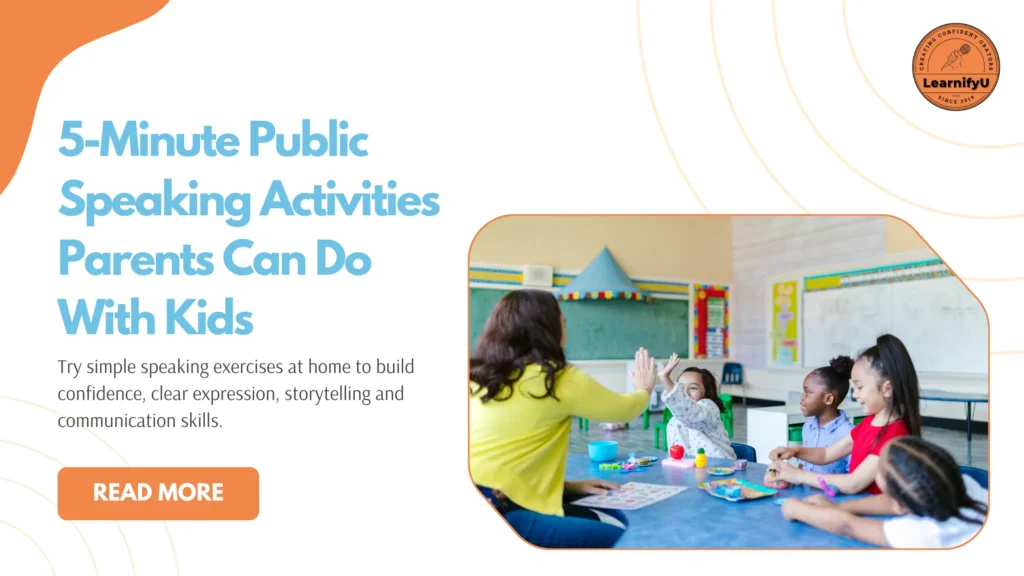
5-Minute Public Speaking Activities Parents Can Do With Kids
Public speaking practice does not always need a stage, a classroom, or a long preparation session.
For many children, five minutes of relaxed speaking practice at home – can be a simple way to practise “organising thoughts, explaining ideas, answering questions, telling stories & speaking in front of another person.”
The goal is not to make every child sound like a professional speaker. It is to help children become more comfortable expressing – what they think and know clearly and confidently.
And the good news for parents is that these activities do not require special equipment.
You can practise them – “at the breakfast table, after school, during a family conversation or whenever you have five minutes together.”
Quick Answer
A child can practise public speaking in five minutes – by speaking about a “familiar topic, describing an object, answering a question & explaining why, retelling a short story, teaching someone how to do something, or giving a mini presentation.”
The key is to keep the activity short, low pressure and repeatable.
Rather than correcting every mistake – parents can focus on one speaking skill at a time — such as speaking clearly, staying on topic, organising ideas or answering questions.
Why Are Short Speaking Activities Useful for Kids?
Public speaking is not only about “standing on a stage.”
Children use speaking skills when they:
- Answer a teacher’s question
- Participate in a classroom discussion
- Explain an idea to a friend
- Give a presentation
- Tell a story
- Share an opinion
- Ask and answer questions
- Explain something they have learned
- Speak during group activities
The American Speech Language Hearing Association (ASHA) includes skills – such as “asking and answering questions, participating in conversations and group discussions, staying on topic, taking turns in conversation and explaining what children have learned among its third grade communication guidance.” ASHA also notes that children develop communication skills at their own rate.
That makes everyday speaking practice valuable because children get opportunities to use
8 Five-Minute Public Speaking Activities Parents Can Try at Home
1. The One Minute Topic Talk
Choose a simple topic and ask your child – to speak about it for one minute.
Try topics such as:
- My favourite game
- An animal I like
- My favourite book
- Something funny that happened today
- A place I want to visit
- My favourite school subject
- Something I would like to learn
- The best part of my weekend
Give younger children a little thinking time before they start.
For older children – make it more challenging by giving them the topic immediately and asking them to organise their thoughts before speaking.
What does this activity develop?
It can help children practise:
- Organising their thoughts
- Speaking without reading a script
- Staying on one topic
- Finding words quickly
- Speaking continuously
- Beginning and ending a short talk
Parent tip – Don’t worry if your child speaks for only 30 seconds initially. Build gradually rather than turning the timer into a test.
2. Pick an Object and Explain It
Ask your child to choose any object nearby.
It could be:
- A toy
- A book
- A water bottle
- A school bag
- A favourite game
- A piece of sports equipment
- A household item
Now ask them to explain it.
You can give them four simple questions:
What is it?
What is it used for?
Why do you like it?
What is one interesting thing about it?
For younger children, these questions provide a helpful structure.
For older children, remove the questions and ask them to organise the explanation themselves.
What does this activity develop?
This simple exercise encourages children to – describe, explain and organise information for a listener.
It can also help children move beyond one-word answers.
Instead of:
“It’s my football.”
They can gradually learn to say:
“This is my football. I use it to play with my friends after school. I like it because football is my favourite sport.”
The aim isn’t perfect wording. The aim is helping the child – communicate a complete thought.
3. Tell Me What Happened
Ask your child to tell you about something – that happened during the day.
Instead of asking only:
“How was school?”
Try:
“Tell me one interesting thing that happened today.”
Then use follow up questions:
- What happened first?
- What happened next?
- Who was there?
- What did you do?
- How did you feel?
- What happened at the end?
This turns an everyday conversation into “speaking practice.”
Why is storytelling useful for public speaking?
A good speaker needs to – help listeners follow an idea.
Retelling an experience – encourages children to think about sequence, details & relevance.
- For younger children – you might simply ask them to tell you what happened first, next and last.
- For older children, ask them to give the story a clear beginning, middle and ending.
4. Teach Me Something
Give your child five minutes to become the teacher.
Ask:
“Teach me something you know.”
It could be:
- How to play a game
- How to make something
- How a sport works
- How to draw something
- How to use an app
- Something about an animal
- Something they learned at school
The subject matters less than the explanation.
Let your child speak while you listen.
At the end – ask one genuine question.
For example –
“Why does that happen?”
or
“What should I do first?”
What does this activity develop?
It gives children practice in:
- Explaining ideas
- Giving information
- Using relevant vocabulary
- Organising information
- Answering questions
- Adjusting an explanation for another person
It also gives children an opportunity to speak about something they already know well – which can make speaking practice feel less intimidating.
5. The “Would You Rather?” Speaking Challenge
Ask a fun question with two choices.
For example –
Would you rather live near the ocean or in the mountains?
Then add one important rule –
Your child has to explain why.
Other examples:
- Would you rather have a pet dog or a pet cat?
- Would you rather travel into space or explore the ocean?
- Would you rather read every book or watch every movie?
- Would you rather be invisible or be able to fly?
- Would you rather have a four-day school week or longer holidays?
Don’t stop at the answer.
Ask:
“Why?”
Then:
“Can you give me an example?”
And perhaps:
“What might be one disadvantage of your choice?”
Why does this help?
Children are not just practising giving an answer. They are practising expressing an opinion & supporting it with a reason.
This becomes increasingly useful – as children move toward classroom discussions, presentations, debates and persuasive speaking.
6. Picture Talk
Choose a photograph, illustration or picture.
Ask your child – to talk about what they see.
Start with:
“What is happening in this picture?”
Then encourage them to go further:
- Who is in the picture?
- Where are they?
- What are they doing?
- What might have happened before this?
- What might happen next?
- How do you think they feel?
- What makes you think that?
For younger children, focus on describing.
For older children – encourage them to make predictions and explain their reasoning.
What does picture talk develop?
It can give children practice with:
- Observation
- Vocabulary
- Description
- Sentence formation
- Story development
- Reasoning
- Spontaneous speaking
It is also an easy activity to repeat – because you can use a different picture every time.
7. The Three-Sentence Story
Give your child a simple prompt.
For example –
“A child finds a mysterious box outside the house.”
Now ask them – to create a story using only three sentences.
Sentence 1:
What happens?
Sentence 2:
What happens next?
Sentence 3:
How does it end?
Once your child becomes comfortable, increase the challenge.
Ask for:
Beginning → Problem → Ending
Or:
Character → Event → Result
Why is this a useful speaking activity?
Children sometimes know what they want to say – but struggle to organise it.
A simple structure gives them something to hold onto.
It also introduces an important public speaking skill – organising ideas so another person can follow them.
8. The Five-Minute Mini Presentation
This activity works particularly well for older children.
Give your child a familiar topic and ask them – to prepare a very short presentation.
For example –
“My Favourite Sport”
They can organise it into:
Opening
What is your topic?
Point 1
What is interesting about it?
Point 2
Why do you like it?
Point 3
What should other people know about it?
Closing
What is your main takeaway?
The presentation does not need slides.
The goal is simply to practise speaking to – a listener with a beginning, middle & ending.
For older children – you can gradually introducec a time limit or ask one or two questions after the “presentation.”
How Can Parents Help a Shy Child Practise Public Speaking?
A child who feels nervous about speaking – does not necessarily need to be pushed immediately into a large performance.
Start smaller.
Instead of asking your child to give a speech to the entire family, begin with:
Parent → Child
Then:
Parent + Child → One family member
Then:
Child → Small family audience
Eventually – the child can practise speaking in slightly less familiar situations.
The goal is to create small, successful speaking experiences.
You can also let your child choose the topic whenever possible. Children often have more to say – when the subject connects with their interests.
If your child regularly knows the answer but hesitates to speak in class – you may also find our guide on What to Do When a Child Hesitates to Speak in Class useful.
How Do You Practise Public Speaking With a Child Who Doesn't Like Speaking?
Don’t start by calling it “public speaking practice.”
For some children – that phrase can make a simple activity feel like a performance.
Instead, turn it into a game.
Try:
“Can you convince me that your favourite game is the best game ever?”
Or:
“You are the teacher for the next three minutes.”
Or:
“I’m going to ask you a mystery question. You have 30 seconds to think and one minute to answer.”
The activity remains purposeful – but it feels less like a formal lesson.
And parents can participate too.
Take turns being the speaker.
When children – see ‘adults speaking, thinking aloud and occasionally making mistakes, speaking can feel more normal and less intimidating.”
What Should Parents Correct During Speaking Practice?
Not everything.
One of the easiest ways to make speaking practice stressful – is to interrupt every sentence to “correct grammar, pronunciation or vocabulary.”
Instead – choose one skill to focus on.
For example:
“Today, let’s practise staying on topic.”
Or:
“Today, let’s work on explaining your ideas with more details.”
Or:
“Today, let’s practise speaking a little more slowly.”
Let your child finish first.
Then give specific feedback.
Instead of:
“Good job!”
Try:
“You explained your three points clearly.”
“I liked how you gave an example.”
“You stayed on the topic even when I asked a follow-up question.”
Specific feedback helps children understand – what they actually did well.
How Often Should Kids Practise Public Speaking?
It does not have to be a long daily lesson.
A five minute activity several times a week – can be easier to maintain than an occasional 30-minute session.
You can also use everyday moments.
Ask your child to:
- Explain something they learned at school
- Recommend a book
- Describe what happened during the day
- Give you directions
- Explain how to play a game
- Share an opinion
- Tell you about something they enjoyed
- Teach you something new
The objective is to make speaking, listening and explaining ideas part of everyday life.
5-Minute Public Speaking Activities by Age
Different ages call for different levels of challenge.
Ages 4–5
Keep activities playful and short.
Try:
- Picture talk
- Object description
- Simple storytelling
- “What do you see?” questions
- Show and tell
At this age, the focus should be on helping children express ideas and enjoy communicating.
You can explore more age-appropriate communication development in LearnifyU’s Communication Skills Classes for Preschool Kids.
Ages 6–8
Try:
- One-minute talks
- Story retelling
- Teach Me Something
- Picture descriptions
- Simple mini presentations
Children can gradually practise staying on topic and giving more complete answers.
For structured public-speaking practice, see Public Speaking Classes for Elementary School Kids.
Ages 9–11
Introduce more structure.
Try:
- Opinion questions
- Short presentations
- Explaining how something works
- Storytelling with a beginning, middle and ending
- “Would You Rather?” with reasons
- Follow up questions
At this stage – children can begin working on clarity, organisation, supporting ideas and audience awareness.
Learn more about age-specific practice through Public Speaking Classes for Middle School Students.
Ages 12–16
Older children can handle more challenging speaking tasks.
Try:
- Two-minute opinion talks
- Persuasive speaking
- Mini presentations
- Impromptu questions
- Explain-and-defend activities
- Short debate-style discussions
For teens – public speaking can increasingly connect with – “leadership, presentations, classroom participation & persuasive communication.”
What Skills Do These 5-Minute Activities Build?
A short activity can target more than one communication skill.
Activity | Skills children practise |
One-Minute Topic Talk | Organising thoughts, fluency, staying on topic |
Object Explanation | Description, vocabulary, clarity |
Tell Me What Happened | Storytelling, sequencing, details |
Teach Me Something | Explanation, listening, answering questions |
Would You Rather? | Opinions, reasoning, spontaneous speaking |
Picture Talk | Observation, description, vocabulary |
Three-Sentence Story | Story structure, sequencing, creativity |
Mini Presentation | Organisation, delivery, audience awareness |
This is why public speaking practice can overlap naturally with broader communication skills.
Children aren’t only learning how to stand in front of an audience. They are learning how to think, organise, explain, respond and communicate ideas to other people.
For a broader look at these skills, explore LearnifyU’s Communication Skills Classes for Kids in the USA.
What If My Child Can Speak at Home but Not at School?
This is a common concern for parents.
A child may be talkative with parents and close family members – but become much quieter when speaking to teachers, classmates or a larger group.
The situations are different.
At home – children know the listener, understand the environment and usually feel less pressure. School may involve – unfamiliar audiences, group discussions, classroom questions or presentations.
Rather than simply telling a child to “speak louder” or “be confident,” parents can give them gradual opportunities to practise:
- Speaking one-on-one
- Speaking to a familiar family member
- Speaking to a small group
- Answering questions
- Giving a short prepared talk
- Speaking with less preparation
For more discussion of this specific parent concern, see My Child Hesitates to Speak in Class – What Should I Do?.
Does Public Speaking Practice Help With Communication Skills?
Yes – the skills overlap considerably.
Public speaking gives children opportunities to practise organising and expressing ideas – while everyday communication also involves listening, responding, asking questions, taking turns & adapting to another person.
ASHA’s school-age communication guidance illustrates this broader picture. For example, its third-grade guidance includes asking and answering questions, participating in conversations and group discussions, staying on topic, taking turns and explaining what a child has learned.
That is why public speaking practice should not be viewed only as stage preparation.
It can also be part of a child’s “broader communication development.”
Can 5 Minutes a Day Really Improve a Child's Public Speaking?
Five minutes alone is not a magic formula.
What matters more is – what the child practises, how regularly they practise and how supportive the environment is.
A five minute activity can be useful because it is short enough to repeat.
One day your child might describe an object.
Another day they might tell a story.
Another day they might explain something they learned.
Over time – these small opportunities can give children more experience with speaking, organising thoughts & responding to listeners.
The aim isn’t perfection.
The aim is practice without unnecessary pressure.
A Simple 5-Minute Public Speaking Routine for Parents
If you want something you can repeat throughout the week, try this –
Minute 1: Choose
Pick a topic or question.
Minute 2: Think
Give your child a little time to organise their ideas.
Minutes 3–4: Speak
Let your child speak without frequent interruptions.
Minute 5: Respond
Ask one or two genuine follow up questions & give one specific piece of positive feedback.
That’s it.
You don’t need a classroom.
You don’t need presentation slides.
And you don’t need to turn every conversation – into a lesson.
You simply need to give your child regular opportunities – to speak and be heard.
FAQs - Frequently Asked Questions
Simple activities such as one minute talks, storytelling, picture descriptions, object explanations, teaching a family member and mini presentations – can give children regular speaking practice at home.
Start with – short, low pressure speaking activities. Ask your child – to ‘explain ideas, tell stories, answer questions, give opinions and speak about familiar topics.” Gradually increase the audience or complexity – as the child becomes more comfortable.
Give your child “frequent opportunities” to speak – without making every activity a performance test. Listen patiently, avoid unnecessary interruptions and give specific feedback – about “what they communicated well.”
Start with one on one conversations and familiar topics. Let your child choose subjects – they enjoy and gradually introduce a slightly larger audience. Avoid – comparing your child with siblings or classmates.
Turn speaking practice into games. Try “Would You Rather?”, pretend interviews, storytelling challenges, teaching games, picture talk and one-minute topic challenges.
There is no universal five minute requirement. Short sessions can simply be an easy way – to make speaking practice manageable and repeatable. Adjust the activity – to the child’s age, attention span & comfort level.
Public speaking can provide practice – with organising thoughts, explaining ideas, speaking clearly, answering questions & communicating with an audience. These skills overlap with broader communication skills – used at home, school and in social situations.
Avoid correcting every mistake – while the child is trying to communicate. Let them finish – then choose one area to work on. Depending on the child’s needs – that could be organisation, clarity, vocabulary, pronunciation or staying on topic.
Quick Parent Checklist
Before you finish today’s five-minute activity, ask yourself:
- Did my child get a chance to speak?
- Did I listen without constantly interrupting?
- Did my child explain at least one idea?
- Did I ask a genuine follow-up question?
- Did I focus on one useful skill rather than every mistake?
- Did the activity feel manageable and positive?
If the answer is yes – you have already created a useful speaking opportunity.
Final Thoughts
Public speaking confidence – does not have to begin with a stage.
It can begin with a child sitting at the kitchen table, explaining a favourite toy.
It can begin with telling a parent what happened at school.
It can begin with answering a funny question.
It can begin with teaching someone how to play a game.
These small moments give children opportunities to – “organise thoughts, express ideas, answer questions, tell stories and practise being heard.”
So the next time you have five minutes, don’t worry about creating a perfect lesson.
Just ask:
“What would you like to tell me?”
And give your child the time to speak.