
Public Speaking Classes for Elementary School Kids in the USA
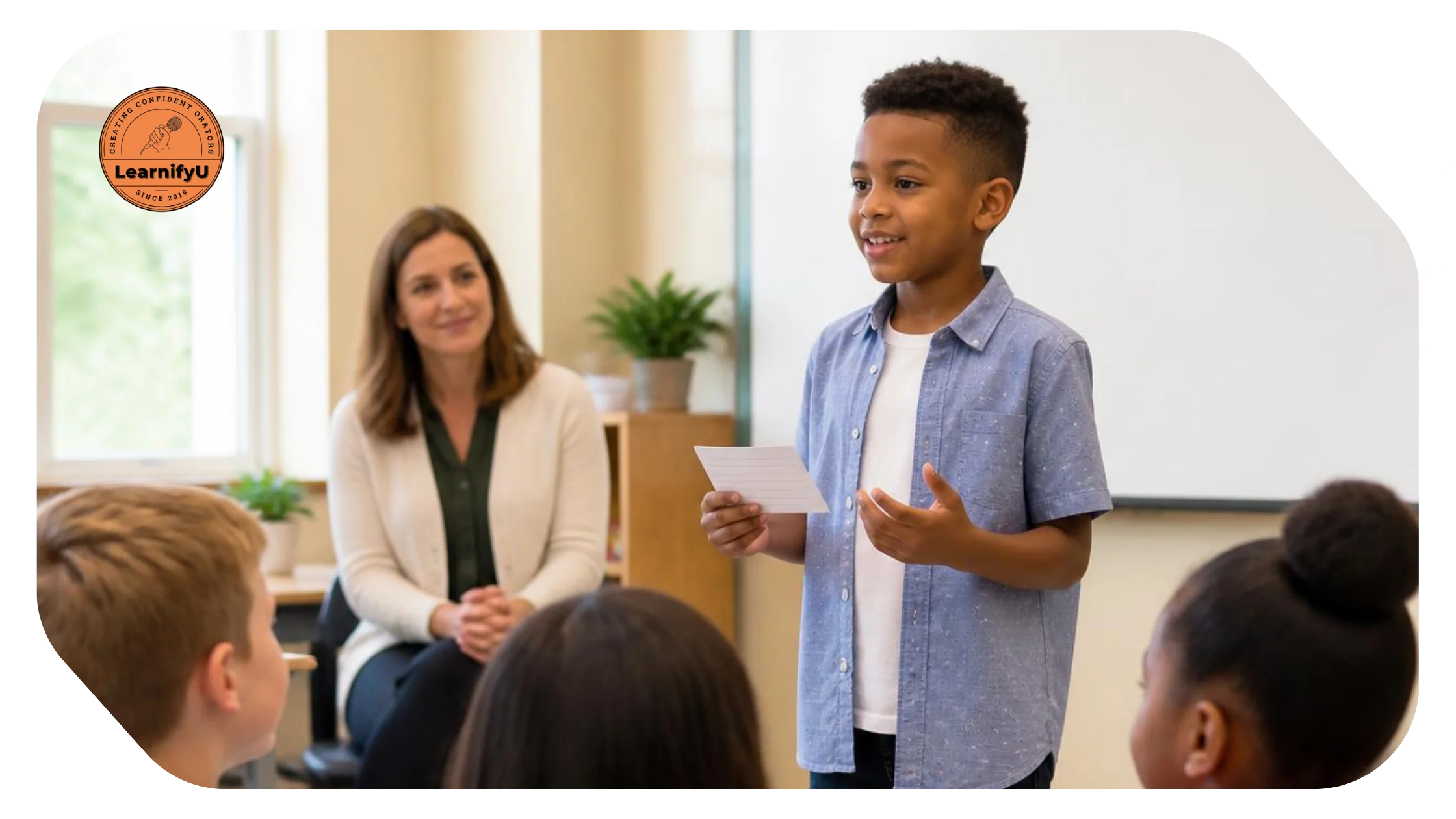
Public Speaking Classes for Elementary School Kids in the USA can help children learn to express ideas clearly, speak in front of others with greater confidence, and become more comfortable participating in conversations, presentations, and classroom activities.
For an elementary school child, public speaking isn’t about delivering a polished ten-minute speech from a stage. It can begin with something much simpler — telling a short story, explaining an idea, describing a picture, answering a question in complete sentences, or speaking to a small group without immediately looking down.
These small experiences matter.
At LearnifyU, public speaking is approached as a skill children can develop through practice, encouragement, structured activities, and age-appropriate challenges. The goal isn’t to turn every child into the loudest person in the room. It is to help children communicate their thoughts with greater clarity, confidence, and purpose.
If you are looking for public speaking classes for elementary school students in the USA, LearnifyU can help your child build a stronger foundation for communication that can support them at school and beyond.
Why Start Public Speaking in Elementary School?
Many parents assume public speaking becomes important later — when children have to give longer presentations, participate in competitions, or prepare for high school.
In reality, the foundation begins much earlier.
Elementary school children are already expected to communicate in many different situations. They may need to:
- 💬 Answer questions in class
- 👥 Engage in group discussions
- 🎤 Give short presentations
- 📖 Read aloud
- 🧠 Explain how they solved a problem
- 📚 Tell a story
- 💭 Share an opinion
- ❓ Ask for an explanation
- 🤝 Work with classmates
- 👩🏫 Speak with teachers and other adults
These are all forms of communication.
The Common Core English Language Arts standards, for example, include speaking and listening expectations throughout the elementary grades, including participating in discussions, expressing ideas clearly, asking and answering questions, and presenting information. Standards vary by state and school, but the broader point is consistent — oral communication is part of children’s academic development.
Public speaking classes give children an opportunity to practise these skills deliberately rather than only encountering them when a school presentation is due.
What Are Public Speaking Classes for Elementary School Kids?
Public speaking classes for elementary students are structured learning sessions that help children become more comfortable expressing themselves before other people.
The teaching approach should be different from adult public speaking training.
A seven-year-old does not need a corporate presentation course. A ten-year-old does not need to memorize an adult-style keynote speech.
Instead, children can learn through activities that make speaking feel natural.
Depending on the child’s age and level, activities may involve:
- 📖 Storytelling
- 🖼️ Picture-based speaking
- 🎤 Short presentations
- 🎭 Role-play
- 💭 Opinion sharing
- ⚡ Impromptu questions
- 🧸 Show-and-tell style exercises
- 📚 Reading aloud
- 💬 Guided conversations
The difficulty can gradually increase as the child becomes more comfortable.
This gradual progression is important. Educational research on elementary public speaking has described the value of beginning with less threatening speaking activities and moving toward more complex presentation situations. Research involving youth presentation programs has also found a strong relationship between repeated mastery experiences and public-speaking self-efficacy.
In simple terms:
Children often become more confident by having successful opportunities to speak — not by being told to “be confident.”
What Will My Child Learn in Public Speaking Classes?
A good elementary public speaking program should go beyond simply asking children to stand up and speak.
Children can work on several connected skills.
1. Speaking Clearly 🗣️
Children learn to slow down when necessary, pronounce words carefully, and make their message easier for others to understand.
Clear speaking does not mean forcing a particular accent or making every child sound the same.
The focus is on understandable, purposeful communication.
2. Building Speaking Confidence 🌟
Confidence doesn’t mean that a child is naturally extroverted.
A quiet child can become a confident speaker.
The objective is to help children become more and more comfortable expressing themselves — even when other people are listening.
3. Body Language and Eye Contact 👀
Children can become more aware of how posture, facial expression, gestures, and eye contact contribute to communication.
These skills should be taught naturally rather than making children worry about every movement.
4. Using Voice Effectively 🎙️
Children can learn how volume, pace, pauses, emphasis, and tone affect communication.
A child who speaks very quickly may learn to pause.
A child who speaks too quietly may practise projecting their voice.
A child who reads every sentence in the same tone can experiment with expression.
5. Organizing Ideas 🧠
A child may have a great idea but struggle to explain it in an order that makes sense. Public speaking practice can help children understand simple structures such as:
Beginning → Main Idea → Details → Ending
For example, instead of saying:
“I went to the zoo. There was a tiger. And my friend came. And we ate lunch. And then…”
A child can learn to organize the same experience into a short, understandable story.
6. Storytelling 📖
Storytelling is one of the most accessible ways for children to practise public speaking.
A child can describe:
- A favourite memory
- An invented character
- An adventure
- A picture-based story
Storytelling also gives children a reason to think about sequence, description, emotion, vocabulary, and audience.
7. Thinking and Speaking Without a Script ⚡
Children will not always have time to prepare every answer.
Age-appropriate impromptu speaking activities can help them learn how to think, organize a response, and speak without memorizing every sentence.
8. Listening & Responding 👂
Public speaking isn’t only about talking.
Strong communication also requires listening.
Children can practise:
- Answering questions
- Responding to classmates
- Building on another person’s idea
- Staying connected to a conversation
This is especially relevant because elementary speaking and listening standards include collaborative discussions, asking and answering questions, and expressing ideas clearly.
Public Speaking Activities for Elementary School Children
Children learn communication skills differently when they are actively involved.
That is why elementary public speaking activities can be more effective when they feel like meaningful challenges rather than repetitive drills.
Picture Talk 🖼️
The child receives a picture and explains:
What they see → What might be happening → What could happen next
This encourages:
- Observation
- Vocabulary
- Sentence formation
- Spontaneous speaking
Storytelling 📖
The child tells a short personal or fictional story using a simple:
Beginning → Middle → Ending
Show-and-Tell Style Speaking 🎤
Children speak about an object, hobby, book, drawing, or experience that interests them.
Familiar subjects can make the first few speaking experiences less intimidating.
One-Minute Speaking ⏱️
The child receives a simple topic and speaks about it for a short period.
The purpose is not perfect grammar. It’s learning to keep an idea moving without giving up after one sentence.
Role-Play 🎭
Children can practise real-life communication through age-appropriate situations such as:
- Introducing themselves
- Asking for help
- Explaining something to a classmate
- Participating in a group activity
Question and Answer Practice❓
Children learn that speaking confidently also means being able to respond when someone asks an unexpected question.
Mini Presentations 📊
As children become more comfortable, they can prepare short presentations around subjects they know or enjoy.
This provides a bridge between simple speaking activities and the longer presentations they may encounter at school.
Can Public Speaking Classes Help a Shy Child?
Yes — but the goal should not be to change a child’s personality.
Being quiet, thoughtful, or reserved is not a communication problem by itself.
A shy child may simply need more time, more preparation, and a supportive environment before speaking in front of others.
For such children, immediately asking them to deliver a long presentation to a large audience may create unnecessary pressure.
A better progression can look like this:
Speak privately → Speak to a small group → Give a short prepared response → Speak with less preparation → Give a longer presentation
Each successful experience can make the next one feel more manageable.
Research on youth public-speaking self-efficacy has highlighted mastery experiences — actually having opportunities to practise and succeed — as an important source of confidence.
Parents should therefore look for a program that encourages children to stretch their abilities without making them feel embarrassed for being nervous.
Public Speaking for Elementary Kids Is Not About Memorizing Speeches
This is an important distinction.
Memorizing a speech can sometimes be useful — but memorization alone does not create a strong communicator.
A child who memorizes ten sentences perfectly may still struggle when a teacher asks:
“Why do you think that?”
Or when a classmate asks an unexpected question.
Or when they forget one sentence from the memorized speech.
Effective public speaking education should help children understand what they are saying, organize their thoughts, adapt to the situation, and communicate with an audience.
That is why activities involving discussion, storytelling, spontaneous responses, explanation, and questions are valuable alongside prepared presentations.
How Are Elementary Public Speaking Classes Different from Teen Classes?
Children at different developmental stages have different communication needs.
Elementary Students
They may be working on:
- 💬 Speaking in complete thoughts
- 📚 Vocabulary and expression
- 📖 Storytelling
- 🏫 Classroom participation
- 🎤 Basic presentation structure
- 👂 Listening and responding
- 🌟 Comfort speaking in front of peers
Older Students
Older students may be ready for:
- 📊 Formal presentations
- 🗣️ Persuasive speaking
- ⚖️ Debate
- 💼 Interview communication
- 👑 Leadership communication
- 📝 Speech structure
- 👥 Audience analysis
- 🎤 Advanced presentation techniques
This is why LearnifyU’s Public Speaking Classes for Kids in the USA can serve as the broader starting point, while this page focuses specifically on the needs of elementary school children.
As children grow, their communication training can become more sophisticated.
Who Can Benefit from Elementary Public Speaking Classes?
Public speaking classes can be useful for children with very different personalities and starting points.
1. The Quiet Child
They may have good ideas but hesitate to share them.
2. The Child Who Talks a Lot
Speaking frequently does not automatically mean communicating effectively. Such children can benefit from learning structure, listening, pacing, and audience awareness.
3. The Child Who Gets Nervous During Presentations
Regular, low-pressure practice can make presentation situations feel more familiar.
4. The Child Who Enjoys Stories and Imagination
Storytelling can turn a natural interest into an opportunity to develop speaking skills.
5. The Child Who Needs More Classroom Confidence
Practice explaining ideas aloud can support participation in classroom discussions and presentations.
6. The Child Who Already Speaks Confidently
Public speaking classes can help turn natural confidence into more organized and purposeful communication.
In other words, public speaking is not only for children who are struggling.
It can also help children who are already comfortable speaking develop greater control over how they communicate.
What Should Parents Look for in a Public Speaking Class?
Not every class labelled “public speaking” will have the same teaching approach.
Before choosing a program, parents may want to ask:
Is the program designed specifically for children?
Children need age-appropriate examples, activities, pacing, and expectations.
Does the program provide actual speaking practice?
Watching a teacher explain public speaking is not the same as practising it.
Is there room for mistakes?
Children should be able to try, make mistakes, receive useful feedback, and try again.
Does the program focus only on stage confidence?
Look for broader communication skills such as listening, organization, expression, vocabulary, storytelling, and responding to questions.
How does the program handle shy or nervous children?
A strong program should encourage participation without using embarrassment or excessive pressure as a teaching method.
Is progress treated as gradual?
A child who is uncomfortable speaking today may need several smaller milestones before confidently delivering a presentation.
These questions can help parents evaluate whether a program is actually teaching communication or simply giving children opportunities to perform.
How LearnifyU Approaches Public Speaking for Children
At LearnifyU, the focus is on helping children develop communication skills through structured practice and age-appropriate public speaking activities.
The objective is not to create identical speakers.
Every child has a different personality, vocabulary level, comfort level, and way of expressing ideas. Effective communication development should give children room to retain their individuality while helping them become clearer and more confident communicators.
For an elementary school child, progress may look surprisingly simple.
A child who previously answered with one word may begin explaining an idea.
A child who avoided raising their hand may volunteer an answer.
A child who rushed through a presentation may begin using pauses.
A child who looked at the floor may gradually become comfortable looking toward their audience.
Those small changes can be more meaningful than simply learning a “perfect speech.”
Benefits of Public Speaking Skills Beyond the Classroom
Public speaking is a visible skill — but its underlying abilities are useful in many situations.
Children who practise expressing ideas can also work on:
- 💬 Communication skills
- 👂 Listening skills
- 📚 Vocabulary
- 🗣️ Verbal expression
- 🧠 Critical thinking
- 🧩 Organization of ideas
- 🤝 Social communication
- 🪞 Self-awareness
- 🎤 Presentation skills
- 🌟 Confidence in group settings
The benefit is not that every child will suddenly become fearless.
A more realistic goal is that the child learns:
“I can be nervous and still speak.”
That is a much more useful lesson.
Confidence does not necessarily mean the absence of nervousness. It can mean knowing what to do when nervousness appears.
FAQs About Public Speaking Classes for Elementary School Kids
Elementary school children can begin developing public speaking and communication skills through age-appropriate activities. The right starting point depends on the child’s age, communication level, attention span, and comfort with speaking.
Younger children may begin with storytelling, picture descriptions, short responses, and simple speaking games, while older elementary students can gradually move toward structured presentations and impromptu speaking.
They can provide structured opportunities to practise speaking in a supportive environment. However, progress varies from child to child.
A child who is nervous should not necessarily be pushed into long presentations immediately. Shorter and less intimidating speaking activities can provide a gradual path toward greater comfort.
Public speaking and English language development can overlap — particularly when children practise vocabulary, sentence formation, pronunciation, listening, and verbal expression.
However, public speaking classes should not automatically be presented as a replacement for a dedicated English language program. If a child needs substantial support with English proficiency, parents should consider the child’s specific language-learning needs.
No.
A public speaking class can be appropriate for confident, quiet, shy, talkative, or nervous children. The starting point may simply be different for each child.
Activities vary by program, but children may practise storytelling, short presentations, picture-based speaking, role-play, question-and-answer activities, impromptu speaking, voice expression, and organizing ideas.
The most useful sessions give children opportunities to actually speak and receive constructive feedback.
No.
The underlying skills — explaining an idea, asking questions, listening, responding, organizing thoughts, and communicating clearly — are useful in everyday conversations as well as academic settings.
Yes, but practice does not need to feel like homework.
Parents can ask children to explain how they built something, retell a story, describe a picture, explain the rules of a game, or give a one-minute opinion on a topic they enjoy.
The objective should be communication, not constant correction.
Questions Parents Often Ask Before Enrolling
A shy child may participate differently from a naturally outgoing child. The important question is whether the learning environment gives them a manageable way to participate and gradually build comfort.
It may help by giving the child structured practice in speaking to people outside their immediate family. It is also worth considering what specifically makes school situations difficult — audience size, unfamiliar people, fear of mistakes, language challenges, or simply lack of practice.
There is no need to wait until high school. Elementary school already provides many opportunities for children to communicate, present, collaborate, and speak in front of others.
Building foundational skills earlier can give children more time to practise and refine them.
Mistakes are part of learning to communicate.
A useful class should help children understand and improve their mistakes rather than making them feel that every error is a failure. The ability to recover, continue speaking, and communicate the main idea is itself an important speaking skill.
Both matter, but they should develop together.
A child needs enough confidence to express an idea, while also learning to make that idea understandable and organized.
Overcorrecting every small mistake can discourage participation; ignoring communication problems entirely does not help the child improve.
Give Your Child a Stronger Start in Communication
A confident speaker is not necessarily the child who talks the most.
It may be the child who can explain an idea clearly, ask a thoughtful question, tell a story others want to hear, respond when the conversation changes, or stand in front of a classroom and continue speaking even when they feel a little nervous.
Those abilities can be developed over time.
LearnifyU’s Public Speaking Classes for Elementary School Kids in the USA are designed to help children practise communication in an age-appropriate, supportive learning environment.
If your child is ready to become a clearer, more confident communicator, explore the Public Speaking Classes for Kids in the USA program and find out how LearnifyU can support their next stage of communication development.
Explore Other Public Speaking Programs
As children progress through school, their communication needs change. You can also explore:
Public Speaking Classes for Middle School Students in the USA
Public Speaking Classes for High School Students in the USA
Public Speaking & Leadership Skills for Teens in the USA
Each program can address communication at a different stage — helping children move from foundational speaking skills toward more advanced presentation and leadership communication.