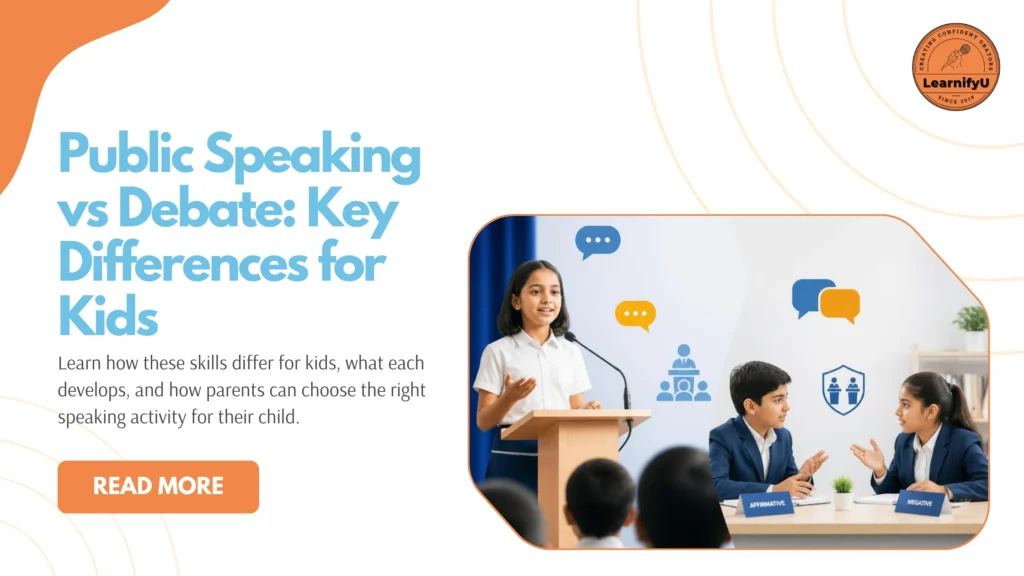
Public Speaking vs Debate: What’s the Difference for Kids?
Public speaking and debate are both valuable ways for children – to develop communication skills. They can help children – become more comfortable expressing ideas, speaking in front of others and listening carefully. But they are not the same activity.
Public speaking generally focuses on communicating an idea, message or story clearly – to an audience. Debate involves – presenting a viewpoint, supporting it with reasons or evidence, listening to an opposing position and responding to it.
For parents, understanding this difference can make it easier to choose activities – that match their child’s current needs and interests.
What Is Public Speaking for Kids?
Public speaking is the ability to communicate thoughts and ideas clearly – when speaking to an audience.
For children, this might include –
- Giving a short speech
- Introducing themselves
- Presenting a school project
- Telling a story
- Speaking about a familiar topic
- Giving a presentation
- Sharing an opinion with a group
- Taking part in a school assembly or event
The focus is not simply on speaking loudly or memorising a speech.
Children gradually learn – how to organise their thoughts, choose appropriate words, speak clearly, use their voice effectively and connect with an audience.
A child practising public speaking may learn to think about questions such as:
- What do I want to say?
- How should I organise my ideas?
- How can I explain this so others understand me?
- How can I speak clearly and confidently?
These skills can become useful in –– “classrooms, school presentations, competitions and everyday communication.”
What Is Debate for Kids?
Debate is a more structured form of communication in which children discuss a topic or question from a particular position.
A debate typically involves two or more viewpoints. A child may be asked – to support a particular position and explain why they believe it is reasonable. They also need to listen to another speaker’s arguments and respond appropriately.
Depending on the child’s age and the format, debate may involve:
- Presenting an argument
- Giving reasons to support a viewpoint
- Listening to opposing arguments
- Asking or answering questions
- Providing examples or evidence
- Responding to counterarguments
- Thinking quickly
- Rebutting another speaker’s point
This makes debate more interactive than many forms of public speaking.
A child is not only thinking about what to say – but also about what the other person has said and how to respond to it.
Public Speaking vs Debate: The Key Difference
The simplest way to understand the difference is this –
Public speaking focuses primarily on –communicating a message to an audience.
Debate focuses on – presenting, defending & responding to viewpoints.
There is considerable overlap between the two.
Both require children – to speak clearly, organise their thoughts, listen and communicate with confidence. However, debate adds another layer: responding to an opposing argument.
|
Public Speaking |
Debate |
|
Communicates an idea, message or story |
Presents and defends a viewpoint |
|
Often involves speaking to an audience |
Usually involves multiple opposing viewpoints |
|
Focuses strongly on clarity and delivery |
Adds argumentation and rebuttal |
|
May involve prepared speeches or presentations |
Requires responding to another position |
|
Voice, structure and body language are important |
Reasoning, evidence and listening are especially important |
|
Can be one-way communication |
Is generally interactive |
Neither activity is simply a replacement for the other. They develop overlapping but distinct communication abilities.
What Skills Does Public Speaking Develop in Children?
Public speaking gives children repeated opportunities – to organise and express their thoughts.
1. Clear Communication
Children learn to communicate complete thoughts – rather than relying on very short answers.
They practise explaining ideas in a way that an audience can follow.
2. Speaking Confidence
Regular speaking practice can help children become more familiar with the experience of speaking in front of others.
Confidence develops through practice, preparation and positive experiences – rather than simply being told to “speak confidently.”
3. Voice and Delivery
Children can learn how pace, volume, pauses and emphasis affect how a message is understood.
They also become more aware of body language & eye contact.
4. Organising Ideas
A good speech needs a beginning, a clear middle & an appropriate ending.
Learning this structure can help children communicate their thoughts more logically.
5. Audience Awareness
Children learn to think about the people listening to them.
What does the audience already know? What needs to be explained? What examples would make the idea easier to understand?
These are useful communication habits beyond public speaking itself.
What Skills Does Debate Develop?
Debate builds many of the same foundational speaking skills – but adds reasoning and response.
1. Critical Thinking
Children need to examine an idea, identify reasons supporting a position and consider – whether those reasons make sense.
2. Reasoning
Instead of simply saying what they think, children learn to explain why they think it.
This distinction is important.
“I think school uniforms are useful” is an opinion.
“School uniforms can make it easier for students to follow a common dress code” provides a reason.
Debate gives children opportunities to practise building this connection between an opinion and its supporting reasoning.
3. Listening
Good debating requires more than waiting for your turn to speak.
Children need to understand what another person is actually saying – before they can respond meaningfully.
4. Rebuttal
A child may need to identify a weakness, limitation or different perspective in another argument and explain their response.
This teaches children that communication is not always about delivering a prepared answer.
5. Thinking on Their Feet
Debate can require children to respond to ideas they did not prepare for word-for-word.
That can strengthen their ability to think and communicate under pressure.
Can Debate Improve a Child’s Public Speaking?
Yes. Debate can provide valuable public speaking practice.
A child participating in debate – may speak before an audience, structure ideas, use appropriate voice modulation and practise confident body language.
At the same time – debate introduces additional demands because the child must listen and respond to other viewpoints.
For example – a child might first learn to deliver a two minute speech about their favourite book. Later, in a debate, they may need to explain why their viewpoint is reasonable and respond when another speaker disagrees.
Both experiences involve speaking, but the communication challenge is different.
Can Public Speaking Prepare a Child for Debate?
Yes.
Strong public speaking foundations can make debate easier to approach because children already have experience with several important skills.
These may include:
- Speaking clearly
- Structuring ideas
- Using appropriate vocabulary
- Maintaining eye contact
- Managing voice and pace
- Addressing an audience
- Presenting an idea logically
However, debate requires additional practice in areas – such as argument building, rebuttal, evidence and responding to opposing viewpoints.
So public speaking can provide a useful foundation – but debate develops skills that go beyond speech delivery.
Which Is Better for a Shy Child: Public Speaking or Debate?
There is no single answer because children can have different – personalities, interests and comfort levels.
For a child who is nervous about speaking in front of others – structured public speaking practice can provide a gradual introduction to speaking before an audience.
They might begin with:
- Introducing themselves
- Describing a picture
- Telling a short story
- Talking about a favourite activity
- Giving a short presentation
As their comfort grows, activities can become more challenging.
Some children, however, may enjoy debate – because they have strong opinions and naturally like asking questions or discussing different viewpoints.
The important consideration is not whether a child is naturally outspoken. It is whether the activity provides an appropriate level of challenge and enough opportunities for guided practice.
Should Children Learn Public Speaking Before Debate?
Not necessarily.
There is no universal rule that says every child must complete public speaking training – before participating in debate.
However, basic speaking skills can make debate easier.
A child who can already organise thoughts, speak clearly and address an audience has a useful foundation. Debate can then add argumentation, rebuttal, reasoning and active listening.
For younger children, activities can be introduced in simpler forms. As children become older and their communication abilities develop – more structured debate activities can be introduced.
The goal should be –– progression rather than rushing into complexity.
Public Speaking and Debate: Where the Two Skills Meet
Although public speaking and debate are different – they share an important foundation: effective communication.
Both can teach children to:
- Express ideas clearly
- Listen to others
- Choose words carefully
- Organise their thoughts
- Speak with greater confidence
- Use appropriate body language
- Consider their audience
- Respond thoughtfully
This is why parents do not necessarily have to think of public speaking and debate as competing activities.
A child can benefit from public speaking practice and later explore debate. Another child may discover debate first and use that experience to strengthen their broader speaking skills.
The activities can complement each other.
How Parents Can Choose Between Public Speaking and Debate
Instead of asking which activity is universally better – consider what your child needs to practise right now.
Choose more public speaking practice if your child needs to:
- Become more comfortable speaking before others
- Organise thoughts into a clear presentation
- Improve speech delivery
- Practise storytelling or presentations
- Build confidence when addressing an audience
- Speak in complete, structured responses
Consider debate if your child is ready to practise:
- Supporting opinions with reasons
- Considering different viewpoints
- Listening & responding
- Building arguments
- Rebutting ideas respectfully
- Thinking on the spot
- Discussing topics from different perspectives
These are not strict categories. A child can work on “both sets of skills at the same time.”
The Bigger Goal: Confident Communication
For children, public speaking and debate should not be viewed only as competition activities.
The deeper value lies in helping children become thoughtful communicators.
- A child who learns to explain an idea clearly – may use that skill during a classroom discussion.
- A child who learns to listen carefully during debate may become better at having everyday conversations.
- A child who practises speaking before an audience may feel more prepared when giving a school presentation.
- A child who learns to support an opinion with reasoning – may become more thoughtful when discussing ideas with others.
These skills develop gradually – through “practice, feedback and age appropriate challenges.”
FAQs - Frequently Asked Questions
No. Public speaking generally focuses on communicating a message or idea to an audience – while debate involves presenting & responding to different viewpoints. Both develop communication skills – but debate adds argumentation & rebuttal.
Debate can help children practise “reasoning, listening, structured communication, responding to opposing viewpoints & speaking with greater confidence.” Activities should be appropriate – for the child’s age & experience.
Debate can provide substantial speaking practice. Children may develop clearer delivery, stronger organisation of ideas and greater comfort speaking before others while also practising reasoning and response.
Children can begin practising age appropriate public speaking skills – from a young age. For younger children, activities might involve introductions, storytelling and short descriptions, while older children can gradually work on presentations and speeches.
Children can be introduced to simple discussion and opinion based activities – at a young age. More formal debate formats are generally better introduced as children develop the language, reasoning and listening skills needed to participate meaningfully.
It depends on the individual child. Public speaking can provide gradual practice in addressing an audience – while some children may find structured debate engaging because it gives them a specific topic and viewpoint to discuss.
Yes. The two activities can complement each other. Public speaking can strengthen speech organisation and delivery – while debate can add reasoning, rebuttal, active listening and responding to different viewpoints.
Public Speaking vs Debate: A Simple Way to Remember the Difference
Public speaking asks:
“How can I communicate my idea clearly to an audience?”
Debate asks:
“How can I communicate, support and defend my viewpoint while responding to another perspective?”
Both are valuable communication experiences for children.
The right starting point depends on your child’s – age, confidence, interests and current communication needs. What matters most is giving children regular opportunities to speak, listen, think, respond & improve.
With consistent practice – public speaking and debate can become more than extracurricular activities. They can become practical ways for children to develop communication skills they can carry into school, relationships and everyday life.