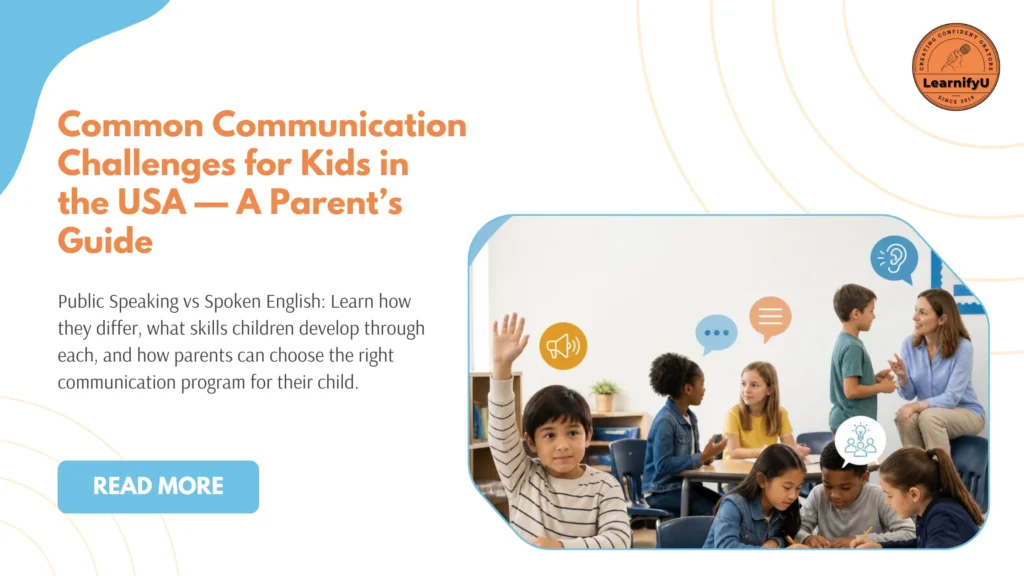
Common Communication Challenges for Kids in the USA
A child can know exactly what they want to say and still struggle to say it.
Maybe they understand the teacher’s question – but don’t raise their hand. Maybe they answer every question with “yes,” “no,” or “I don’t know.” Perhaps they can talk comfortably at home – but become unusually quiet during a class discussion. Or they speak confidently with family but find it difficult to – join a conversation with other children.
These situations can leave parents wondering – Is my child simply shy? Does my child need more practice? Is English the issue? Or is something else getting in the way?
Communication is much broader than “speaking clearly.” Children gradually learn to – “listen, take turns, explain ideas, ask questions, maintain conversations, adjust how they speak for different situations & understand another person’s perspective.” These skills develop over time and look different at different ages.
For children growing up and learning in the USA – communication happens throughout the school day — during classroom discussions, presentations, group projects, conversations with teachers, lunch or recess, extracurricular activities and everyday interactions.
So what communication challenges do parents commonly notice, and what can they do to help?
Quick Answer:
Common communication challenges for kids can include – “difficulty expressing ideas clearly, hesitating to speak in class, giving very short answers, struggling to participate in group conversations, difficulty listening & responding, nervousness during presentations, trouble starting or maintaining conversations, and limited confidence when speaking.”
These challenges do not automatically mean that – a child has a communication disorder. Children develop at different – rates, and confidence, experience, personality, language exposure and the situation itself can all affect how a child communicates.
Parents can help by creating regular opportunities for – conversation, modelling good listening, asking open ended questions, encouraging children to explain their thinking and giving them low pressure opportunities to speak. Structured communication or public speaking practice – can also give children additional opportunities to practise these skills.
If communication difficulties are persistent, significantly affect school or relationships, or raise concerns about a child’s development – parents should discuss those concerns with an “appropriate healthcare or school professional.”
What Does Good Communication Look Like for a Child?
Before talking about challenges – it helps to broaden the definition of communication.
A strong communicator is not necessarily the child – who talks the most.
Depending on age, effective communication can involve being able to:
- Listen and understand what someone is saying
- Follow directions
- Answer questions appropriately
- Ask for clarification
- Explain an idea
- Tell or retell a story
- Take turns in conversation
- Stay on a topic
- Ask relevant follow up questions
- Participate in group discussions
- Adjust language for different people and situations
- Express opinions respectfully
- Notice another person’s perspective
- Speak clearly enough for others to understand
ASHA’s guidance for school age children includes skills – such as staying on topic, taking conversational turns, asking and answering questions, participating in group discussions and explaining what they have learned.
That is why a child who can speak in complete sentences – may still need help developing broader communication skills.
1. My Child Knows the Answer but Won't Speak in Class
This is one of the situations parents notice quickly.
A child may understand the lesson, answer questions confidently at home and even explain the topic to a parent — yet remain silent when the teacher asks the class a question.
There can be several reasons.
The child might worry about – giving the wrong answer. They may dislike being the “center of attention.” They may need more time to formulate their response. Or they may simply have had limited practice speaking in groups.
The important point is that knowing an answer and communicating it in front of others are different skills.
Instead of repeatedly saying, “You need to speak up,” parents can create smaller speaking opportunities.
Try asking:
“What do you think the character should have done?”
Then give your child time to think.
You can also ask them to explain their answer rather than simply give it.
If classroom participation remains a concern, see our guide on what parents can do when a child hesitates to speak in class.
2. “My Child Gives One-Word Answers”
Some parents know this scene very well.
“How was school?”
“Good.”
“What did you do?”
“Nothing.”
“Did you enjoy science?”
“Yeah.”
The problem isn’t necessarily that the child has nothing to say. Sometimes they simply haven’t learned how to extend a conversation.
Children can practise this naturally at home.
Instead of asking a series of questions, try sharing something first:
“I had a funny moment at work today. My coffee spilled right before a meeting.”
Then ask:
“Did anything funny happen at school today?”
This gives your child something to respond to.
You can also encourage follow-up questions:
- “What happened next?”
- “Why do you think that?”
- “What was your favourite part?”
- “What would you have done?”
- “Tell me more about that.”
The American Academy of Pediatrics recommends active listening & regular, distraction free opportunities for parents and children to talk.
The goal isn’t to turn every dinner into a communication lesson. A few good conversations are often more useful than – constant correction.
3. Difficulty Explaining Ideas Clearly
A child may know what they mean but struggle to put the thought – into a logical sequence.
You might hear:
“It was this thing… and then we went there… and she said something… and then… I don’t know.”
This can happen when a child has the idea in their head but hasn’t yet developed the habit of organizing information for a listener.
Parents can practise this through everyday storytelling.
After a movie, book or school activity, ask:
What happened first?
What happened next?
What was the important part?
How did it end?
This builds narrative and explanation skills without making the child feel as though they are doing homework.
As children get older, the same skill becomes useful for classroom presentations, project work, interviews and discussions.
4. Struggling to Participate in Group Discussions
Talking one to one can feel very different from – joining a group.
A child participating in a group discussion may need to:
- Listen while someone else is talking
- Wait for an appropriate moment
- Add something relevant
- Disagree respectfully
- Ask a question
- Build on someone else’s idea
- Notice when the conversation has moved on
These are sometimes overlooked when parents think about communication.
School age social communication includes skills – such as maintaining a topic, taking conversational turns, repairing misunderstandings and using language for different purposes, including expressing and advancing an opinion.
A simple activity at home is to discuss a family decision.
For example:
“Where should we go this weekend?”
Ask each family member to give one reason.
Then ask:
“Do you agree with that reason? Why or why not?”
The objective isn’t to produce a winner. It is to practise listening and responding.
5. Difficulty Listening and Responding
Communication is not just about talking.
Sometimes a child is eager to respond – but doesn’t actually answer the question that was asked. Other times, they interrupt, miss part of an instruction or immediately change the subject.
Active listening is a skill that needs practice. The American Academy of Pediatrics recommends giving children full attention and focusing on understanding – rather than simply preparing the next response.
Parents can model this.
If your child tells you about a school problem, avoid immediately jumping in with a solution.
Try:
“So you were working with two classmates, and then you couldn’t agree on what to do. Is that right?”
This kind of reflective listening shows your child what attentive communication sounds like.
Then turn the skill around:
“Can you tell me what I just said?”
It can become a surprisingly useful little game.
6. Nervousness During Presentations or Public Speaking
A child may communicate comfortably with friends but become nervous when asked to stand in front of the class.
That can show up as:
- Speaking very quietly
- Looking down
- Rushing through the presentation
- Forgetting prepared points
- Avoiding presentations
- Saying “I don’t know” even when they do know
- Becoming visibly uncomfortable when everyone is watching
Public speaking involves more than knowing the subject.
Children need to manage the experience of speaking to an audience.
They can gradually practise:
- Introducing themselves
- Speaking for 30 seconds
- Describing an object
- Telling a short story
- Explaining how something works
- Giving a short presentation
- Answering follow-up questions
For families looking for structured practice, LearnifyU’s Public Speaking Classes for Kids in the USA focus on age-appropriate speaking and presentation skills.
7. Difficulty Starting or Maintaining Conversations
Some children want to make friends but aren’t sure – how to enter a conversation.
They might stand nearby without joining in, wait for someone else to approach them or ask a question and then struggle to continue the interaction.
Conversation involves several small skills working together.
A child may need to:
- Notice what others are talking about.
- Find a relevant way to join.
- Ask or answer a question.
- Listen to the response.
- Add something connected to the topic.
- Know when to change the subject or finish the conversation.
These skills become increasingly important – as children become more independent.
Parents can practise through role-play.
For example:
“Imagine you’re meeting someone new at an after-school activity. What could you say?”
Possible starters include:
- “Hi, I’m Alex. What’s your name?”
- “Have you done this activity before?”
- “What grade are you in?”
- “How did you hear about this club?”
The goal isn’t to give children a script for every situation. It is to give them a few starting points so they don’t feel completely stuck.
8. “My Child Speaks English, But Doesn't Communicate Confidently”
This is an important distinction.
A child may understand English, know plenty of vocabulary and perform well on written schoolwork but still hesitate during –– “real conversations.”
Language knowledge and communication confidence are related, but they aren’t identical.
A child may need more practice with:
- Forming responses quickly
- Speaking in complete thoughts
- Explaining ideas
- Asking questions
- Using conversational language
- Pronunciation and clarity
- Speaking without translating every sentence mentally
- Participating in discussions
For families looking specifically for English speaking practice LearnifyU’s –– Spoken English Classes for Kids in the USA are designed around children’s speaking and communication needs.
This distinction is particularly useful for multilingual families. Speaking more than one language is not itself a communication problem. Children can have rich communication abilities across languages – and language development should be considered in its cultural and linguistic context. ASHA notes that cultural and linguistic factors can affect how social communication benchmarks are interpreted.
Communication Challenges Can Look Different at Different Ages
There isn’t one communication checklist that fits every child.
A preschooler might be working on taking turns, answering simple questions and telling short stories.
An elementary school child – may be expected to participate in conversations, explain what they learned and contribute to group discussions.
Older children increasingly need to explain ideas, present information, discuss different viewpoints and communicate appropriately with teachers and peers.
ASHA’s age-based guidance, for example, describes kindergarten communication in terms of following simple directions, answering questions, retelling experiences, taking conversational turns and starting conversations. By third grade, children are expected to – participate in group discussions, ask and answer questions, stay on topic and explain what they learned.
That progression matters.
A communication goal that is appropriate for a 5-year-old may be far too basic for a high-school student.
For this reason, parents should consider their child’s age, environment and individual communication needs rather than comparing them too closely with another child.
How Parents Can Improve Their Child's Communication Skills at Home
You don’t need to turn your home – into a classroom.
In fact – everyday situations often provide the best opportunities.
Ask questions that invite more than “yes” or “no”
Instead of –
“Did you have fun?”
Try:
“What was the most interesting part of today?”
Give your child time to answer
A child may need a few extra seconds to organise a thought. Jumping in too quickly – can unintentionally take away the opportunity to practise.
Read and discuss stories
Don’t stop at “What happened?”
Ask:
- “Why do you think she did that?”
- “How do you think he felt?”
- “What would you have done?”
- “What might happen next?”
Discussing characters and perspectives can support communication and listening skills.
Let children explain things to you
Ask them to “teach you how to play a game, explain a science idea or describe how they completed a project.”
If their explanation is unclear – don’t immediately correct every sentence.
Ask:
“Can you explain that another way?”
That’s a communication skill in itself.
Practise real situations
Role-play can help children prepare for:
- Introducing themselves
- Asking a teacher for help
- Joining a group
- Giving a presentation
- Disagreeing respectfully
- Asking a follow up question
- Talking to someone new
Model the communication you want to see
Children learn a great deal from watching adults.
The American Academy of Pediatrics describes parents as – important communication role models and recommends modelling verbal, nonverbal and listening skills.
- If you want your child to listen, let them see you listen.
- If you want them to explain rather than shut down – give them room to explain.
When Should Parents Consider Extra Communication Support?
Not every quiet child needs a class.
Not every child who gives short answers has a communication problem.
And being nervous before a presentation is hardly unusual.
The more useful question is –
Is the difficulty persistent, interfering with the child’s everyday life, or causing meaningful problems at school, home or with peers?
If you have ongoing concerns about your child’s speech, language, hearing, social communication or development – talk with your child’s pediatrician or an appropriate school based professional. The American Academy of Pediatrics recommends seeking professional guidance when ongoing communication problems raise concerns, while ASHA provides information about assessment of children’s communication abilities.
A communication class and a clinical evaluation are also not the same thing.
A class can provide structured practice in speaking, listening and confidence. A qualified healthcare or speech language professional can evaluate concerns related to – speech, language or communication development.
Knowing the difference helps parents – choose the right kind of support.
Communication Skills Are Useful Beyond the Classroom
A child doesn’t stop using communication skills when the school day ends.
They use them when:
- Making friends
- Asking for help
- Talking to teachers
- Explaining a problem
- Joining an activity
- Working in a team
- Sharing an opinion
- Resolving a disagreement
- Giving a presentation
- Speaking to unfamiliar adults
- Participating in extracurricular activities
The American Academy of Pediatrics notes that communication affects children’s relationships with family, friends and teachers and helps them navigate everyday situations.
That is why communication development is broader than simply teaching a child to “speak confidently.”
A confident communicator also needs to know “when to listen, how to respond, how to explain and how to make themselves understood.”
Quick Parent Checklist: What Communication Skill Does My Child Need?
If you’re trying to identify where your child needs practice, start here –
What you notice | Skill to practise |
“My child won’t answer in class.” | Speaking confidence and classroom participation |
“My child gives one-word answers.” | Conversation and elaboration |
“My child can’t explain what happened.” | Organising and sequencing ideas |
“My child interrupts constantly.” | Active listening and turn-taking |
“My child struggles in group work.” | Collaborative communication |
“My child is nervous during presentations.” | Public speaking and presentation skills |
“My child doesn’t know how to join conversations.” | Social communication and conversation skills |
“My child knows English but doesn’t speak much.” | Spoken English practice and communication confidence |
This isn’t a diagnostic checklist. It’s simply a way to think about what kind of communication practice might be useful.
FAQs About Communication Challenges in Kids
Common everyday challenges – can include difficulty “expressing ideas, answering questions, participating in conversations, listening actively, taking conversational turns, explaining experiences & speaking confidently in groups.” The specific challenge varies with age & context.
There isn’t one universal reason. A child may be inexperienced in – “a particular situation, nervous about making mistakes, unsure how to join a conversation, still developing language skills or simply need more opportunities to practise.” Persistent concerns that affect everyday functioning should be discussed – with an “appropriate professional.”
Start with ordinary conversations. Ask – “open ended questions, listen without immediately correcting, give your child time to answer, discuss stories, let them explain things to you & practise real life situations through role play.”
Begin with low pressure speaking opportunities. Let your child – practise answering questions at home, explaining an idea for 30 seconds or giving a short presentation to family members. Gradually increase the audience & difficulty.
Understanding a language and using it spontaneously in conversation – are different experiences. Your child may benefit – from more opportunities to “practise speaking, vocabulary, sentence formation, pronunciation, conversation & explaining ideas in English.”
Model active listening. Put away distractions, give your child your attention and show that you’re interested in understanding their message. You can also ask your child to – retell a story, explain instructions or summarize what another person said.
Yes. Children use communication throughout school — to follow instructions, participate in discussions, ask questions, explain what they have learned, collaborate with classmates & give presentations. Communication is therefore closely connected to everyday classroom participation. ASHA’s school-age guidance includes group discussion, asking and answering questions, staying on topic and explaining learning as communication skills children develop.
Not necessarily. Shyness is a personality trait or response – that can vary by situation. A child may be quiet and still communicate effectively. The more important question is – whether the child can communicate “what they need and want to communicate” & whether difficulty speaking is interfering with – school, relationships or everyday activities.
Consider discussing your concerns with your child’s – “pediatrician, teacher, school support team or an appropriate speech language professional when communication difficulties are persistent, noticeably affect school or social participation, or seem inconsistent with your child’s overall development.” A professional can help determine – whether further evaluation is appropriate.
Questions Parents Often Ask About Children's Communication
Start by finding out when & where your child becomes quiet. Is it only during whole-class discussions? Does it happen with teachers, peers or both? Talk with the teacher about – what they observe & avoid putting sudden pressure on the child to perform publicly. Small, predictable speaking opportunities – can be a useful starting point.
Rather than repeatedly asking a child to “talk more,” create conversations worth joining. Talk about – “their interests, ask open ended questions, share your own experiences and give them time to respond.” Sometimes children communicate more when the interaction doesn’t feel like an interrogation.
Explaining requires several skills at once – remembering information, organising it, selecting relevant details and presenting those details in an understandable order. Practise by asking your child to explain a game, retell a story or teach you something they know.
Practise the small behaviours that make group discussion easier – listening to another person, waiting for a turn, asking a related question, agreeing or disagreeing respectfully & adding a new idea. Role playing family discussions can make this feel less intimidating.
It can. Public speaking gives children structured opportunities to – “organise ideas, speak clearly, use their voice effectively and communicate with an audience.” Broader communication also includes listening, conversation and responding, so public speaking is one part of communication development rather than the whole picture.
They can help – when the child’s challenge involves using English confidently and naturally. Effective practice should go beyond memorising vocabulary or grammar rules and include conversation, listening, sentence formation, pronunciation and expressing ideas.
Teenagers increasingly need to – “explain ideas clearly, participate in discussions, listen to different viewpoints, ask thoughtful questions, express opinions respectfully, give presentations & communicate appropriately with adults and peers.” The emphasis gradually shifts from simply speaking clearly – to communicating effectively in more complex social and academic situations.
Final Thoughts
Communication doesn’t suddenly appear when a child is old enough to give a presentation.
It grows through hundreds of ordinary moments — answering a question, telling a story, asking for help, listening to a friend, explaining a homework problem, joining a group conversation or simply telling a parent what happened at school.
Some children need more encouragement. Others need more practice. Some are confident in one setting and quiet in another.
That is normal.
The goal isn’t to make every child the most talkative person in the room. It is to – help children become clearer, more confident and more thoughtful communicators – while giving them the skills to listen and respond to the people around them.
And sometimes, the best place to start is not with a big speech.
It’s with one good conversation.