10 Public Speaking Activities for Kids at Home
Your child doesn’t need a stage to practise public speaking.
The living room, dining table, bedroom or even a family car ride can become –– a simple practice space for building speaking confidence. In fact, some of the most useful public speaking activities for kids don’t feel like public speaking practice at all.
A child who is comfortable explaining a favourite game, telling a story to the family or sharing an opinion at the dinner table is already developing skills –– that can later help with classroom presentations, speeches and group discussions.
The key is to make speaking feel natural.
If every activity becomes a test of pronunciation, grammar or performance, children may start avoiding it. But when speaking becomes part of everyday family life –– children get repeated opportunities to organise their thoughts, use their voice and discover that people actually want to hear what they have to say.
Here are 10 simple public speaking activities for kids at home that parents can try –– without needing special equipment or complicated preparation.
1. The One Minute Talk
Choose a familiar topic & ask your child to speak about it for one minute.
The topic could be:
- My favourite book
- A game I enjoy
- My favourite animal
- The best day I’ve had recently
- Something I would like to learn
- My favourite place
- A person I admire
Give your child a few minutes to think before they begin.
The first few attempts may be very short.
That’s perfectly fine.
Don’t interrupt to correct every sentence. Let your child finish first.
Why it works
A one minute talk teaches children how to keep speaking even when they don’t have a written script in front of them. It also helps them practise organising thoughts quickly.
Once one minute becomes comfortable, increase the challenge to two or three minutes.
You can also introduce a simple structure:
Introduction → 2–3 points → Ending
This is one of the easiest public speaking exercises for kids because it can be repeated regularly with completely different topics.
2. Teach the Family Something
Ask your child to become the “teacher” for five minutes.
They can explain something they already know well.
Perhaps they know how a particular video game works. Maybe they understand how to make their favourite snack. They might know interesting facts about dinosaurs, football, space or animals.
Let them teach you.
The important part is that your child is speaking from knowledge rather than –– trying to memorise information.
Encourage them to explain:
What is it?
How does it work?
Why is it interesting?
What should we know about it?
Then ask one or two genuine questions.
Why it works
Children often speak more confidently –– when discussing something they genuinely enjoy.
This activity helps them experience an important communication principle:
You don’t need to know everything to communicate well. You need to understand –– what you are talking about and explain it clearly.
It also develops listening and question-answer skills because your child has to respond when parents ask something unexpected.
3. Storytelling From Three Random Objects
Place three unrelated objects on a table.
For example:
A spoon.
A toy car.
A notebook.
Ask your child to create a story connecting all three.
Don’t worry about whether the story is realistic.
It can be funny, imaginative or completely impossible.
The child might decide that the toy car belongs to a detective –– who uses a spoon to find clues and writes everything in the notebook.
Let the story develop naturally.
Why it works
Storytelling is one of the most effective communication activities for kids at home –– because children have to think about sequence, characters, descriptions and conclusions.
It also encourages children to speak in complete ideas –– rather than answering questions with one or two words.
As your child becomes more comfortable, add another challenge ––
“Now tell the same story from another character’s point of view.”
This encourages flexibility & creativity while strengthening verbal expression.
Parents looking for broader storytelling and communication development can also explore –– structured Storytelling Classes for Kids in India as a related learning activity.
4. Picture Talk
Choose a photograph, illustration or interesting picture.
Ask your child to describe what they see.
Start with simple questions:
“What do you notice?”
“Who is in the picture?”
“What do you think happened before this?”
“What might happen next?”
Then move towards interpretation:
“How do you think this person feels?”
“Why do you think that?”
“What would you do if you were there?”
Why it works
Picture talk gives children something concrete to look at –– while they practise speaking.
It is particularly useful for children who say, “I don’t know what to talk about.”
The picture gives them a starting point.
Over time, encourage your child to move from describing what they see to explaining –– what they think.
That transition—from observation to interpretation—is an important communication skill.
5. Family Show-and-Tell
Show-and-tell doesn’t have to end with preschool.
Ask your child to –– choose one object from their room & present it to the family.
It could be:
- A favourite toy
- A medal
- A drawing
- A book
- A souvenir
- A collection
- A sports item
Give them two or three minutes to talk about it.
Encourage them to explain not only what the object is –but why it matters to them.
Why it works
Show-and-tell is an excellent bridge between casual conversation & formal presentation.
Children practise standing or sitting in front of an audience –– speaking continuously and answering questions afterwards.
You can make this a weekly family tradition.
One week the child presents.
The next week a parent presents.
The following week everyone participates.
When adults take part too, children are less likely to feel that they are being singled out for practice.
6. Opinion of the Day
Ask your child a question that has no single correct answer.
For example ––
- Should children have homework every day?
- Is it better to read a book or watch a movie?
- Should kids be allowed to choose their bedtime?
- Are pets better than toys?
- Should schools have longer lunch breaks?
- Ask your child to choose a position & explain why.
Then ask:
“What might someone who disagrees with you say?”
This second question is important.
Why it works
The activity teaches children that public speaking isn’t simply about talking confidently.
It is also about thinking.
Children begin learning how to support an opinion with reasons, consider another perspective and respond respectfully.
This can build foundations for debate, critical thinking and persuasive speaking.
It also prepares children for classroom discussions where they may be expected to explain –– why they think something rather than simply provide an answer.
7. The Family Interview
Turn your child into an interviewer.
Ask them to prepare five questions for a parent, grandparent or sibling.
The questions could be about –– childhood memories, hobbies, school experiences, work or favourite books.
But there’s one rule:
They cannot simply ask the next question and move on.
They need to listen to the answer and ask a follow up question.
For example:
Child: “What was your favourite subject at school?”
Parent: “Science.”
Child: “Why did you like science?”
Why it works
This activity develops a skill that is often overlooked in public speaking –– “listening“.
Good communicators don’t simply wait for their turn to talk.
They listen, process information & respond appropriately.
The activity also helps children become –– more comfortable starting conversations with other people.
8. Pretend You're on a Podcast
You don’t need recording equipment.
Simply tell your child:
“Imagine you’re hosting your own podcast.”
Choose a topic & let them speak for three to five minutes.
They could host:
- A sports podcast
- A book podcast
- A science podcast
- A gaming podcast
- A movie discussion
- A “things I learned this week” podcast
You can even give the podcast a name.
Why it works
The pretend format can make speaking feel less formal.
Children often become more expressive when they are playing a role.
It also encourages them to speak for a longer period without relying on –– constant questions from an adult.
If your child enjoys the activity then record an occasional session with their permission so they can listen to themselves later.
Don’t use the recording to point out every mistake.
Instead, ask:
“What did you like about your speaking?”
“What would you change next time?”
This encourages self-reflection.
9. The Two-Minute Presentation
Choose a topic your child is learning at school.
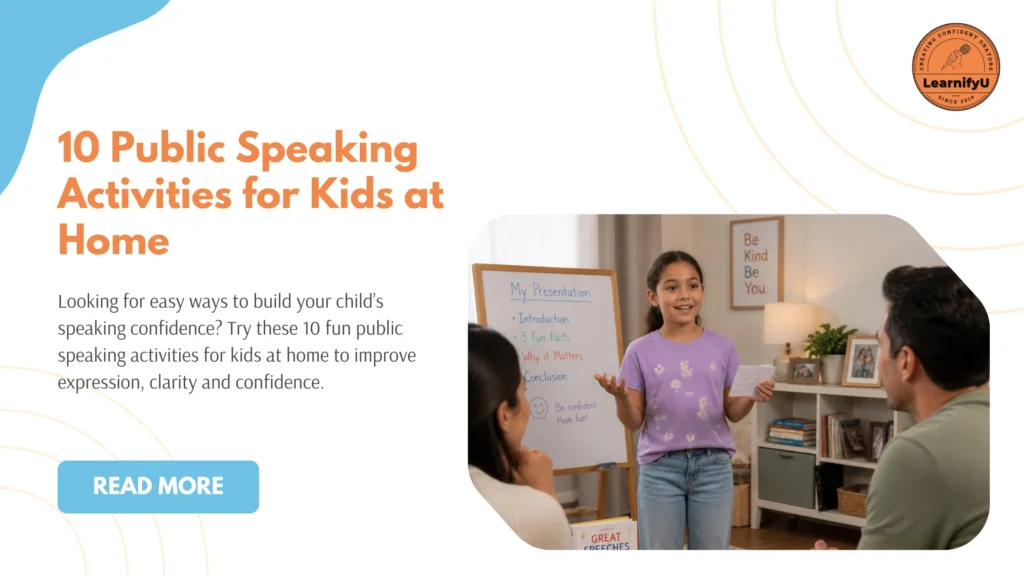
Ask them to prepare a two minute presentation for the family.
For example:
- A science concept
- A historical person
- A book they are reading
- An animal
- A country
- A hobby
- A school project
Help them create three simple sections:
What is it?
What should people know about it?
Why is it interesting?
Then let them present.
Afterwards, ask one or two questions.
Why it works
This is closer to real public speaking practice for kids because it combines preparation, organisation, delivery and questions.
It can also help children become more comfortable with school presentations.
As they improve, introduce additional skills such as:
- Speaking without reading every word
- Looking at the audience
- Using pauses
- Changing tone
- Giving examples
- Answering questions
The aim isn’t to create a perfect presentation.
It’s to make presenting feel familiar.
10. The "Convince Me" Challenge
Give your child a playful challenge:
“Convince me that –– your favourite activity is the best way to spend a Saturday.”
Or:
“Convince me that your favourite book should become a movie.”
The child has two minutes to persuade you.
They should provide at least three reasons.
Then switch roles.
Now the parent has to defend the opposite position.
Why it works
Persuasive speaking requires children to think about their audience.
They have to decide which reasons are most convincing & explain them clearly.
It also introduces children to the idea that –– effective communication isn’t just about what you want to say.
It is about how your listener understands what you say.
How to Make Public Speaking Practice More Effective at Home
The activity itself matters –but the way parents respond can make an even bigger difference.
Don't Correct Every Mistake
If a child is constantly interrupted for grammar, pronunciation or word choice, speaking can quickly become stressful.
Let them finish.
Then choose one thing to improve.
Give Them Thinking Time
Don’t immediately complete your child’s sentence when they pause.
A few seconds of silence can give them time to organise their thoughts.
Ask Follow Up Questions
Instead of saying only “Good job,” show genuine interest.
Ask:
“Why did you choose that?”
“What happened next?”
“Can you give me an example?”
This encourages children to develop their answers.
Praise Specific Effort
Instead of simply saying “You’re a great speaker,” try ––
“I liked how clearly you explained that.”
“You remembered your three points.”
“You spoke even though you were nervous.”
Specific feedback tells children what they are doing well.
Don't Compare Siblings or Friends
Public speaking confidence develops differently for every child.
One child may enjoy performing immediately.
Another may need months of gradual practice.
Comparison can make children more self-conscious –– rather than more confident.
Turn Everyday Conversations Into Speaking Practice
Parents don’t need to –– schedule a formal activity every day.
Everyday situations can become “opportunities” for communication.
Ask your child to:
- Explain a decision
- Tell you about something they learned
- Give directions
- Describe an experience
- Recommend a book
- Explain how to play a game
- Share an opinion
- Tell a story about their day
Even a five-minute conversation can provide –– useful speaking practice.
The important thing is consistency.
When Should You Consider Structured Public Speaking Classes?
Home activities are an excellent starting point.
However, some children benefit from structured guidance –– particularly when they consistently avoid speaking in groups, feel very nervous during presentations or need more opportunities to practise with people outside their immediate family.
A structured programme can introduce:
- Different audiences
- Group discussions
- Presentations
- Storytelling
- Impromptu speaking
- Constructive feedback
- More challenging speaking situations
For families looking for a more organised approach, Public Speaking Classes for Kids in India can provide regular opportunities for children to practise speaking beyond the home environment.
The purpose of structured classes isn’t to replace conversations at home.
It is to build on them.
The Goal Isn't to Make Your Child Talk More
This is perhaps the most important point.
Public speaking isn’t about –– making children louder or turning quiet children into performers.
A strong communicator knows how to:
- Think before speaking
- Express an idea clearly
- Listen to others
- Ask questions
- Explain an opinion
- Respond thoughtfully
- Speak appropriately for the situation
Those abilities take time to develop.
Some children will enjoy every activity on this list.
Others may strongly prefer storytelling to presentations.
That’s okay.
Follow their interests.
If your child loves animals, let them talk about animals.
If they love football, let them explain a game.
If they enjoy drawing, ask them to present their latest picture.
The easiest speaking practice is often the kind –– that begins with something a child already cares about.
FAQs - Frequently Asked Questions
Simple activities include –– one-minute talks, storytelling, show-and-tell, picture descriptions, family interviews, pretend podcasts and short presentations. The best activity is –– one that matches the child’s age and interests & gives them a genuine reason to speak.
Give your child regular opportunities to speak –– without turning every conversation into a test. Ask open-ended questions, encourage them to explain their opinions –– let them finish their thoughts and praise specific efforts rather than expecting perfect speech.
Don’t force them into a long presentation immediately. Start with comfortable activities such as talking about a favourite toy or explaining something to one parent. Gradually increase the audience or speaking time as your child becomes more comfortable.
There is no fixed requirement. Short, regular opportunities are often more useful than occasional long sessions. Even five to ten minutes of relaxed speaking practice several times a week can give children –– valuable opportunities to develop their communication skills.
Yes. Activities such as –– one-minute talks, show-and-tell and two-minute presentations help children practise organising thoughts, speaking continuously & responding to questions. These skills can make –– formal school presentations feel more familiar.
Usually, it is better to let children complete their thoughts – before offering feedback. Constant interruptions can make speaking feel like a “test”. Choose one or two areas to work on afterwards and keep the overall experience positive.
Children can begin simple speaking activities as soon as they can comfortably communicate ideas. The activity should become more structured as they grow. A preschooler might tell a short story about a picture –– while an older child might deliver a prepared presentation or participate in a debate.
Confidence matters but it is not the only skill. Children also need to learn –– how to organise thoughts, listen actively, communicate clearly, adapt to an audience and respond thoughtfully. The strongest public speakers combine confidence with good communication habits.
Final Thoughts
Your home doesn’t need to become a classroom for your child to develop –– “public speaking skills”.
A family conversation can become an exercise in expressing an opinion.
A favourite toy can become the subject of a presentation.
A photograph can inspire a story.
A dinner table discussion can become a debate.
A simple question can give a child an opportunity to explain –– what they think.
These small moments matter because confidence is rarely built in one dramatic event.
It develops through repeated experiences of –– speaking, being listened to, making mistakes, trying again and discovering that your ideas are worth sharing.
So don’t wait for the next school presentation to help your child practise.
Start with something they already love.
Ask them to tell you about it.
Then listen.
Sometimes, that’s where confident speaking begins.