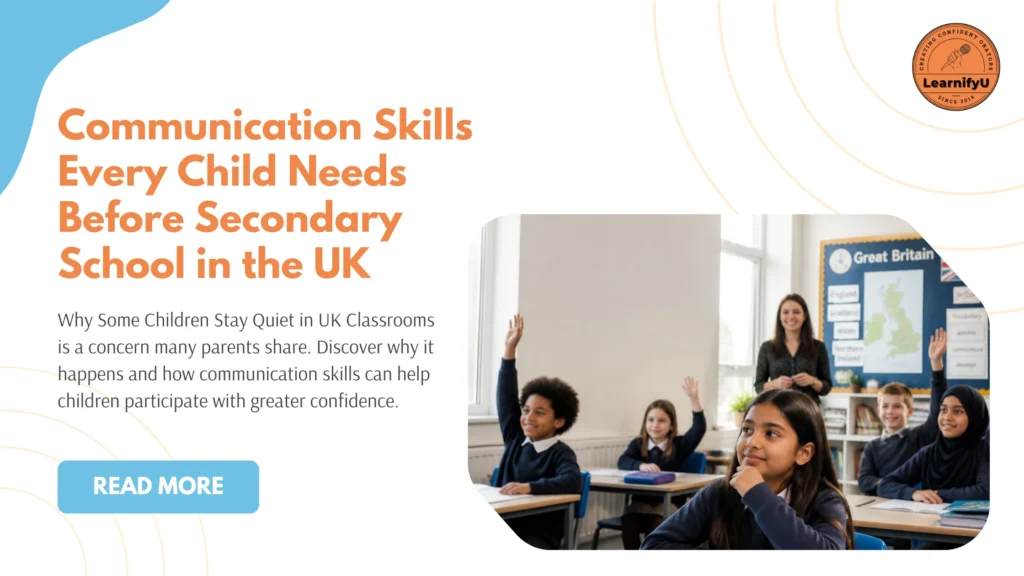
Why Some Children Stay Quiet in UK Classrooms Even When They Know the Answer
If you’ve attended a parents’ evening, there’s a good chance you’ve heard a teacher say something like this:
“Your child is doing well academically –but we’d like them to contribute a little more during class discussions.”
For many parents across the UK, that comment is both reassuring & puzzling.
It confirms that their child understands the lessons, yet it also highlights something that isn’t reflected in “test scores”.
Why does a child who confidently explains a maths problem at home –– suddenly become quiet in the classroom?
Why do they happily discuss a favourite book with family but avoid answering a teacher’s question?
Why do they know the answer but never raise their hand?
These questions are becoming increasingly common as –– classrooms place greater emphasis on participation alongside academic achievement.
Today’s lessons are rarely built around listening quietly for an hour before completing written work. Children are encouraged to –– share opinions, explain how they reached an answer, work with classmates, present projects and ask thoughtful questions.
For some children, these opportunities feel natural.
For others, they feel like the most challenging part of the school day.
Knowing the answer and feeling comfortable saying it aloud –– are two very different abilities.
One reflects subject knowledge.
The other depends on communication.
That is why many parents are beginning to pay as much attention to “communication skills” –– as they do to academic progress.
Being Quiet Doesn't Mean a Child Has Nothing to Say
One of the biggest misconceptions parents worry about is that –– silence reflects a lack of understanding.
Teachers often know that isn’t true.
Many children who rarely volunteer answers perform well in written assessments.
Others quietly explain the correct solution to a friend after someone else has already answered.
Some produce excellent written work but contribute very little during discussions.
Their silence isn’t always linked to ability.
Sometimes it comes from caution.
Sometimes from overthinking.
Sometimes from worrying about saying the wrong thing.
Children process classroom situations differently.
Some enjoy thinking before they speak.
Others speak while organising their thoughts.
Neither approach is wrong.
The difficulty arises when hesitation prevents children from sharing ideas they already understand.
Over time, repeated hesitation can become a habit.
Not because children have less to contribute –but because remaining quiet begins to feel safer than speaking.
UK Classrooms Ask Children to Do More Than Give Correct Answers
Education has gradually become more interactive.
Across many UK schools –– children are encouraged to explain their reasoning rather than simply provide the correct answer.
Teachers often ask questions such as –
“How did you work that out?”
“Can you explain your thinking?”
“Does anyone have a different opinion?”
These questions encourage discussion rather than memorisation.
Children also take part in:
- paired learning activities
- group projects
- classroom discussions
- reading aloud
- presentations
- problem-solving tasks
- collaborative learning
Each of these activities depends on communication as much as academic understanding.
A child may understand every step of a science experiment -but still feel uncomfortable explaining it to classmates.
Another may know exactly how to solve a maths question yet hesitate when everyone turns to listen.
Parents sometimes mistake this for a knowledge gap.
In reality, it is often a communication gap.
The encouraging part is that communication can be developed through regular practice –– just like reading, writing or numeracy.
Why Some Children Stay Quiet Even When They Know the Answer
There is rarely one single explanation.
Different children stay quiet for different reasons.
They Worry About Making Mistakes
Children often remember embarrassing moments far longer than –– adults expect.
Answering incorrectly once.
Forgetting what they wanted to say halfway through a sentence.
Hearing another child laugh.
These experiences may seem small, yet they can influence –– how willing a child feels to participate the next time.
Rather than risk another uncomfortable moment –– some children decide it is easier not to answer at all.
They Need More Time to Think
Not every child processes information at the same speed.
Some prefer to organise their thoughts carefully before speaking.
Unfortunately, classroom discussions move quickly.
By the time they’ve decided how to answer, another pupil has already spoken.
Repeated experiences like this gradually teach children that someone else will probably answer first anyway.
Eventually, they stop trying.
They Feel Comfortable at Home but Not in School
Parents often say,
“My child never stops talking at home.”
That doesn’t necessarily contradict what teachers observe.
Home feels familiar.
Children know they won’t be judged for choosing the wrong words or taking a little longer to explain something.
School is different.
Classmates are listening.
Teachers are assessing understanding.
The environment naturally feels more demanding.
Feeling quieter in school than at home –– is more common than many parents realise.
Speaking in Front of Class Feels Bigger Than Adults Imagine
Adults sometimes see answering a classroom question as a small task.
Children often experience it differently.
Standing up to explain an idea while thirty classmates are listening can feel surprisingly similar to –– speaking on a stage.
This explains why some children who struggle with classroom participation also become nervous during assemblies, presentations or school performances.
The audience may be smaller than a theatre.
Emotionally, however, it can feel just as significant.
They Want Their Answer to Be Perfect
Some children place enormous pressure on themselves.
Instead of thinking,
“I know the answer.”
They think,
“What if I don’t explain it properly?”
Perfectionism can quietly reduce participation.
Children wait until they are completely certain before speaking.
By then, the discussion has usually moved on.
Ironically, many highly capable children become quieter because –– they expect too much from themselves.
Why "Shy" Isn't Always the Right Description
When a child rarely speaks in class –– the first word many adults use is shy.
Sometimes that description is accurate.
Quite often, it isn’t.
A child may confidently chat with neighbours, happily perform in a school play or spend hours talking to cousins –– yet remain unusually quiet during – classroom discussions.
That doesn’t necessarily mean they’re shy.
It simply means their confidence changes depending on the situation.
Communication is rarely the same in every environment.
A child who enjoys storytelling at home may hesitate –– when explaining an answer in front of thirty classmates.
Another child may speak confidently with friends but become nervous when they know a teacher is evaluating their response.
This is why labels can sometimes be unhelpful.
Rather than asking –– “Why is my child so shy?”, it is often more useful to ask,
“What makes this particular situation difficult?”
The answer usually provides far better direction than the label itself.
Communication Develops Through Small Everyday Moments
Parents often look for one activity that will suddenly make their child more confident.
In reality, communication develops gradually.
A child answers one question in class.
Introduces themselves to someone new.
Explains how they solved a maths problem.
Reads aloud during English.
Shares an opinion in a group discussion.
Each experience becomes another opportunity to become a little more comfortable using their voice.
Progress is rarely dramatic.
It is usually quiet.
Children don’t wake up one morning feeling completely confident.
Instead – they build confidence by collecting successful speaking experiences over time.
That is why patience often matters – as much as practice.
What Parents Can Do at Home
The goal isn’t to turn every child into –– the most talkative person in the room.
The goal is to help them feel –– comfortable expressing ideas when they want to.
Small changes at home can make a “meaningful” difference.
Ask questions that invite conversation
Instead of questions that only require “yes” or “no”, try asking ––
“What made you laugh today?”
“Which lesson did you enjoy the most?”
“If you could change one thing about school –– what would it be?”
Open conversations encourage children to organise thoughts instead of –– giving one-word answers.
Give children time to respond
Adults often answer for children without realising it.
If a shop assistant asks your child’s name or someone asks about their favourite subject, allow a few extra seconds before stepping in.
Those brief pauses create opportunities for children to speak independently.
Celebrate participation and not perfection
If your child tells you they answered a question in class –– celebrate the fact that they took part.
Whether the answer was completely correct is often less important than the willingness to contribute.
Children usually repeat the behaviours that receive encouragement.
Let children explain everyday things
Ask them to explain the rules of a game.
Describe a film they enjoyed.
Teach you something they learned in school.
These conversations help children practise organising ideas –– without feeling as though they are being tested.
When Extra Communication Practice Can Help
Some children gradually become more comfortable speaking through everyday classroom experiences.
Others benefit from more structured opportunities to practise.
This is especially true if hesitation begins affecting –– presentations, classroom participation or the confidence to express ideas.
Many families choose activities that give children regular opportunities to discuss, present and communicate in a positive environment.
For parents looking for additional support, our Online Communication & Public Speaking Classes for Kids in the UK are designed to help children build confidence through –– interactive discussions, speaking activities and guided practice. Rather than encouraging children to memorise speeches –– the focus is on helping them think clearly, organise ideas and communicate naturally in different situations.
The objective isn’t to create louder children.
It’s to help children feel comfortable using their voice when it matters.
Every Child Finds Their Voice Differently
Some children become confident speakers early.
Others need more time.
Neither path is wrong.
The child who raises their hand once this week after staying silent for months has made –– genuine progress.
The child who speaks a little more during group work than they did last term is –– moving forward.
Growth doesn’t always arrive in obvious ways.
Parents often notice these changes before anyone else.
Longer answers at the dinner table.
Greater willingness to ask questions.
More confidence introducing themselves.
Less hesitation during school presentations.
Small moments like these often signal that something important is changing.
Not just how children speak.
But how they see themselves.
FAQs - Frequently Asked Questions
Many children hesitate as they worry about making mistakes, speaking in front of classmates or finding the right words quickly. Understanding a topic and expressing it confidently are two –– different skills.
No. Some children are confident in familiar settings -but become more reserved in classrooms. Their communication often depends on the situation – rather than their personality.
Create regular opportunities for conversation at home, encourage independent responses, and recognise effort –– rather than expecting “perfect” answers. Consistent practice usually helps children become more comfortable speaking.
Yes. Strong communication skills help children explain their thinking, participate in discussions, ask questions and work effectively with classmates –– all of which support learning.
If hesitation consistently affects classroom participation, presentations or everyday communication despite encouragement at home, structured communication practice can help children build confidence gradually.
People Also Ask
Children may stay quiet because –– they fear making mistakes, need more time to think or feel nervous speaking in front of others.
Yes. Many children communicate freely with family -but become more cautious in unfamiliar or evaluative environments like school.
Teachers often use paired discussions, smaller group activities and positive reinforcement to help –– children share ideas without feeling pressured.
Regular speaking practice can help children –– organise their thoughts, express ideas more clearly and feel more comfortable contributing during lessons.
Knowledge is understanding a concept. Communication is the ability to explain that understanding clearly so others can follow your thinking.
Final Thoughts
Children who stay quiet in class are not always lacking knowledge.
Many simply need more time, more opportunities and more confidence to express –– what they already know.
Modern classrooms encourage children to –– explain ideas, ask questions, work collaboratively and communicate clearly.
These expectations continue to grow throughout secondary school and beyond.
Helping children become comfortable sharing their thoughts isn’t about –– making them speak all the time.
It’s about helping them recognise that their ideas are worth hearing.
When children begin trusting their own voice, they often become more willing to participate in –– lessons, contribute during discussions and approach new situations with greater confidence.
Sometimes the biggest change isn’t that –– a child suddenly becomes the loudest person in the classroom.
It’s that they no longer stay silent when they know –– they have something valuable to say.