
Communication Skills Classes for Teens in the USA
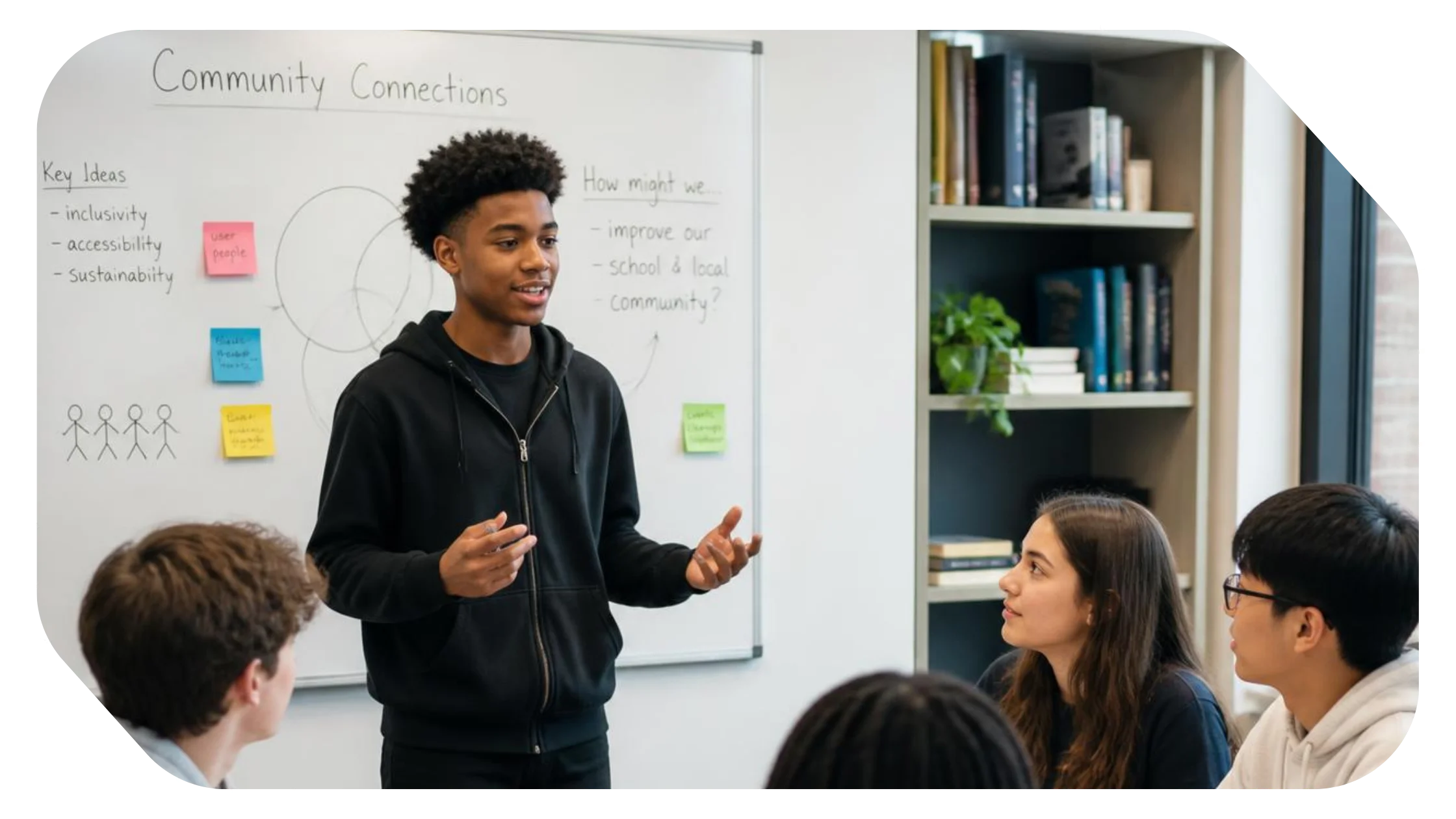
The teenage years bring a different kind of communication challenge.
Teenagers are no longer simply expected to answer questions in class or engage in school activities. They are gradually learning –– how to express their identity, communicate their opinions, handle disagreements, build relationships, speak to adults, work with peers and make decisions independently.
At the same time – the situations in which they need strong communication skills become more important.
A teenager may need to give a presentation, engage in a group discussion, interview for a leadership position, explain an idea to a teacher, introduce themselves to unfamiliar people or speak confidently during an academic or extracurricular activity.
Yet, many teenagers who are intelligent & capable still hesitate – when they need to communicate.
Some know exactly what they want to say but struggle to say it clearly.
Some are confident with friends –– but become quiet around adults or unfamiliar groups.
Others avoid presentations because they feel uncomfortable being watched.
And some teenagers speak frequently –– but need help organising their thoughts, listening carefully or communicating disagreement respectfully.
Communication is not simply about talking more.
It is about knowing –– what to say, how to say it, when to say it & how to respond when someone sees things differently.
At LearnifyU, our Communication Skills Classes for Teens in the USA help teenagers develop these abilities through practical speaking, listening, discussion, presentation & confidence-building activities.
The goal is to help teens communicate with greater clarity, confidence and purpose — at school and beyond.
Why Communication Skills Matter for Teenagers?
Teenagers are entering a stage where their communication becomes even more independent.
Parents and teachers may no longer guide every interaction.
Teenagers begin communicating directly with:
- Teachers and school staff
- Coaches and activity leaders
- Classmates and peers
- New social groups
- Interviewers
- College-related contacts
- Community members
- Adults outside their immediate family
They also face situations where there may not be a single correct answer.
They need to explain what they think.
They need to listen to other perspectives.
They need to ask questions.
They need to make decisions.
They need to handle dispute.
These situations require more than vocabulary or grammatical Correctness.
They require communication judgment.
The communication needs of teenagers are different from those of younger children. They are increasingly expected to express opinions, participate in discussions, present ideas and communicate independently with teachers and peers. Our communication skills classes for kids in the USA are designed around age-appropriate communication development, helping students build these skills as they move through different stages of learning.
When a Teenager Has the Knowledge but Not the Confidence
Parents sometimes say:
My teenager is very intelligent – but they do not speak up.
This can be frustrating for both parents and students.
A teenager may understand a topic thoroughly – but hesitate to contribute during a classroom discussion.
They may have a strong idea for a project but allow someone else to present it.
They may know “how to answer an interview question” — but become nervous “when asked to speak spontaneously”.
This doesn’t necessarily reflect their ability.
Sometimes the missing piece is simply communication confidence.
Confidence develops through repeated experiences.
When teenagers have opportunities to speak, receive constructive feedback & try again, communication gradually becomes more familiar.
The objective is not to eliminate nervousness completely.
Even experienced speakers can feel nervousess.
The objective is to help teenagers communicate despite feeling nervous.
Communication Skills Are More Than Public Speaking
Public speaking is an important communication skill – but teenagers communicate in many situations that don’t involve a stage.
Effective communication also involves:
Listening
Understanding another person’s point before responding.
Conversation
Knowing how to start, maintain & end a meaningful conversation.
Self-Expression
Explaining feelings, opinions, interests & ideas clearly.
Logical Thinking
Thinking about information before accepting or repeating it.
Questioning
Knowing “how to ask useful & relevant questions.”
Polite Disagreement
Expressing a different opinion without becoming dismissive or aggressive.
Adaptability
Changing communication style depending on the audience and situation.
A teenager may communicate differently with a – close friend, teacher, interviewer & younger student.
Learning how to adapt is part of becoming an “effective communicator.”
Helping Teens Express Their Opinions Clearly
Teenagers naturally develop stronger opinions as they become more “independent”.
But having an opinion & explaining it effectively are different skills.
Instead of simply saying:
“I do not agree.”
A strong communicator can explain –
“I don’t agree because…”
They can provide an example.
They can acknowledge another perspective.
They can explain what might change their opinion.
These skills are valuable during — classroom discussions, debates, group projects & everyday conversations.
Communication classes give teenagers opportunities to practise this process without making every conversation feel like an academic exercise.
Building Confidence for Presentations
Presentations can be uncomfortable even for teenagers – who communicate confidently in everyday situations.
The difficulty may come from several sources.
They may worry about:
- Forgetting what they planned to say
- Speaking too quickly
- Looking nervous
- Being judged by classmates
- Answering unexpected questions
- Losing their train of thought
- Not sounding confident enough
Good presentation skills are not simply about “memorising” a script.
Teenagers need to understand how to structure an idea and communicate it naturally.
They can practise:
Opening → Main Point → Supporting Ideas → Examples → Conclusion
They can also learn — how to pause, emphasise important information & respond when an audience asks a question.
With practice, presentations can become less intimidating because teenagers know how to handle the structure rather than – depending entirely on memorisation.
Communication and Leadership for Teens
Leadership communication becomes increasingly relevant during the “teenage years.”
Students may participate in:
- Student councils
- School clubs
- Sports teams
- Community activities
- Volunteer programmes
- Academic groups
- School events
Leadership does not necessarily mean being the “loudest” person in the room.
A strong student leader needs to –– listen, explain, organise, encourage and make decisions.
Communication helps bring these abilities together.
A teenager –– who can clearly explain a plan, listen to feedback and help a group move forward is already practising leadership.
Helping Teens Handle Disagreement
Teenagers will inevitably encounter people – who think differently from them.
The ability to disagree constructively is an important communication skill.
Instead of reacting immediately – teenagers can learn to –
- Listen to the complete argument
- Identify the “main point”
- Ask questions
- Explain their own position
- Give reasons
- Acknowledge valid points
- Disagree respectfully
This is particularly useful during classroom discussions & debates – but it also matters in friendships, family conversations and future workplaces.
Communication is not about making everyone agree with you.
It is about – being able to “communicate your position” without damaging the conversation.
This ability becomes particularly valuable when teenagers participate in debates and structured discussions. Learning to disagree respectfully is not simply about winning an argument; it is about understanding another perspective while communicating your own position clearly. Our article on why debate skills matter beyond school competitions explores how these abilities can support children’s communication and thinking well beyond competitive debate.
Communication Skills and Logical Thinking
Strong communication often begins with strong thinking.
Before teenagers can explain an idea clearly – they need to understand “what they actually think.”
For example, consider the question –
Should teenagers have Unlimited access to social media?
A quick answer might be “yes” or “no.”
A deeper conversation asks:
Why?
What are the benefits?
What are the risks?
Are the effects the same for every teenager?
What evidence supports the position?
What might someone who disagrees say?
Would there be circumstances where the opposite position makes sense?
Questions like these encourage teenagers to – examine their thinking.
Activities involving discussion, debate, problem solving & opinion sharing can therefore strengthen both communication & logical thinking skills.
Helping Teens Who Are Quiet Around Others
Not every quiet teenager lacks confidence.
Some teenagers are naturally reflective.
They may prefer to think before speaking.
Others communicate freely with close friends – but become uncomfortable in unfamiliar groups.
Some may worry about being judged.
The goal should not be to change their personality.
A teenager doesn’t need to become highly outgoing to be a strong communicator.
Instead – they should feel capable of speaking when they need to.
That might mean asking a teacher a question, introducing themselves to someone new, sharing an idea during a group project or speaking during an interview.
Communication confidence gives teenagers more choices.
They can remain naturally quiet while still knowing how to make themselves heard.
Helping Teens Who Speak –– Too Quickly or Too Much
Communication challenges don’t always look like silence.
Some teenagers speak quickly because — they are nervous.
Others provide long answers without reaching the main point.
Some interrupt because they are eager to respond.
Others struggle to notice when the listener has lost interest.
Communication training can help teenagers become more aware of these patterns.
They can learn to:
- Pause before responding
- Focus on the main point
- Listen without interrupting
- Adjust speaking pace
- Notice audience reactions
- Ask whether the other person has questions
- Keep explanations focused
Effective communication is about connection – not simply the amount of talking.
Communication Skills for Interviews
Teenagers increasingly encounter interviews as they approach the later years of school.
These may involve applications for:
- Student leadership roles
- Scholarships
- Summer programmes
- Volunteer opportunities
- Internships
- Academic programmes
- Part-time opportunities
Interview communication requires a different kind of confidence.
Teenagers need to listen carefully to the question & respond naturally rather than – reciting memorised answers.
They may be asked:
- “Tell me about yourself.”
- “What are you interested in?”
- “Describe a challenge you faced.”
- “What did you learn from that experience?”
- “What would you contribute to this programme?”
Communication practice can help teenagers become more comfortable answering questions about their experiences, interests & goals.
Preparing Teens for College Communication
College introduces teenagers to situations that require — greater independence.
They may need to communicate with – professors, participate in seminars, work on group assignments, give presentations or introduce themselves to people they have never met.
The transition can be easier when students have already practised communicating independently.
They have learned how to ask questions.
They have learned how to explain ideas.
They have learned how to present.
They have learned how to listen.
They have learned how to handle disagreement.
These skills become useful foundations for college and beyond.
Communication Skills and Social Confidence
Communication also influences “how teenagers interact socially?.”
Starting a conversation can feel difficult.
So can joining an unfamiliar group or explaining how they feel.
Some teenagers worry about saying the wrong thing.
Others struggle to – maintain conversations beyond simple questions and answers.
Communication activities can provide structured practice in:
- Starting conversations
- Asking follow up questions
- Showing interest
- Listening actively
- Sharing experiences
- Expressing opinions
- Understanding different perspectives
These skills can help teenagers feel more – comfortable navigating different social situations.
For Teens Who Understand English but Don't Speak Confidently
Some teenagers in the USA may understand English very well –– but still feel uncomfortable speaking spontaneously.
They may have spent years learning English academically –– but have fewer opportunities to use it in extended conversations.
They may worry about – pronunciation, grammar or finding the right words quickly.
Communication practice can help by creating situations where teenagers need to use language naturally.
They can practise:
- Explaining ideas
- Sharing opinions
- Telling stories
- Take part in discussions
- Asking questions
- Giving presentations
- Responding naturally
The focus should be on communicating meaning, not producing perfectly rehearsed sentences.
Some teenagers in the USA may understand English very well but still feel uncomfortable speaking spontaneously. They may worry about pronunciation, grammar or finding the right words quickly. For students who need additional practice with everyday verbal expression, Spoken English Classes for Kids in the USA can complement broader communication development by providing opportunities to use English naturally in conversations and interactive activities.
What Teens Learn in Our Communication Skills Classes
LearnifyU’s programme is designed around active participation.
Depending on the student’s needs and learning stage, activities may include:
- Public speaking
- Presentations
- Discussions
- Storytelling
- Debate
- Interview practice
- Role-play
- Opinion based conversations
- Logical thinking activities
- Listening exercises
- Question and answer sessions
- Leadership communication activities
The objective is to give teenagers repeated opportunities to think and communicate in real time.
Rather than simply learning communication concepts, they practise using them.
A Teen Friendly Learning Environment
Teenagers need a learning environment – where they can participate without feeling embarrassed about making mistakes.
At LearnifyU – communication development is approached through encouragement, practice & constructive feedback.
A teenager might give an incomplete answer today and improve it during the next activity.
They might initially avoid speaking and later volunteer an opinion.
They might deliver a presentation nervously and gradually become more comfortable.
These small changes matter.
Confidence develops through experience.
Live Online Communication Classes for Teens in the USA
LearnifyU offers live online communication programmes – that allow teenagers across the USA to participate from home.
Live sessions provide opportunities for interaction, discussion and real time speaking practice rather than relying only on recorded lessons. LearnifyU’s broader USA programmes similarly emphasise live instruction, interactive activities and age-appropriate communication development.
For teenagers, the important part is the opportunity to actually communicate.
They need to speak.
They need to listen.
They need to respond.
They need to think.
And they need opportunities to try again.
Who Can Benefit From These Classes?
Communication Skills Classes for Teens in the USA can be useful for teenagers who ––
- Feel nervous speaking in front of groups
- Avoid classroom discussions
- Struggle with presentations
- Have difficulty organising thoughts
- Want to express opinions more clearly
- Need stronger conversation skills
- Want to improve interview communication
- Are interested in leadership
- Find it difficult to disagree respectfully
- Understand English but lack speaking confidence
- Want to prepare for college
- Want to become more confident communicators
They can also benefit teenagers who already speak confidently –– but want to become more polished, thoughtful and effective communicators.
FAQs – Communication Skills Classes for Teens in the USA
Teenage programmes are generally designed for students who are moving toward greater independence in school, social and academic communication. The exact age range can vary depending on the student’s development and learning needs.
Yes. Structured communication activities can give shy teenagers gradual opportunities to – speak without requiring them to become highly outgoing. The aim is to build comfort & confidence while respecting the student’s personality.
Yes. Students can practise – organising ideas, delivering presentations, speaking clearly & responding to questions. Repeated practice can make presentations feel more familiar & manageable.
It can provide opportunities to practise communication in different contexts. Teenagers can work on –– introducing themselves, answering questions, explaining ideas and adapting their communication to different audiences.
Yes. Interview practice can help teenagers become more comfortable answering questions, describing their experiences & communicating their interests naturally rather than relying entirely on memorised responses.
Communication skills can support several aspects of — college life, including presentations, group projects, discussions, interviews and interactions with professors and classmates. Developing these skills before college can give students more experience communicating independently.
No. Communication activities can be adapted to the student’s current ability. Teens who understand English –– but hesitate to speak can use structured discussions and speaking activities to gain more experience expressing ideas naturally.
Yes. Leadership often involves – listening, explaining ideas, handling disagreement, encouraging participation & communicating decisions. Developing these abilities can help teenagers become more effective in group & leadership situations.
Help Your Teen Find Their Voice
Teenagers are moving toward a stage of life –– where they will increasingly need to speak for themselves.
They will make decisions.
They will meet new people.
They will express opinions.
They will face interviews.
They will participate in discussions.
They will work with different personalities.
And eventually, they will enter environments where nobody else can speak on their behalf.
Strong communication can help them navigate these situations with greater confidence.
At LearnifyU –– our Communication Skills Classes for Teens in the USA focus on helping teenagers think clearly, express ideas confidently, listen actively and communicate with purpose.
Whether your teen is –– naturally quiet, already an enthusiastic speaker or somewhere in between, communication is a skill that can continue to develop.
The goal isn’t to create a teenager who talks all the time.
It is to help create a young person who knows what they want to say – has the confidence to say it & knows how to listen when someone else speaks.
Help your teenager become a confident, thoughtful & effective communicator. Book a trial class with LearnifyU today.