
Communication Skills Classes for Middle School Students in the USA
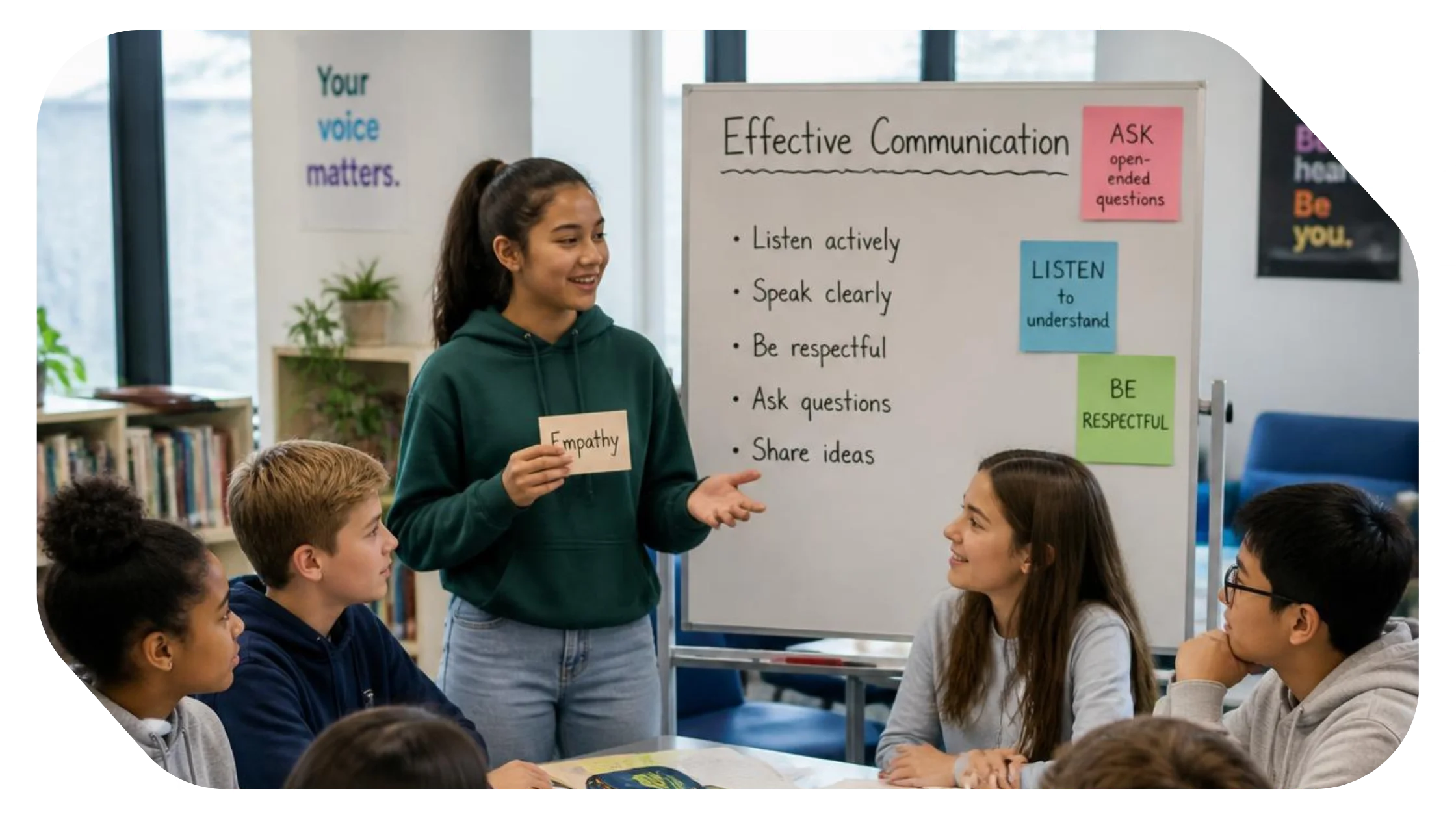
Middle school is a time when children begin to express more complex ideas, take greater responsibility for their learning & interact with –– a wider range of teachers & classmates.
Yet, many parents notice a gap between what their child knows & how comfortably they communicate it.
A student may understand a lesson – but hesitate to answer a question in class. They may have a good idea during a group project – but struggle to explain it. They may know exactly what they want to say during a presentation – but become nervous when everyone starts looking at them.
These situations are common during the middle school years.
Academic knowledge is important but students also need to know –– how to express their ideas, listen carefully, ask questions, participate in discussions & communicate with confidence.
Our Communication Skills Classes for Middle School Students in the USA are designed to help children develop these abilities –– through practical, age appropriate activities.
Rather than simply teaching students what to say –– we help them understand how to organise their thoughts, communicate clearly and become more comfortable using their voice.
Our communication skills classes for kids in the USA are designed to support children at different stages of development, with age-appropriate activities that gradually build confidence, clarity and effective communication.
Why Communication Skills Matter in Middle School?
The communication demands placed on students change considerably as they move into middle school.
Children are increasingly expected to:
- Take part in classroom discussions
- Give presentations
- Work on group projects
- Explain their reasoning
- Ask teachers questions
- Share opinions respectfully
- Collaborate with classmates
- Present research and project work
- Listen to different perspectives
- Communicate with greater independence
A student who was comfortable answering simple questions in elementary school may suddenly find these situations more challenging.
The reason is that communication is becoming more complex.
Students are no longer only expected to provide an answer. They may be asked to explain –– why they think something, defend an opinion, compare two ideas or respond to another student’s perspective.
This is where “structured” communication practice can make a meaningful difference.
When a Student Knows the Answer but Doesn't Speak
One of the most common concerns parents have is ––
“My child knows the answer but they never raise their hand.”
This does not necessarily mean the student lacks knowledge.
They could be afraid of answering incorrectly.
They may need more time to organise their thoughts.
They could be shy about addressing the class.
They may worry about how their peers will react.
Or they may simply have developed –– a habit of listening rather than participating.
Communication confidence develops through experience.
When students regularly practise explaining ideas in a supportive environment –– speaking can gradually become less intimidating.
The goal isn’t to turn every quiet student into the most vocal person in the classroom.
The goal is to help students feel comfortable enough to contribute –– when they have something to say.
Communication Skills Are More Than Speaking
When parents hear “communication skills” –– they often think about speaking clearly.
Speaking is important but effective communication involves much more.
Middle school students also need to learn how to:
Listen Actively
Good communication starts with listening.
Students need to understand what another person is saying before responding. Active listening helps them –– follow classroom instructions, take part in group discussions and respond thoughtfully.
Organise Their Thoughts
A student may have a strong idea but struggle to explain it.
Learning to structure thoughts into a beginning, supporting points and a conclusion can make communication much clearer.
Ask Better Questions
Asking questions is an “important” part of learning.
Students should feel comfortable –– asking for clarification, exploring an unfamiliar idea or seeking additional information when they do not understand something.
Express Opinions Respectfully
Middle school students are developing stronger opinions & independent perspectives.
Communication practice can help them learn –– how to disagree without becoming disrespectful and explain their position without dismissing someone else’s.
Respond Thoughtfully
Communication is not a prepared speech.
Students also need to respond –– when someone asks an unexpected question or presents a different point of view.
This ability becomes particularly important during discussions, presentations and group activities.
What Students Learn in Our Communication Skills Classes?
Our programme focuses on –– practical communication rather than memorising sentences or delivering rehearsed speeches.
Students work on several interconnected skills.
Speaking With Clarity
Students practise expressing ideas in a way –– that is easy for others to understand.
This includes:
- Choosing appropriate words
- Speaking in complete thoughts
- Using an appropriate pace
- Refining voice clarity
- Avoiding unnecessary repetition
- Communicating ideas in a logical sequence
The emphasis is on being understood rather than –– trying to sound perfect.
Building Speaking Confidence
Confidence develops when students experience themselves communicating successfully.
Students get regular opportunities to –– speak, explain, discuss and present in a supportive setting.
Small successes matter.
A student who initially gives a one-sentence response may gradually begin explaining an idea in greater detail.
Developing Active Listening
Students learn to listen for meaning rather than –– simply waiting for their turn to speak.
Activities can encourage them to –– identify key points, ask follow up questions & respond appropriately to what another person has said.
Expressing Opinions
Middle school is an excellent time for students to develop the ability to explain what they think and why.
Students can explore age appropriate topics & learn to support opinions with reasons and examples.
This also encourages them to understand that –– two people can disagree while still communicating respectfully.
Organising Ideas
Students often know what they want to say – but struggle with where to begin.
Communication activities help them learn simple frameworks for organising information.
For example ––
Point → Reason → Example → Conclusion
These structures can be useful –– when answering classroom questions, participating in discussions or preparing presentations.
Communication Skills and Classroom Participation
Classroom participation is not simply about speaking more.
A strong communicator knows –– when to speak, what to contribute and how to respond to others.
Students who become more comfortable communicating may find it easier to:
- Answer questions
- Ask for clarification
- Share ideas
- Participate in group discussions
- Explain their reasoning
- Present projects
- Contribute to team activities
These skills can complement academic learning because –– students have more opportunities to actively participate in the learning process.
Helping Middle School Students With Presentations
Presentations can be particularly challenging for students –– who are uncomfortable speaking in front of others.
They may know their topic well but struggle with ––
- Starting the presentation
- Maintaining eye contact
- Speaking loudly enough
- Remembering what they want to say
- Organising information
- Responding to questions
- Managing nervousness
Communication practice can break the process into smaller skills.
Students can learn –– how to introduce a topic, explain key points, use examples & finish with a clear conclusion.
Over time, presentations can become less about “performing” & more about sharing information with an audience.
As students move through middle school, speaking in front of others becomes a more regular part of academic life. Presentations, group projects, classroom discussions and school activities all require children to communicate their ideas clearly. For students who feel nervous when speaking before an audience, structured public speaking classes for kids in the USA can provide additional opportunities to practise presentation skills in a supportive environment.
Communication Skills for Group Projects
Group projects are another important part of middle school.
Students need to communicate with classmates who may have different ideas, personalities & working styles.
They may need to:
- Suggest an idea
- Listen to another student’s suggestion
- Explain a disagreement
- Divide responsibilities
- Ask for help
- Give constructive feedback
- Reach a decision together
These are communication skills that cannot be learned just through –– memorizing new words.
Students need opportunities to practise them.
Communication is not only about having the right words. Middle school students also need to feel comfortable using English spontaneously when answering questions, participating in discussions or explaining their opinions. For children who need additional support with everyday spoken communication, Spoken English Classes for Kids in the USA can complement broader communication practice by helping them become more comfortable expressing themselves naturally.
Helping Students Communicate Without Fear of Making Mistakes
Some students become reluctant speakers because –– they believe every sentence has to be perfect.
This can be particularly noticeable among students –– who are developing confidence in spoken English.
When students constantly worry about grammar, pronunciation or choosing the “right” word, they may speak less.
A supportive communication environment gives students room to:
- Think before answering
- Try different ways of expressing an idea
- Make mistakes
- Receive constructive feedback
- Try again
The objective is not to eliminate every mistake.
It is to help students become comfortable communicating even when –– they are still learning.
Communication Skills and Critical Thinking
Communication and critical thinking often develop together.
When students are asked to explain an opinion –– they have to think about the reasoning behind it.
Consider a question such as ––
“Should students have less homework?”
A student can simply answer yes or no.
But effective communication requires more:
What makes you think that?
What example supports your view?
What might someone who disagrees say?
Would your opinion change in a different situation?
These questions encourage students to –– move beyond quick answers & examine their own thinking.
This is why communication activities such as –– discussions, storytelling, presentations and age appropriate debates can contribute to broader intellectual development.
Communication Skills and Confidence Outside School
The benefits of communication are not limited to classrooms.
Middle school students communicate in many parts of their lives.
They speak with friends.
They interact with teachers.
They participate in activities.
They explain their preferences.
They solve disagreements.
They ask adults for help.
They eventually begin making more independent decisions.
A student who can express thoughts clearly & listen to others is developing a skill that will continue to matter throughout high school, college and adulthood.
What Makes LearnifyU's Approach Different?
At LearnifyU, we don’t believe communication can be developed by asking children to simply “speak more.”
Students need meaningful reasons to communicate.
Our online communication skills programme uses interactive activities designed around the age and developmental stage of middle school students.
Depending on the activity, students may practise:
- Storytelling
- Group discussions
- Opinion sharing
- Presentations
- Role-play
- Question-and-answer activities
- Listening exercises
- Problem-solving discussions
- Structured speaking activities
The objective is to keep students actively involved rather than turning communication practice into another lecture.
LearnifyU offers age-appropriate online communication and public speaking programs for kids in the USA, helping children develop their speaking, listening, presentation and interpersonal skills as they grow.
A Supportive Environment Matters
Students communicate differently.
Some are naturally expressive.
Some prefer to think before speaking.
Some are confident with friends but hesitate around unfamiliar people.
Others have plenty to say but worry about making mistakes.
A good communication programme should account for these differences.
We encourage students to participate without making them feel that every response is being judged.
The focus is on progress.
A student who becomes slightly more comfortable sharing an opinion today is building a foundation for greater confidence tomorrow.
Online Communication Skills Classes for Middle School Students
Online learning can provide a convenient way for families across the USA to access structured communication practice.
Students can participate from home while interacting with an instructor & practising communication in a focused environment.
For middle school students –– online sessions can provide opportunities to speak, listen, discuss and present without the distractions that can sometimes accompany a traditional classroom.
The most important part is not the screen.
It is the interaction taking place through it.
Who Can Benefit From These Classes?
Our Communication Skills Classes for Middle School Students in the USA can be useful for children who:
- Understand lessons but hesitate to speak
- Need more confidence during presentations
- Find it difficult to express opinions clearly
- Prefer listening rather than participating
- Feel nervous speaking in front of groups
- Need help organising their thoughts
- Want to improve conversational skills
- Are developing spoken-English confidence
- Want to become better at discussions and presentations
- Need stronger communication skills before high school
Students do not need to be poor communicators to benefit.
Even confident speakers can improve their ability to –– listen, reason, structure ideas & communicate effectively.
Preparing for High School and Beyond
Middle school is an important stage between childhood & greater academic independence.
As students move into high school, communication demands often increase.
They may encounter –– more presentations, group projects, classroom discussions, interviews, extracurricular activities and leadership opportunities.
Developing communication skills early gives students more time to practise before these situations become more demanding.
The objective isn’t to prepare a child for one presentation.
It is to help them develop a communication foundation they can continue building throughout their education.
FAQs – Communication Skills Classes for Middle School Students in the USA
There is no single starting age. Children begin developing communication skills from an early age –– but middle school is particularly important because students are expected to express increasingly complex ideas. Structured practice can help them become more confident communicators during these years.
Yes. Communication classes do not need to be limited to naturally outgoing children. A supportive environment can give quieter students structured opportunities to participate without forcing them –– into uncomfortable situations immediately.
They can. Students can practise –– organising information, speaking clearly, presenting ideas & responding to questions. These skills can make presentations feel more manageable with continued practice.
Communication practice can give students more opportunities to use English in meaningful conversations. Instead of focusing only on memorising vocabulary or grammar rules –– students practise expressing real ideas, answering questions and participating in discussions.
Communication skills do not replace academic knowledge but they can help students participate more effectively in learning. Asking questions, explaining reasoning, presenting projects & contributing to discussions are all important parts of school.
Give children opportunities to explain their ideas rather than answering everything for them. Ask open-ended questions, discuss books or current topics –– encourage them to tell stories about their day and allow them enough time to complete their thoughts.
Give Your Child More Opportunities to Be Heard
A middle school student does not need to become the loudest person in the classroom –– to become a strong communicator.
At LearnifyU, our Communication Skills Classes for Middle School Students in the USA are designed to give children that practice in an interactive and supportive environment.
Whether your child is already confident or still finding their voice –– communication is a skill they can continue to develop.
Because the ability to communicate clearly isn’t only useful for the next school presentation.
It is a skill children carry with them into –– high school, college, relationships, leadership opportunities & eventually the workplace.
Give your child the confidence to express their ideas, listen to others and communicate with purpose. Book a trial class with LearnifyU today.