
Communication Skills Classes for Kids in UAE
A child may know the answer but still hesitate to say it. That is one reason many parents start looking for –– communication skills classes for kids in the UAE. Their child may have good ideas but struggle to explain them. They may speak comfortably with family – but become quiet in a group. Or they may talk a lot at home – but find it difficult to listen, take turns, ask questions or express their thoughts clearly around teachers & other children.
These situations are more common than many parents realise.
Communication skills are not simply about “speaking more”. They are about helping children – express themselves, listen to others, respond appropriately & feel comfortable participating in conversations.
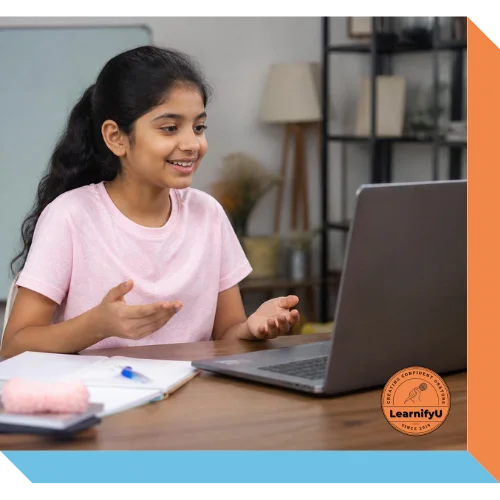
At LearnifyU, our Communication Skills Classes for Kids in UAE are designed to help children develop these abilities through – interactive conversations, storytelling, role play, discussions, speaking activities and guided practice.
The goal is not to make every child speak in the same way.
It is to help each child become a more confident and effective communicator.
Why Communication Skills Matter for Children in the UAE
The UAE is a multicultural & highly connected environment. Children may interact with classmates from – different cultural backgrounds, participate in group projects, communicate with teachers from different countries and eventually study or work in international environments.
That makes communication more than a classroom skill.
It becomes part of everyday life.
The UAE’s National Education Charter, launched in 2026, identifies effective communication, critical thinking and creativity among the future skills that should be developed throughout a learner’s educational journey. The Ministry of Education’s 2026–27 back to school campaign also focuses on giving students opportunities to practise these skills through – classroom, extracurricular, home and community activities.
But parents do not need to wait until a child reaches secondary school to think about communication.
The foundation starts much earlier.
A young child saying, “I don’t like this because…” is practising communication.
A school-age child asking a question instead of remaining confused is practising communication.
A teenager explaining an opinion, listening to a different point of view & responding respectfully is practising communication.
These small moments gradually become bigger skills.
Is Your Child Struggling to Express Themselves?
You may recognise some of these situations ––
- Your child knows what they want to say – but cannot find the right words.
- They give very short answers even when they understand the topic.
- They rarely ask questions in class.
- They avoid speaking to unfamiliar people.
- They interrupt instead of listening and waiting for their turn.
- They find group discussions uncomfortable.
- They become nervous when asked to explain an idea.
- They struggle to describe an experience in detail.
- They speak confidently at home – but become quiet in school or social settings.
- They have good ideas but find it difficult to organise them while speaking.
- They rely heavily on memorised answers.
- They need more confidence before presentations or classroom activities.
None of these automatically means that a child has a serious communication problem.
Sometimes –– they simply need more opportunities to practise communication in a supportive environment.
That is where structured communication skills training can help.
What Do Communication Skills Classes for Kids Teach?
Communication is a combination of “several skills working together.”
At LearnifyU, children get opportunities to practise ––
1. Speaking Clearly
Children learn to communicate their thoughts in a way – that is easier for others to understand.
This can involve – sentence formation, vocabulary, pronunciation, tone, pacing & organising thoughts before speaking.
2. Active Listening
Good communication is not only about speaking.
Children also need to listen carefully, understand what someone else is saying & respond appropriately.
Activities can encourage children to listen for key information, follow instructions, answer questions and respond to “what another person has actually said.”
3. Expressing Ideas
A child may have an interesting idea but struggle to explain it.
We encourage children to move from short responses towards fuller explanations by asking questions such as –
What do you think? Why do you think that? Can you explain more? What happened next?
This helps children practise expressing their “own thoughts” – rather than simply repeating prepared answers.
4. Asking and Answering Questions
Questions are an important part of “everyday communication.”
Children practise asking for information, seeking clarification, responding to questions and continuing conversations.
5. Vocabulary for Better Expression
Vocabulary is useful when it helps a child communicate an idea.
Instead of memorising long word lists – children can learn words and expressions in context and then use them in conversations, stories and speaking activities.
6. Social Communication
Children also need to understand – how communication changes depending on the situation.
Speaking with a friend is different from “speaking with a teacher.”
Answering a question is different from – starting a conversation.
Disagreeing with someone is different from – arguing with them.
Age appropriate role play can help children ‘practise these situations.”
What Happens in an Online Communication Skills Class?
A good communication class should not feel like – a child is simply sitting through another lecture.
Children need to use communication skills while learning them.
A typical LearnifyU session may include:
Warm-up conversation:
Simple questions help children start speaking and become comfortable participating.
Vocabulary or expression activity:
New words, phrases or communication strategies are introduced in context.
Guided speaking activity:
Children respond to questions, describe situations or explain ideas.
Interactive activity:
Storytelling, role play, games or problem solving activities encourage natural interaction.
Discussion:
Older children may discuss age-appropriate topics, share opinions or respond to different viewpoints.
Feedback:
Children receive supportive guidance on clarity, vocabulary, sentence formation and participation.
The activities change according to the child’s age and existing communication ability.
Communication Skills for Different Age Groups
A four year old does not need the same communication programme “as a teenager.”
The goals should grow with the child.
Ages 4–6
The focus is on developing comfort with communication through:
- Simple conversations
- Everyday vocabulary
- Stories and pictures
- Asking and answering basic questions
- Listening activities
- Role play
- Expressing likes, dislikes and simple ideas
At this stage, communication learning should feel natural, interactive and enjoyable.
Ages 7–9
Children can gradually work on:
- Complete sentences
- Describing people, places and experiences
- Asking better questions
- Storytelling
- Listening & responding
- Everyday conversations
- Role play
- Speaking in small groups
The aim is to move from simply answering questions towards participating in conversations.
Ages 10–12
Children can begin working more deeply on:
- Explaining ideas
- Giving reasons
- Sharing opinions
- Longer conversations
- Group discussions
- Storytelling
- Presentations
- Problem-solving discussions
- Clearer and more organised responses
Ages 13+
Older students may need communication skills for more complex situations:
- Expressing opinions confidently
- Taking Part in discussions
- Explaining ideas logically
- Responding to different viewpoints
- Presentations
- Interviews
- Group conversations
- Real-world communication
- Speaking with greater independence
If your child also needs support with everyday English – explore our Spoken English Classes for Kids in the UAE. If the primary concern is speaking confidently in front of an audience – our Public Speaking Classes for Kids in the UAE can be a natural next step.
What If My Child Is Shy?
Shyness is one of the most common reasons parents start looking for communication classes.
But the answer is not always to tell a child to “speak more.”
A child who is uncomfortable speaking in front of others – may need a gradual progression.
First, they may answer a simple question.
Then describe a picture.
Then tell a short story.
Then participate in a role play.
Then share an opinion.
Then speak during a small-group discussion.
The objective is to create repeated, manageable speaking experiences.
Over time, the child can become more comfortable expressing themselves without feeling that every speaking opportunity is a test.
What If My Child Speaks Well at Home but Not at School?
This is another situation parents often notice.
A child may be talkative with parents and siblings but become extremely quiet around – teachers, classmates or unfamiliar adults.
That does not necessarily mean the child lacks communication ability.
The environment matters.
They may be worried about “making mistakes, being corrected, being laughed at or simply not knowing how to enter a conversation.”
Structured activities can give children opportunities to practise these situations in a low pressure setting.
Instead of asking them to suddenly “be confident” – we help them build confidence through participation.
Why Communication Skills Matter More in an AI Driven World
There is an interesting change happening in education.
Children can now use technology to find information, generate ideas and complete certain tasks faster than before.
So does that make communication less important?
Quite the opposite.
When information becomes easier to access – children still need to ask good questions, evaluate ideas, explain their thinking, collaborate with others and communicate what they have learned.
The UAE’s current education framework reflects this shift by placing effective communication alongside critical thinking, creativity and AI mastery as future skills.
A child may have access to powerful technology.
But they still need to explain an idea to a teacher.
Ask a meaningful question.
Work with a team.
Listen to another person’s viewpoint.
Present a solution.
And communicate with people.
Those are human skills worth developing early.
Can Communication Skills Help With School Presentations?
Yes, but communication skills are broader than public speaking.
A presentation requires a child to organise information & communicate it to an audience.
Communication skills provide some of the foundation behind that ability.
For example, a child who regularly practises:
- explaining ideas,
- choosing appropriate words,
- listening carefully,
- answering questions,
- organising thoughts,
- speaking clearly, and
- responding to others
has more opportunities to develop skills that can support classroom presentations.
For dedicated work on stage confidence, speeches, storytelling and presenting before an audience, you can explore our Public Speaking Classes for Kids programme.
How LearnifyU Builds Communication Confidence
At LearnifyU, we do not treat communication as a single skill that can be “completed” in a few classes.
Children develop communication through practice.
Our approach combines:
- Interactive conversations
- Storytelling
- Role play
- Speaking games
- Guided discussions
- Vocabulary activities
- Listening exercises
- Opinion-based activities
- Presentation practice for age-appropriate learners
- Constructive feedback
The activities are adapted to the child’s age & communication level.
The aim is to create opportunities for children to – listen, think, respond and express themselves.
That distinction matters.
We are not trying to teach children what to say all the time.
We want them to gradually become more comfortable deciding “what they want to say & how they want to express it.”
How Can Parents Improve Their Child's Communication Skills at Home?
You do not need to turn your home “into a classroom.”
Small everyday conversations can create “valuable practice.”
Instead of asking only:
How was school?
try:
“What was the most interesting thing you learned today?”
Instead of –
“Did you enjoy the activity?”
try:
“What did you like about it, & why?”
You can also ask your child to ––
- Describe something they see.
- Explain how a game works.
- Retell a story.
- Tell you about a problem and suggest a solution.
- Share an opinion about an age appropriate topic.
- Ask you three questions.
- Explain something they know well.
Most importantly, give them time to finish.
Communication confidence grows –– “when children feel that their ideas are worth listening to.”
How Do You Know If Communication Skills Are Improving?
Progress does not always mean that – a child suddenly becomes the most talkative person in the room.
Look for smaller changes.
Your child may begin to:
- Answer with more detail.
- Ask more questions.
- Explain ideas more clearly.
- Use a wider range of vocabulary.
- Listen before responding.
- Participate more willingly.
- Give reasons for their opinions.
- Continue a conversation for longer.
- Speak with less reliance on memorised answers.
- Feel more comfortable communicating with others.
For some children – the biggest improvement may simply be moving from “I don’t know what to say” to “Let me explain.”
That is meaningful progress.
Why Choose LearnifyU for Communication Skills Classes in UAE?
At LearnifyU, we focus on communication as a practical skill rather than another subject children simply study.
Our live online classes use conversations, storytelling, role play, discussions and guided speaking activities to give children regular opportunities to communicate.
We also recognise that children develop differently.
Some need more vocabulary.
Some need help organising their thoughts.
Some need more speaking practice.
Some understand everything but hesitate to participate.
And some are already confident speakers but need to become more structured and effective communicators.
The approach should reflect – where the child is starting from.
Spoken English, Communication Skills and Public Speaking: What's the Difference?
Parents often come across all three programmes and wonder – whether they are essentially the same.
They are connected, but they have different purposes.
Spoken English focuses on helping children use English comfortably through – vocabulary, sentence formation, listening, pronunciation & conversation.
Communication Skills go broader. They help children express ideas, listen, respond, interact & communicate effectively in “different situations.”
Public Speaking focuses more specifically on communicating ideas to an audience through “presentations, storytelling, speeches, debates and structured speaking.”
A simple way to think about the progression is –
Learn the language → communicate your ideas → present those ideas confidently.
A child may need one of these areas or benefit from developing all three over time.
What Do Parents Say About Us
Posted on Google
 Raina Kumar
Trustindex verifies that the original source of the review is Google.
Very elaborative course structure! They really work hard and deliver what they commit.Posted on Google Indra DeviGreat experience with English speaking course for my child.Posted on Google
 Sanjay ParasharMy daughter joined LearnifyU a few weeks back. Her teacher is Ms Jerline Thomas. We can already see a remarkable difference in her communication skills. She is more open and enthusiastic to talk to people and already much more confident. The best part about the curriculum is that it focuses on spoken english and not all that bookish learning. That should be best left for the schools. Great job LearnifyU!! And Thank You!!Posted on Google
 Manorama SinghBeing a professional teacher myself, I joined LearnifyU as a student with the aim of enhancing my teaching skills and exploring new approaches to learning. My experience has been extremely positive and rewarding. LearnifyU provided structured guidance, practical strategies, and valuable insights that helped me grow both personally and professionally. The mentors were supportive, knowledgeable, and always willing to address doubts with patience. What I appreciated the most was that the learning experience was practical and directly applicable to real classroom situations. Even as an experienced teacher, I discovered new techniques, improved my communication skills, and gained fresh perspectives on student engagement. I would highly recommend LearnifyU to educators and learners who are looking for meaningful learning experiences and continuous professional growth.Posted on Google
 Udit RanaWe enrolled our nephew in LearnifyU to improve communication and public speaking skills, and the transformation has been amazing. The sessions are interactive, engaging, and designed in a way that keeps children comfortable while encouraging them to speak confidently. My nephew has become more expressive, confident while speaking in English, and much more active in school presentations and conversations. The mentors are supportive, patient, and give personal attention to every child. What we really appreciate is that the classes focus not only on speaking English but also on confidence building, stage presence, vocabulary, and overall communication skills. Highly recommended for parents looking for online public speaking and communication classes for kids.Posted on Google
 Vasudha RathiA very unique blend of classes - where one can learn, have fun activities and improve your speaking skills.
Frequently Asked Questions
Communication skills classes help children develop abilities – such as speaking clearly, listening actively, expressing ideas, asking questions, responding appropriately and participating in conversations.
There is no single “perfect” age. Young children can begin with simple conversations, stories, questions & play based activities – while older children can work on discussions, presentations, opinions & more complex communication situations.
They can provide structured opportunities for a shy child to participate gradually. The focus should be on building comfort through manageable speaking activities – rather than forcing a child to perform before they are ready.
Spoken English primarily focuses on using English through – vocabulary, sentence formation, pronunciation and conversation. Communication skills are broader and include listening, expressing ideas, responding, social interaction & communicating effectively “in different situations.”
Communication skills can support classroom participation, group activities, discussions, question answer sessions & presentations. They can also help children become more comfortable explaining what they know.
Yes, when online classes are interactive rather than lecture based. Children should have opportunities to speak, listen, respond, participate in activities & receive feedback “during the session.”
Give your child regular opportunities to speak & listen. Ask – open ended questions, encourage them to explain their ideas, discuss everyday situations, retell stories & share opinions. Avoid interrupting or correcting every mistake – while they are trying to express themselves.
Not necessarily – for the same reason as a child learning English. A child may speak English comfortably but still need help – organising ideas, listening, participating in discussions, explaining opinions or communicating confidently in different situations.
People Also Ask –– Communication Skills for Kids
Give children regular opportunities to speak, listen, ask questions, explain ideas and participate in conversations. Activities such as storytelling, role play, picture description and discussions – can provide useful practice.
Communication helps children “express their needs & ideas, understand others, participate in learning, build relationships & work with people.” It also supports skills – such as “collaboration, confidence and problem solving.”
Common areas include – speaking, listening, asking questions, understanding non verbal communication and responding appropriately. The exact skills a child needs can change with age and context.
Avoid putting pressure on a child to “perform every time they speak.” Instead, create frequent low pressure opportunities to express ideas, make choices, tell stories & participate in conversations. Positive feedback and gradual challenges can help build confidence.
Storytelling, role play, picture description, group discussions, question games, problem solving activities and everyday conversations – can all encourage communication practice.
No. Public speaking is one form of communication. Communication skills also include everyday conversation, listening, questioning, responding, expressing ideas & interacting “with others.”
Give Your Child More Opportunities to Communicate
Children do not become confident communicators simply because they know more words.
They become better communicators –– when they have opportunities to listen, think, speak, respond, make mistakes, try again and express their own ideas.
That is what meaningful communication practice should provide.
If you are looking for Communication Skills Classes for Kids in the UAE –– LearnifyU offers live online learning designed around children’s age, communication level and confidence.
Help your child move from simply knowing what they want to say to feeling comfortable saying it.
Explore LearnifyU’s Communication Skills Classes for Kids in the UAE and book a free demo.