
Spoken English Classes for Kids in Mumbai
If your child understands English but hesitates when it is time to speak – the problem may not be a lack of knowledge. Many children know the words and grammar they need – but they need more opportunities to use English in real conversations.
LearnifyU offers Spoken English Classes in Mumbai for kids through –– live, interactive online learning. The program is designed to help children develop vocabulary, sentence formation, pronunciation, listening and, most importantly, the confidence to express themselves in English.
Whether your child is shy while “speaking, struggles to form sentences, comes from a non English speaking home, or simply wants to become more comfortable communicating in English” – regular speaking practice can make a “meaningful difference.”
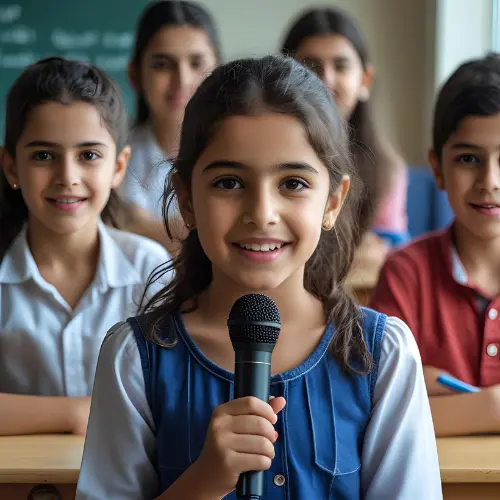
Online Spoken English Classes for Kids in Mumbai
Finding the right English speaking classes for kids in Mumbai – is not simply about choosing a course that teaches more grammar.
Children need to listen, think, respond and speak.
That is why spoken English learning should go beyond “worksheets and memorisation.” A child may know the difference between a noun and a verb – but still struggle to answer a simple question in English.
Our approach focuses on helping children use English naturally through activities such as:
- Guided conversations
- Picture based speaking
- Vocabulary activities
- Sentence building exercises
- Listening & response activities
- Storytelling
- Role play
- Pronunciation practice
- Everyday conversation practice
The objective is not to make children sound perfect. It is to help them become –– clearer, more comfortable and more confident English speakers.
Why Do Children Understand English but Hesitate to Speak?
This is one of the “most common” concerns parents have.
A child may understand “classroom instructions, cartoons, stories or conversations in English” – but still answer in Hindi, Marathi or another familiar language.
There can be several reasons.
They are afraid of making mistakes
Children often become self conscious – when they believe others may laugh at their pronunciation or grammar.
They have limited speaking practice
Listening to English is different from actively using it. A child needs regular opportunities to construct their own responses.
They translate before speaking
Some children first think in – their home language, translate the sentence mentally & then try to speak. This can make “conversations slow and uncomfortable.”
They know vocabulary but cannot use it
Knowing individual words does not automatically mean – a child can use those words in complete sentences.
They lack confidence
Sometimes the biggest barrier is not English itself. It is the fear of getting it wrong.
Spoken English classes for kids should therefore create opportunities for children – to practise without feeling that every sentence is a test.
How Can I Improve My Child's Spoken English?
Start with “regular opportunities” to speak.
Help your child talk about – their day share a book explain how a game works or answer simple open-ended questions, in English. Reading and listening can grow vocabulary. Children also need real speaking practice to use what they learn.
Structured classes can add consistency by giving children guided conversations and feedback.
What Do Children Learn in Our Spoken English Classes?
Our English speaking classes for kids focus on practical communication rather than –– memorising isolated words and rules.
Speaking with Confidence
Children learn to speak in complete thoughts instead of relying only on one word answers.
They practise introducing themselves, describing experiences, answering questions & sharing their opinions.
Expressing Ideas and Opinions
As children become more comfortable, they can move beyond simple sentences.
They can learn – to explain why they like something, describe what happened, compare ideas and share their opinions.
Vocabulary in Context
Children learn words through topics and situations they understand.
Instead of simply memorising a list of words – they learn how vocabulary can be used while talking about school, family, hobbies, feelings, activities and everyday situations.
Sentence Formation
Children gradually learn how to turn ideas into complete sentences.
They practise answering questions, describing objects, talking about experiences and expressing their thoughts.
Pronunciation and Clarity
Good spoken English is not about –– copying a particular accent.
The focus should be on –– clear pronunciation, understandable speech, appropriate stress & natural sentence rhythm.
Listening & Responding
Communication is a two way skill.
Children need to understand what someone says – before they can respond appropriately. Listening activities help them pay attention, process questions and formulate better responses.
Everyday English Conversations
Speaking becomes easier when children practise situations they may actually encounter.
Activities can include –– Introducing themselves, Talking about their day, Asking and answering questions, Talking about hobbies, Describing pictures, Sharing opinions, Narrating experiences, Participating in conversations.
Spoken English Classes for Different Age Groups
Children do not learn “communication skills in exactly the same way at every age.”
A four year old may need playful vocabulary & simple conversation activities. An older child may need more structured discussions, presentations and opinion-based speaking.
LearnifyU’s kids’ English programme is designed around age and learning level.
Ages 4–6
Younger children can build their foundation through –– Basic vocabulary, Simple sentences, Listening games, Picture-based speaking, Everyday expressions, Songs, stories and interactive activities. The goal is to make English feel familiar and enjoyable.
Ages 7–9
At this stage, children can work on –– Sentence formation, Vocabulary expansion, Storytelling, Describing experiences, Question-and-answer practice, Everyday conversations, Pronunciation and fluency
Ages 10–12
Older children can gradually develop more structured communication through –– Longer responses, Opinion sharing, Story narration, Discussions, Presentation practice, Vocabulary development, More confident conversations
Ages 13+
Teenagers often need English for more complex situations. They can work on –– Speaking with clarity, Expressing opinions, Structured conversations, Presentations, Vocabulary and fluency, Pronunciation, Confidence in academic & social situations
How Do Online Spoken English Classes for Kids Work?
Parents often ask –– whether “online English speaking classes can genuinely help children improve.”
The important question is not simply whether a class happens online or offline. It is what the child actually does during the class.
A useful online spoken English class should give children opportunities to participate rather than simply watch a teacher.
At LearnifyU, the learning experience is built around live interaction and speaking activities. Children are encouraged to – listen, respond, participate and practise English during the session.
This makes the learning experience more active than simply watching recorded lessons.
For parents in Mumbai, online classes can also remove the need to travel across the city for every session.
Are Online Spoken English Classes Effective for Children?
They can be useful when children receive consistent practice and actively participate.
A spoken English course should not promise instant fluency.
Language development takes time.
Children improve when they repeatedly get opportunities to:
Listen → Understand → Think → Speak → Receive feedback → Try again.
Parents can support this process at home – by encouraging short English conversations rather than “correcting every mistake.”
For example, instead of asking a child to memorise ten new words, parents can ask:
“What did you enjoy at school today?”
“What was the most interesting thing you learned?”
“Can you tell me what happened in the story?”
Small conversations can turn passive English knowledge into “active speaking ability.”
Who Should Join Spoken English Classes in Mumbai?
These classes may be suitable for children who ––
- Hesitate to speak English
- Understand English but rarely use it
- Struggle to form complete sentences
- Need more conversation practice
- Want to improve vocabulary
- Need help with pronunciation
- Feel nervous while speaking in front of others
- Want to communicate more confidently at school
- Come from a home where English is not regularly spoken
- Want structured support beyond school English
The goal is not to replace school education.
Instead spoken English classes can give children additional opportunities to use English –– as a communication skill.
Spoken English Classes Near Me in Mumbai
Parents searching for spoken English classes near me in Mumbai – often want something convenient, reliable and suitable for their child’s age.
Mumbai’s geography can make regular travel difficult – particularly for families balancing school, homework, activities and work schedules
LearnifyU’s online format allows children to attend spoken English sessions from home without travelling to a physical classroom.
This makes the programme accessible to families across Mumbai and surrounding areas, including locations such as ––
- Andheri
- Borivali
- Powai
- Dadar
- Bandra
- Worli
- Malad
- Thane
- Navi Mumbai
- Chembur
- Kandivali
- Kurla
- Colaba
- Ghatkopar
- Vile Parle
The important distinction is that LearnifyU provides online learning so parents should choose it for the teaching experience and convenience rather than –– expecting a local physical centre.
How Can a Child Become Fluent in English?
Fluency does not happen simply by learning –– more grammar.
Children become more comfortable speaking – when English becomes something they use regularly.
Parents can encourage fluency – by combining structured classes with everyday practice.
Try simple activities such as:
- Ask your child to describe their day in English.
- Encourage them to narrate a short story.
- Let them explain how to play a favourite game.
- Ask open ended questions instead of questions requiring only yes or no.
- Encourage them to describe pictures.
- Practise new vocabulary in conversations.
- Allow them to make mistakes without embarrassment.
The goal is to gradually move from –– knowing English to using English.
How Can Shy Children Become Better English Speakers?
A shy child should not be forced into long speeches immediately.
Confidence usually develops through smaller successful speaking experiences.
Start with questions the child can answer comfortably.
Then move towards:
- Short answers
- Complete sentences
- Descriptions
- Storytelling
- Opinions
- Group discussions
- Presentations
A supportive environment matters.
Children should feel that mistakes are part of learning – rather than something they will be punished or embarrassed for.
This is also where spoken English and broader communication skills overlap. If your child needs help with listening, expression, interaction and confidence, explore LearnifyU’s Communication Skills Classes for Kids as well.
How Can Children Improve English Pronunciation?
Pronunciation improves with listening, awareness & repeated practice.
Children can listen carefully to “how words are pronounced”, repeat them, use them in sentences & receive corrective feedback.
Parents can also encourage children to read aloud occasionally and listen to age appropriate English content.
The goal is clear and understandable speech – not forcing a particular “foreign accent.”
What Do Parents & Learners Say About Us
Posted on Google
 Udit Rana
Trustindex verifies that the original source of the review is Google.
We enrolled our nephew in LearnifyU to improve communication and public speaking skills, and the transformation has been amazing. The sessions are interactive, engaging, and designed in a way that keeps children comfortable while encouraging them to speak confidently. My nephew has become more expressive, confident while speaking in English, and much more active in school presentations and conversations. The mentors are supportive, patient, and give personal attention to every child. What we really appreciate is that the classes focus not only on speaking English but also on confidence building, stage presence, vocabulary, and overall communication skills. Highly recommended for parents looking for online public speaking and communication classes for kids.Posted on Google Mitha PouloseI enrolled my son for public speaking classes and I am truly happy with the experience. The classes have been excellent and I can see a great improvement in his speech.Posted on Google
 Rathana AroulI had enrolled my kid (6 years old)in LearnifyU for Public speaking classes. He used to be shy and finding it difficult to speak up. Thanks to Urvashi Mam's friendly approach and effective coaching, he has improved now... Improvement started showing up after 3 classes and he is progressing well...Still a long way to go..but tremendous improvement...Posted on Google
 preethiba mahendran"Your patience and dedication have helped my child feel so confident in her skills"."You bring such creativity to the subject, making it easy to learn and enjoyable".Posted on Google
 Nithu MahendranBest platform for kids to boost up their confidence, personalised curriculum so that each kids get prior importance, gamified learning and Flexible with scheduling.Posted on Google
 Vasudha RathiA very unique blend of classes - where one can learn, have fun activities and improve your speaking skills.Posted on Google
 Tulika SharmaGreat place for kids to build confidence in English! The teachers are really friendly and patient, and they make learning fun with lots of interactive activities. I’ve seen a big improvement in communication skills, especially in speaking and confidence. Overall, a very positive and encouraging environment for kids.Posted on Google
 rupali lohaniHighly experienced teachers with great technique to make kids learn English in a interesting way. My son has shown significant improvements in his English speaking and writing capabilities.
How Much Time Does It Take to Improve Spoken English?
There is no universal timeline.
A child who already understands English but lacks confidence may progress differently from a child – “who has limited vocabulary or exposure to English.”
Consistency is usually more useful than – trying to learn everything quickly.
Parents should look for gradual changes such as –
- Longer answers
- Less hesitation
- Better sentence formation
- More active vocabulary
- Greater willingness to participate
- Clearer pronunciation
- More spontaneous use of English
These small improvements often indicate that – a child is becoming more comfortable using the language.
Spoken English vs Grammar Classes: What Is the Difference?
Grammar is an important part of learning English – but grammar knowledge alone does not guarantee “confident speaking.”
A grammar-focused class may teach children rules such as:
- Tenses
- Articles
- Prepositions
- Sentence structure
- Conjunctions
A spoken English programme applies language knowledge through communication. Children practise:
- Answering questions
- Holding conversations
- Describing things
- Expressing opinions
- Telling stories
- Listening and responding
- Speaking clearly
Ideally, children should understand grammar and learn how to use it while communicating.
Why Parents Choose LearnifyU for Spoken English
Parents looking for an English speaking course for children usually want more than another academic class.
They want their child to become comfortable using English.
LearnifyU’s approach focuses on practical speaking, interactive activities and age-appropriate learning.
The wider LearnifyU programme also connects spoken English with related skills – such as “communication, storytelling, public speaking and confidence building.”
If your child needs a broader communication development pathway, you can explore ––
- Speak more often
- Participate in conversations
- Build usable vocabulary
- Form clearer sentences
- Improve pronunciation
- Listen and respond
- Express their ideas
- Develop confidence gradually

Questions Parents Often Ask About Spoken English Classes for Kids in Mumbai
There is no single perfect age. Young children – can begin developing vocabulary, listening and simple speaking skills early – while older children can work on fluency, structured conversations and confidence.
Yes. A child does not need advanced English to start learning spoken English. The programme should adapt activities to the “child’s current comfort and ability.”
Create “short, regular opportunities to speak English.” Ask your child – about “their day, encourage storytelling and use everyday situations for simple conversations.”
Understanding English is a “receptive skill.” Speaking requires active practice. Children may hesitate because – “they lack practice, worry about mistakes or need more confidence.”
It varies from “child to child.” Progress depends on the – child’s “starting level, age, exposure to English, consistency and willingness to participate.”
They can be, particularly when sessions provide a supportive environment and regular opportunities for participation rather than putting children under pressure to perform immediately.
They can support skills – such as vocabulary, sentence formation, listening, speaking and expressing ideas. These skills may also help children participate more comfortably in school conversations and presentations.
Parents Also Ask About Spoken English Classes in Mumbai
They are structured learning sessions that help children develop the ability to understand & communicate in English – through “speaking, listening, vocabulary, pronunciation & conversation practice.”
The right course depends on the – child’s “age, current English level, speaking confidence and learning needs.” Age appropriate and interactive programmes are generally more suitable – than a one size fits all approach.
Make English part of normal conversations. Ask questions about topics your child enjoys, encourage short responses and gradually increase the complexity.
No. Grammar explains how English works – while spoken English focuses on using the language to communicate. Children benefit from learning both.
Yes. Children can practise individual sounds, word pronunciation, stress, rhythm and clear speech – through guided activities and repeated speaking practice.
Regular conversation, storytelling, reading aloud, describing pictures and discussing everyday experiences – can give children additional speaking practice.
The format is less important – than the quality of teaching and the amount of meaningful participation. Parents should look for age appropriate instruction, qualified educators, interaction and regular speaking opportunities.
What Should Parents Look for Before Choosing a Spoken English Course?
Before enrolling your child – ask a few practical questions.
1. Will my child actually speak during the class?
A programme that is mostly teacher explanation may provide less speaking practice than a highly interactive class.
2. Is the programme designed for children?
Children need age-appropriate activities, examples and interaction. A programme designed primarily for adults may not suit younger learners.
3. How is progress evaluated?
Parents should understand how instructors identify improvement in speaking ability, confidence, vocabulary and communication.
4. What happens when a child makes mistakes?
Constructive correction is more useful than making children afraid of errors.
5. Is the class suitable for my child’s current level?
A beginner and a confident English speaker may require very different learning experiences.
These questions can help parents compare programmes more meaningfully – than price or proximity alone.
Help Your Child Speak English with More Confidence
Your child does not need to speak perfect English – before they begin speaking.
They need opportunities to practise.
With the right guidance, regular conversation and a supportive learning environment – children can gradually become more comfortable expressing their thoughts in English.
If you are looking for Spoken English Classes in Mumbai for your child, explore LearnifyU’s live online programme and see whether it matches your child’s age, level and communication goals.
Book a Free Demo and give your child a comfortable place to start speaking.