
Spoken English Classes for Kids in Chennai
Does your child understand English but hesitate – when it is time to speak?
Many children can follow English conversations, understand what their teacher is saying & answer questions in writing, yet become quiet – when they have to speak.
The reason is often simple – knowing English and using English are two different skills.
LearnifyU offers Spoken English Classes in Chennai for kids through –– live, interactive online learning. Children get regular opportunities to – “listen, respond, ask questions, build sentences, tell stories and express their ideas in English.”
The focus is not on memorising more grammar rules. It is on – helping children become more comfortable using English in everyday conversations, school activities and situations where “they need to express themselves.”
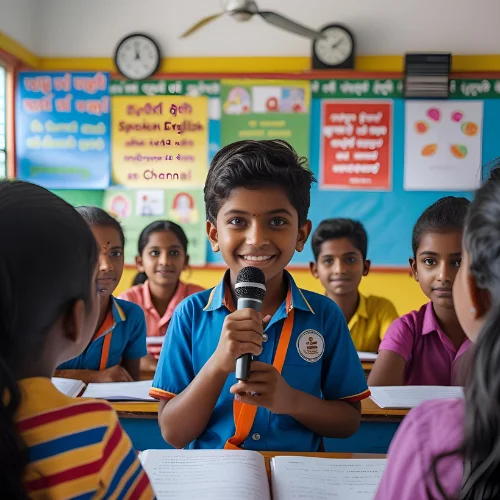
Online Spoken English Classes for Kids in Chennai
Parents searching for English speaking classes in Chennai – often want more than another academic English class.
They want their child to:
- Speak without hesitation
- Form complete sentences
- Improve everyday vocabulary
- Pronounce words more clearly
- Understand questions and respond appropriately
- Participate in classroom conversations
- Express ideas and opinions
- Become more comfortable speaking in front of others
That requires regular speaking practice.
LearnifyU’s approach combines – interactive conversations, vocabulary activities, storytelling, role play, pronunciation practice and guided speaking exercises. These are also the core elements reflected in the broader LearnifyU spoken-English programme.
The objective is simple ––
Help children move from understanding English to actually using it.
Why Do Some Children Understand English but Not Speak It?
This is one of the “biggest concerns parents have.”
A child may understand “an English cartoon, follow classroom instructions or read a simple story” – but still reply in their mother tongue.
That does not necessarily mean the child is weak in English.
They have more listening practice than speaking practice
Children often hear English regularly – but do not get enough opportunities to produce their own sentences.
They are afraid of making mistakes
Some children worry that – classmates, teachers or even family members may correct or laugh at them.
They translate before speaking
When children first think in another language and then translate into English, their responses can become slower and less natural.
They know words but cannot connect them
Vocabulary alone doesn’t create fluency. Children need to practise – putting “words together into meaningful sentences.”
They lack confidence
A child may know the answer but still avoid raising their hand because they are unsure about speaking.
This is why – effective Spoken English Classes for Kids should provide a supportive environment – where children can practise without feeling that every sentence is a test.
How Can I Improve My Child's Spoken English?
Start with “regular opportunities” to speak.
Help your child talk about – their day share a book explain how a game works or answer simple open-ended questions, in English. Reading and listening can grow vocabulary. Children also need real speaking practice to use what they learn.
Structured classes can add consistency by giving children guided conversations and feedback.
What Will Your Child Learn in Spoken English Classes?
A useful spoken English course should develop more than vocabulary.
Children need several connected skills to communicate comfortably.
Storytelling
Storytelling gives children a reason to speak for longer.
They can describe characters, explain what happened, predict what may happen next & eventually create their own stories.
This develops –– vocabulary, sequencing, imagination & verbal expression at the same time.
Expressing Ideas and Opinions
As children grow, speaking should move beyond simple answers.
They should gradually learn to say –– What they think, Why they think it, What they prefer, How they feel, What they would do, How they would solve a problem.
This becomes particularly useful for school discussions, presentations and public speaking.
Vocabulary in Context
Children learn words more effectively when they understand “how those words are used.”
Instead of simply memorising lists – vocabulary can be introduced through stories, pictures, conversations, activities and real-life situations.
Topics can include –– Family and friends, School, Food, Sports, Hobbies, Feelings, Nature, Animals, Travel, Daily routines.
Sentence Formation
Knowing individual words is not enough.
Children need to learn “how to turn an idea into a complete sentence.”
They can gradually move from:
Word → Phrase → Sentence → Longer Response → Conversation
This also allows grammar to become something children use – while communicating rather than a collection of rules they memorise.
Pronunciation and Clarity
Pronunciation matters because “clear speech makes communication easier.”
Children can practise “sounds, word pronunciation, sentence rhythm & natural speech patterns.”
The objective should be clarity – not forcing every child to copy a particular accent.
Listening and Response
Good communication begins with “listening.”
Children practise understanding –– Questions, Instructions, Short conversations, Stories, Descriptions.
They then learn “how to respond appropriately.”
Everyday English Conversations
Children practise talking about situations they already understand.
For example –– Introducing themselves, Talking about school, Discussing hobbies, Describing their day, Talking about family, Asking questions, Answering questions, Sharing experiences.
Starting with familiar situations helps children build confidence – before moving towards unfamiliar topics.
Spoken English Classes for Different Age Groups
A four year old and a fourteen year old should not learn spoken English in exactly the same way.
Age, vocabulary, attention span, confidence and existing English ability – all affect how children learn.
Ages 4–6: Building Early English Communication
Younger learners benefit from playful and highly interactive activities. Learning can include –– Everyday vocabulary, Simple expressions, Basic questions and answers, Picture-based speaking, Listening activities, Rhymes and stories, Simple conversations, Pronunciation practice The goal is to make English familiar - rather than intimidating. The focus can include basic vocabulary, simple sentences, listening, introductions & everyday expressions.
Ages 7–9: Developing Everyday Speaking
Children at this stage can begin handling longer responses. Activities can include ––Sentence formation, Vocabulary expansion, Picture description, Storytelling, Reading aloud, Question formation, Everyday conversations, Role play, Listening comprehension The aim is to help children move from one-word or short answers towards complete expression.
Ages 10–12: Building Fluency and Expression
Older children can begin discussing ideas in greater detail. They can practise –– Guided discussions, Storytelling, Presentations, Descriptive speaking, Opinion sharing, Vocabulary development, Grammar in conversation, Pronunciation and speech clarity. This can also support greater participation in school activities.
Ages 13+
Teenagers often need English for more complex situations. They may need to –– Present ideas, Take part in discussions, Express opinions, Explain their reasoning, Speak before a group, Participate in debates, Communicate confidently with teachers & peers.
For teenagers who want to develop presentation and stage skills alongside everyday English – LearnifyU’s Public Speaking Classes for Kids can complement spoken English learning.
How Do Online Spoken English Classes for Kids Work?
Online learning works best when children are active participants.
Simply watching a teacher speak for an hour – is not enough to develop spoken English.
Children need opportunities to speak.
LearnifyU’s online approach uses interactive activities where children can listen, answer questions, describe pictures, share ideas, participate in conversations and practise different speaking situations.
Interactive Speaking Practice
Children respond to questions and speaking prompts instead of simply listening to explanations.
Storytelling and Role Play
Stories and role play give children a natural reason to use English.
Guided Conversations
Some children need prompts before they can speak independently.
Guided questions help them organise their thoughts and gradually give longer responses.
Pronunciation Practice
Children can receive guidance on pronunciation & speech clarity – while using English in context.
Feedback
Constructive feedback helps children understand what they can improve – without making them afraid of making mistakes.
The current LearnifyU programme describes its classes as live and interactive and includes speaking activities as part of the learning experience.
Are Online Spoken English Classes Effective for Children?
They can be effective when children are genuinely participating.
The important question is not simply online or offline?
Instead, parents should ask:
How much does my child actually speak during the class?
A strong online English speaking programme should give children repeated opportunities to:
Listen → Understand → Respond → Speak → Receive Feedback → Try Again
This repeated practice is what helps move English from passive knowledge towards active communication.
Online classes can also be convenient for families in Chennai because “children can join from home rather than –– travelling across the city for every session.”
Who Can Benefit From Spoken English Classes in Chennai?
These classes may be useful for children who ––
- Understand English but hesitate to speak
- Speak very quietly
- Struggle to form complete sentences
- Need more English conversation practice
- Want to improve vocabulary
- Need help with pronunciation
- Feel nervous speaking in front of others
- Want to participate more actively at school
- Come from a home where English is not regularly spoken
- Want structured support beyond school English
They can also be useful for children studying in different school systems including –– CBSE, ICSE and Tamil Nadu State Board schools.
Spoken English Classes Near Me in Chennai
When parents search for spoken English classes near me in Chennai, they are usually looking for three things ––
Convenience. Relevance. Results.
But a nearby class is not automatically the right class for a child.
Parents should consider:
- Is the programme specifically designed for children?
- Is teaching age-appropriate?
- Will my child speak during every session?
- Can beginners join?
- Does the programme cover pronunciation and listening?
- How is progress communicated to parents?
- Does the teacher encourage children to participate?
LearnifyU offers online classes so children can join from home –– without travelling to a physical classroom.
Spoken English Classes for Kids in Anna Nagar
Families in Anna Nagar can access the programme online without needing to travel for every class.
Spoken English Classes for Kids in Velachery
Children in Velachery can participate in live online speaking practice from home.
Spoken English Classes for Kids in Tambaram
For families in Tambaram, online learning can remove the commute while keeping structured English practice part of the child’s routine.
Spoken English Classes for Kids Across Chennai
Because the programme is online, parents do not need to be restricted by their exact locality.
The more important question is whether the programme matches –– the child’s age, current English ability and communication needs.
How Can a Child Become Fluent in English?
Fluency develops through use.
A child does not become a confident speaker simply by memorising hundreds of words.
They need to use those words repeatedly.
Parents can encourage this at home by asking questions such as –
“What was the most interesting thing you did today?”
“Can you explain how you played that game?”
“What would you do if you were the character in this story?”
“Why do you like that book?”
These questions encourage children to think and respond rather than repeat memorised sentences.
You can also practise through:
- Story retelling
- Picture description
- Reading aloud
- Short family conversations
- Role play
- Describing daily activities
- Discussing favourite hobbies
- Sharing opinions
The goal is not to turn home into another classroom.
It is to make English a normal part of communication.
How Can Shy Children Improve Their Spoken English?
Shy children should not be pushed immediately into long speeches.
Confidence usually develops gradually.
A better progression is:
Listen → Answer → Speak → Converse → Present → Perform
A child might begin by answering a simple question.
Then they may describe a picture.
Later, they may tell a short story.
Eventually, they can participate in discussions or presentations.
This gradual progression gives children repeated experiences of speaking successfully.
LearnifyU’s broader English programme similarly emphasises moving children from participation and conversation towards more confident expression.
How Can Children Improve English Pronunciation?
Pronunciation improves with listening, awareness & repeated practice.
Children can listen carefully to “how words are pronounced”, repeat them, use them in sentences & receive corrective feedback.
Parents can also encourage children to read aloud occasionally and listen to age appropriate English content.
The goal is clear and understandable speech – not forcing a particular “foreign accent.”
What Do Parents & Learners Say About Us
Posted on Google
 Udit Rana
Trustindex verifies that the original source of the review is Google.
We enrolled our nephew in LearnifyU to improve communication and public speaking skills, and the transformation has been amazing. The sessions are interactive, engaging, and designed in a way that keeps children comfortable while encouraging them to speak confidently. My nephew has become more expressive, confident while speaking in English, and much more active in school presentations and conversations. The mentors are supportive, patient, and give personal attention to every child. What we really appreciate is that the classes focus not only on speaking English but also on confidence building, stage presence, vocabulary, and overall communication skills. Highly recommended for parents looking for online public speaking and communication classes for kids.Posted on Google Mitha PouloseI enrolled my son for public speaking classes and I am truly happy with the experience. The classes have been excellent and I can see a great improvement in his speech.Posted on Google
 Rathana AroulI had enrolled my kid (6 years old)in LearnifyU for Public speaking classes. He used to be shy and finding it difficult to speak up. Thanks to Urvashi Mam's friendly approach and effective coaching, he has improved now... Improvement started showing up after 3 classes and he is progressing well...Still a long way to go..but tremendous improvement...Posted on Google
 preethiba mahendran"Your patience and dedication have helped my child feel so confident in her skills"."You bring such creativity to the subject, making it easy to learn and enjoyable".Posted on Google
 Nithu MahendranBest platform for kids to boost up their confidence, personalised curriculum so that each kids get prior importance, gamified learning and Flexible with scheduling.Posted on Google
 Vasudha RathiA very unique blend of classes - where one can learn, have fun activities and improve your speaking skills.Posted on Google
 Tulika SharmaGreat place for kids to build confidence in English! The teachers are really friendly and patient, and they make learning fun with lots of interactive activities. I’ve seen a big improvement in communication skills, especially in speaking and confidence. Overall, a very positive and encouraging environment for kids.Posted on Google
 rupali lohaniHighly experienced teachers with great technique to make kids learn English in a interesting way. My son has shown significant improvements in his English speaking and writing capabilities.
How Much Time Does It Take to Improve Spoken English?
There is no universal timeline.
A child who already understands English but lacks confidence may progress differently from a child – “who has limited vocabulary or exposure to English.”
Consistency is usually more useful than – trying to learn everything quickly.
Parents should look for gradual changes such as –
- Longer answers
- Less hesitation
- Better sentence formation
- More active vocabulary
- Greater willingness to participate
- Clearer pronunciation
- More spontaneous use of English
These small improvements often indicate that – a child is becoming more comfortable using the language.
Spoken English vs Grammar Classes: What Is the Difference?
Grammar and spoken English are related – but they are not the same thing.
Grammar helps children understand how English is structured.
Spoken English helps children use that structure while communicating.
For example, a child may know the rule for the past tense but still struggle to answer:
“What did you do yesterday?”
A spoken English class gives the child opportunities to actually use the language.
That can include:
- Conversations
- Question-and-answer activities
- Storytelling
- Role play
- Descriptions
- Opinion sharing
- Presentations
The ideal learning experience does not ignore grammar.
It puts grammar into context.
Spoken English & Communication Skills: What's the Difference?
Spoken English is primarily about using “English comfortably & effectively.”
Communication skills are broader.
They include:
- Listening
- Speaking
- Understanding others
- Expressing ideas
- Asking questions
- Responding appropriately
- Using appropriate tone
- Reading social situations
A child may speak English well but still need help with communication skills.
If your child’s broader need is interaction, listening and expression, you can explore LearnifyU’s Communication Skills Classes for Kids alongside spoken English.
Why Parents Choose LearnifyU
Parents are not simply looking for another class on their child’s timetable.
They want to know whether their child will actually get an opportunity to speak.
LearnifyU’s broader spoken English programme focuses on practical communication – through conversation, vocabulary, sentence formation, listening, pronunciation, storytelling and role play.
The current Chennai programme also highlights live interactive sessions, speaking activities and small-group learning.
Most importantly, the programme is designed around a simple principle –
Children learn spoken English by using spoken English.
- Speak more often
- Participate in conversations
- Build usable vocabulary
- Form clearer sentences
- Improve pronunciation
- Listen and respond
- Express their ideas
- Develop confidence gradually

Questions Parents Often Ask About Spoken English Classes for Kids in Chennai
Children can begin developing spoken English – from a young age. The teaching approach should change according to the – child’s age and existing language ability.
Yes. Beginners can start with vocabulary. They can practice expressions and short questions and answers. As they get more comfortable they can move toward conversations. This step-, by-step approach helps build confidence and fluency over time.
Structured speaking practice can give children chances to use English. Structured speaking practice can help children feel more comfortable – when they express themselves.
Use – short, regular conversations. Ask open ended questions. Encourage storytelling. Discuss topics – that your child enjoys.
There is no fixed timeline. Progress depends on – age, starting level, exposure, consistency, speaking opportunities & individual confidence. Parents start to see improvement in couple of months.
They can – provided the sessions are interactive and supportive. Children should have opportunities to participate gradually rather than being pressured to perform immediately.
Yes. Pronunciation and speech clarity are important parts of “spoken communication.”
Parents Also Ask About Spoken English Classes in Chennai
Regular speaking practice combined with listening, vocabulary, sentence formation and constructive feedback – can help children become more comfortable using English.
Start with “short conversations” about familiar topics. Avoid turning every conversation into a correction exercise.
Grammar knowledge and speaking ability develop differently. A child can understand grammatical rules without having enough practice using them spontaneously.
A well rounded programme can include – vocabulary, sentence formation, listening, pronunciation, conversation, storytelling, role play & expressing ideas.
They can support skills children use at school – including “answering questions, participating in discussions, giving presentations and communicating with teachers and classmates.”
Regular listening and guided speaking practice – can help children “notice and practise sounds, word pronunciation, stress and speech clarity.”
The format is only one factor. Parents should also consider the – “teacher, curriculum, amount of speaking practice, age suitability, class interaction and how progress is monitored.”
What Should Parents Check Before Choosing an English Speaking Course?
Before enrolling your child, ask these questions –
Is the course designed for children?
Adult English courses and children’s English programmes – require different teaching approaches.
Will my child actually speak?
Ask how much of the class involves active participation.
Is the programme age appropriate?
A four year old should not receive the same learning experience as a “fourteen year old.”
Does the course cover more than grammar?
Look for vocabulary, listening, pronunciation, conversation & sentence formation.
How are beginners supported?
A child who is hesitant to speak needs a different starting point from a confident English speaker.
How is progress communicated?
Parents should understand what their child is learning and where improvement is taking place.
Is the learning environment supportive?
Children need room to make mistakes & try again.
Help Your Child Become a More Confident English Speaker
Your child does not need perfect English before joining a spoken English programme.
They need a safe place to practise.
They need someone to ask questions.
They need opportunities to answer.
They need encouragement to try again when a sentence does not come out perfectly.
That is how speaking confidence develops.
If you are looking for Spoken English Classes in Chennai for your child, LearnifyU provides live online learning focused on practical speaking, vocabulary, pronunciation, listening and communication.
Book a Free Demo and let your child take the first step towards speaking English with greater confidence.