
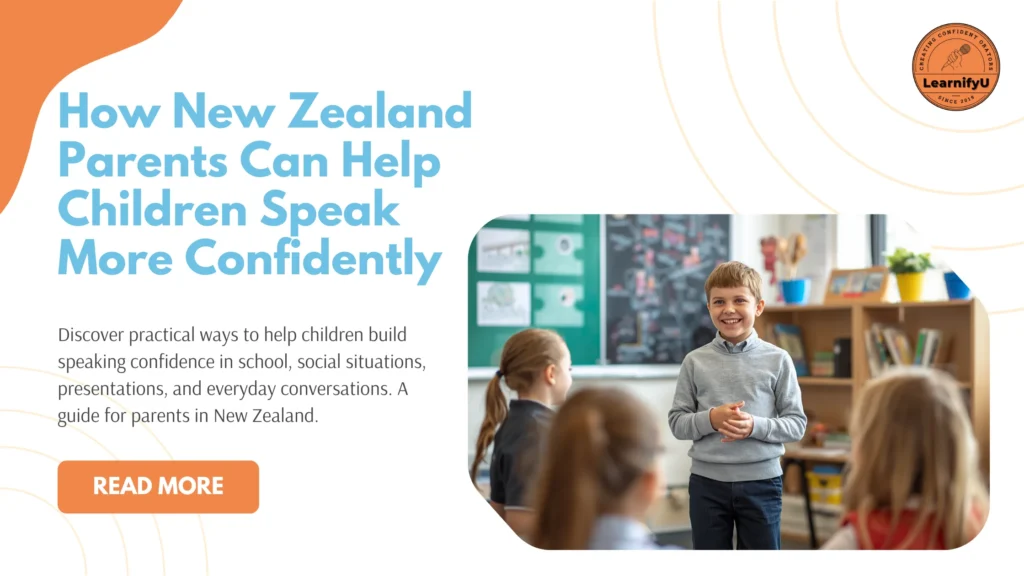
Helping Children Speak Confidently in School and Beyond in New Zealand
Every parent has seen it happen.
A child who talks freely at home suddenly becomes “quiet” – when a teacher asks a question. A child who knows the answer chooses not to “raise a hand”. During a presentation, words that were practiced many times seem difficult to say in front of classmates.
For many children, the challenge is not knowledge. The challenge is confidence in expressing what they know.
Schools today encourage participation, collaboration, presentations, and discussions. Children are expected to share ideas, explain opinions, work in groups, and communicate clearly. While academic learning remains important – the ability to speak confidently has become equally valuable.
Confidence in speaking does not appear overnight. It develops gradually through experiences, encouragement and regular opportunities to communicate.
Why Speaking Confidence Matters in School
Children who feel comfortable expressing themselves often participate – more actively in classroom activities.
When a child can communicate ideas clearly, several things begin to change:
- Classroom participation improves
- Questions are asked more freely
- Group activities become easier
- Presentations feel less intimidating
- Friendships develop more naturally
- Teachers gain a better understanding of the child’s abilities
Many parents focus heavily on grades while overlooking communication skills. However a child who can explain ideas confidently often gains advantages that extend beyond examinations.
Strong communication skills help children become active contributors rather than silent observers.
Confidence and Communication Are Not the Same Thing
A common misunderstanding is that confident children automatically become strong communicators.
In reality, many confident children struggle to organize thoughts clearly while speaking. Similarly, some children have excellent ideas but hesitate to express them publicly.
Communication confidence involves:
- Speaking clearly
- Organizing thoughts
- Listening carefully
- Responding appropriately
- Maintaining eye contact
- Speaking with a comfortable pace
These are skills that can be developed through practice.
Small Signs Parents Often Miss
Parents sometimes expect confidence issues to appear dramatically. In reality, hesitation often shows up in subtle ways.
You may notice that your child:
- Avoids answering questions in groups
- Speaks very softly around unfamiliar people
- Relies on parents to speak on their behalf
- Avoids school presentations
- Becomes nervous before speaking activities
- Struggles to start conversations
- Gives one-word answers despite knowing more
These behaviours do not necessarily indicate a lack of ability. Often, they simply indicate a lack of confidence with communication.
The Role of Schools and Home Environment
Children spend significant time both at school and at home. Because of this – confidence development works best when both environments encourage communication.
Simple opportunities can make a difference:
- Asking open ended questions
- Encouraging children to explain their opinions
- Discussing books and stories
- Sharing daily experiences
- Allowing children to speak without interruption
The goal is not perfect speaking. The goal is helping children become comfortable expressing themselves.
Why Presentation Skills Matter Earlier Than Most Parents Realise
Many parents associate presentation skills with older students or working professionals.
However, presentation opportunities often begin much earlier.
Children may be asked to:
Present projects
Participate in assemblies
Share book reviews
Explain classroom activities
Participate in competitions
Speak during group tasks
Children who receive guidance early often feel more prepared when these opportunities arise.
This is one reason many families explore structured programs such as our Online Public Speaking & Communication Classes for Kids in New Zealand – where children receive age appropriate support to build communication confidence gradually.
Building Confidence Through Practice
Confidence rarely grows through advice alone.
A child can be told “speak confidently” many times, but genuine confidence develops through repeated positive experiences.
Small wins matter.
A child answering one question in class today may feel comfortable delivering a short presentation tomorrow.
Progress often happens in stages:
- Speaking comfortably at home
- Speaking with small groups
- Participating in classroom discussions
- Presenting in front of peers
- Communicating confidently in different environments
Each stage builds on the previous one.
Communication Skills Beyond School
Communication skills continue to influence children long after school years.
As children grow, they encounter situations that require them to:
- Share ideas clearly
- Participate in interviews
- Lead projects
- Collaborate with others
- Express opinions respectfully
- Solve problems through discussion
Children who develop communication confidence early often find these situations easier to navigate later.
How Public Speaking Supports Everyday Confidence
Many people assume public speaking means standing on a stage.
For children, public speaking often begins much earlier and in much simpler ways.
Examples include:
- Introducing themselves
- Sharing thoughts in class
- Reading aloud
- Participating in discussions
- Telling stories
- Presenting school projects
These everyday speaking opportunities gradually strengthen confidence.
Key Takeaways
Every child has something valuable to say.
Sometimes they simply need the confidence to say it.
Helping children become comfortable communicators is not about – creating perfect speakers. It is about giving them –– the ability to express ideas, participate fully and approach opportunities with confidence.
The earlier children begin developing communication skills, the more naturally those skills become part of everyday life.
Whether in classrooms, friendships, presentations or future careers –– the ability to speak “confidently” remains one of the most “valuable skills” a child can develop.
FAQs - Frequently Asked Questions
Confidence usually grows through regular opportunities to –– speak, share ideas and participate in discussions. Encouraging children to –– express opinions, read aloud and take part in presentations can help them become more comfortable communicating in different situations.
Many children worry about making mistakes or being judged by others. Sometimes they know the answer –but still avoid speaking because they lack confidence. With practice and positive encouragement – this hesitation often reduces over time.
Communication skills begin developing from an early age. Children can benefit from age appropriate speaking activities as young as four or five years old. Early practice often makes classroom participation and presentations easier later.
Yes – Public speaking activities can help shy children become more comfortable expressing themselves. The goal is not to make every child an extrovert but to help them communicate clearly and confidently when needed.
Absolutely. Strong communication skills support children in interviews, group projects, leadership opportunities, social interactions as well as future careers. Learning to express thoughts clearly is a skill that – remains valuable throughout life.