
Public Speaking Classes for Middle School Students in the USA
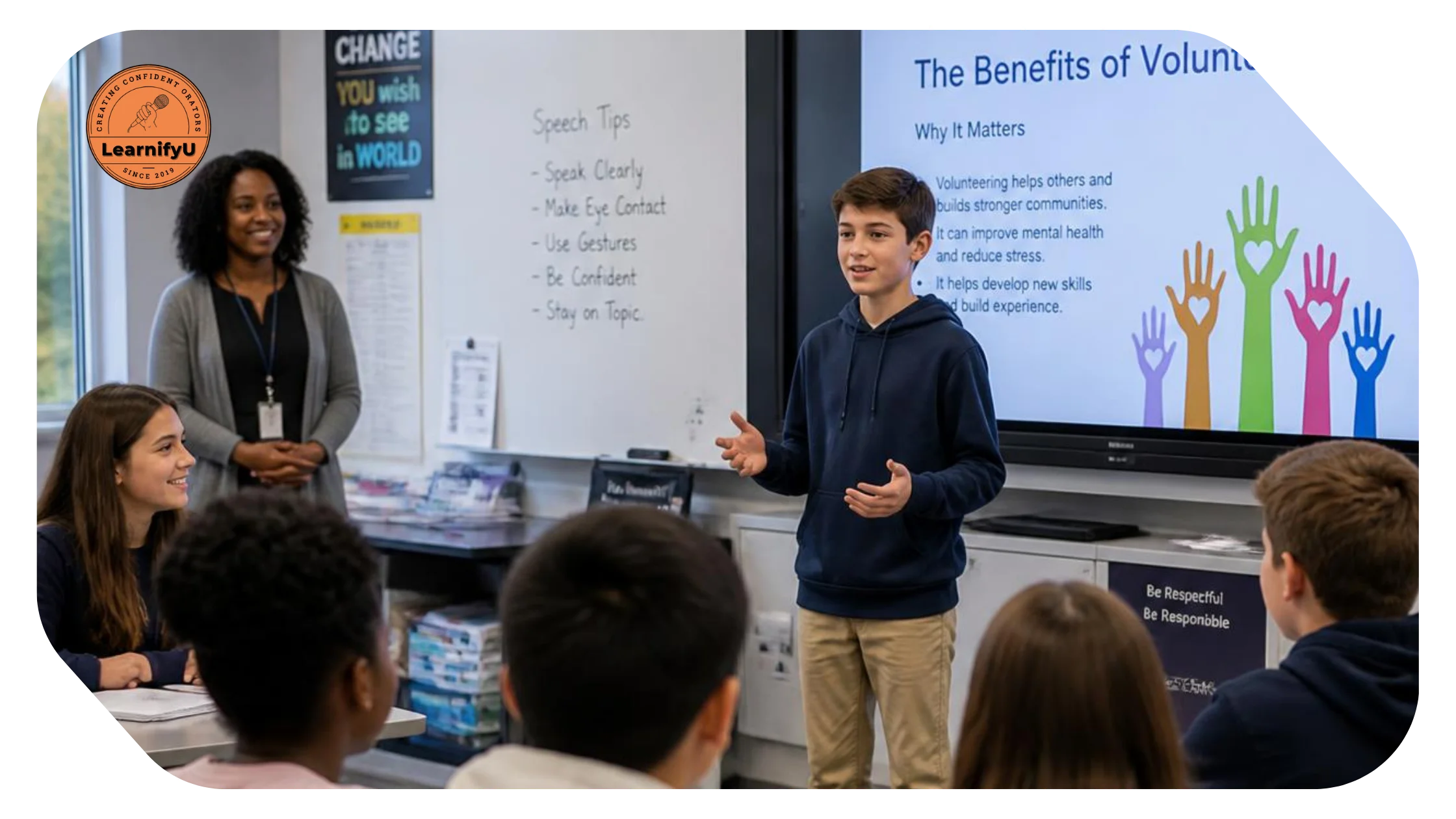
Public Speaking Classes for Middle School Students in the USA can help students become clearer, more confident, & more thoughtful communicators at a stage when classroom expectations are becoming more demanding.
Middle school is often a noticeable transition. Students are expected to – participate in discussions, explain their thinking, work on group projects, give presentations, & communicate their ideas to teachers & classmates. At the same time – many students become increasingly conscious of “how they are perceived by others.”
That combination can make speaking in front of a group feel uncomfortable.
A student may know the answer but “hesitate” to raise a hand. They may understand a topic – but struggle to organize their thoughts during a presentation. They may speak confidently with friends – but become nervous when addressing a classroom.
Public speaking practice can give students a structured way to work through these challenges.
At LearnifyU, the focus is not simply on teaching students how to deliver a speech. It is on developing practical communication skills — organizing ideas, speaking clearly, listening actively, presenting information, responding to questions, and becoming more comfortable expressing an opinion.
Why Public Speaking Matters in Middle School
Public speaking becomes more complex as students progress through school.
In elementary school, speaking activities may focus heavily on basic expression, storytelling, short presentations, & classroom participation. Middle school students can begin working with more developed ideas and more demanding speaking situations.
They may be asked to:
- 🎤 Give classroom presentations
- 💡 Explain a project
- 💬 Take part in discussions
- 📊 Present research or information
- 🗣️ Defend an opinion
- ❓ Ask and answer questions
- 🤝 Work collaboratively
- 📝 Speak without reading every sentence
- ⚡ Respond to unexpected questions
- 🧠 Explain their reasoning
These skills connect closely with broader speaking & listening expectations in school. For example – the Common Core State Standards include expectations for students to present information clearly, adapt speech to different contexts, participate in collaborative discussions, and evaluate information presented by others. Individual states and school systems may use different standards – but oral communication remains an important part of academic learning.
The earlier students become comfortable with these situations – the more opportunities they have to practise.
What Are Public Speaking Classes for Middle School Students?
Public speaking classes for middle school students are designed to help young adolescents develop the skills needed to – communicate ideas effectively in front of individuals or groups.
At this age – students can begin moving beyond basic speaking confidence toward more structured communication.
A class may include:
- 🎤 Short and longer presentations
- 📖 Storytelling
- ⚡ Impromptu – speaking
- 💭 Opinion-based speaking
- 💬 Group discussions
- 📝 Presentation planning
- 🎙️ Voice and expression exercises
- ❓ Question and answer practice
- 🎭 Role-play
- 🗣️ Convincing speaking activities
- 🔄 Feedback and self evaluation
The objective is not to make every student sound like a professional speaker.
Instead – students can learn “how to understand their audience, decide what they want to say, organize their message, and deliver it in a way that other people can follow.”
What Students Learn in the Classes
1️⃣ Organizing Ideas Before Speaking
One of the biggest challenges for students is not necessarily a lack of ideas. It is having too many ideas at once.
Public speaking activities can teach students how to identify their main point and choose supporting information.
A simple presentation structure might be:
Introduction → Main Point → Supporting Details → Conclusion
Learning this structure can make presentations easier to prepare & easier for an audience to understand.
2️⃣ Speaking Clearly and Naturally
Students can practise — pronunciation, pace, volume, pauses, emphasis, & sentence delivery.
The goal isn’t to eliminate every natural characteristic of the student’s voice. It is to help the student communicate clearly and intentionally.
A student who tends to rush can learn to pause.
A student who speaks quietly can practise appropriate projection.
A student who reads directly from notes can gradually learn to look up and connect with the audience.
3️⃣ Presentation Skills
Middle school presentations can be longer and more structured than elementary-school speaking activities.
Students may learn how to:
- Prepare speaking notes
- Introduce a topic
- Explain key information
- Use examples
- Transition between ideas
- Conclude effectively
- Respond to questions
These skills can be useful across subjects because students may encounter presentations in language arts, science, social studies, technology, & group projects.
4️⃣ Spontaneous Speaking
Not every speaking situation comes with preparation time.
A teacher may ask a student to explain an opinion. A classmate may ask a question during a presentation. A student may need to introduce themselves or contribute to an unexpected discussion.
Age-appropriate spontaneous speaking activities help students practise thinking before speaking and forming a response without relying entirely on a prepared script.
5️⃣ Persuasive Communication
Middle school is also a useful stage for introducing students to convincing speaking.
Students can learn the difference between simply stating an opinion and supporting that opinion with reasons and evidence.
For example:
Opinion:
“Students should have more time for reading.”
Stronger communication:
Students should have more time for reading – because regular reading can expose them to new vocabulary, different ideas, and different styles of writing.
The emphasis is on explaining why – not merely speaking more loudly or forcefully.
6️⃣ Listening and Responding
Strong public speakers are also good “listeners.”
Students can practise:
- Listening to a question fully
- Responding directly
- Asking follow-up questions
- Building on another student’s idea
- Disputing respectfully
- Summarizing another person’s point
This makes public speaking training relevant to everyday communication – not only formal presentations.
Public Speaking Activities
Middle school students usually benefit from activities that challenge them without making every exercise feel like a “formal speech.”
Some useful public speaking activities include:
One-Minute Opinions ⏱️
Students choose a familiar topic & explain their position for approximately one minute.
This encourages organization, clarity, and concise speaking.
Picture or Scenario Speaking 🖼️
Students are given an image or situation and asked to explain – “what they observe, what might happen next, or how they would respond?.”
This can encourage spontaneous thinking.
Mini Presentations 📊
Students prepare a short presentation around a topic they know or genuinely care about.
Personal interest can make it easier to focus on communication rather than – worrying about performance.
Convincing Speaking 🗣️
Students choose a position and provide reasons supporting it.
The activity can introduce basic concepts such as – evidence, examples, counterarguments, & audience awareness.
Question and Answer Practice❓
Students practise responding to questions after a presentation instead of treating the speech as finished the moment they reach the final sentence.
Panel Discussions 👥
Students learn to — contribute ideas, listen to others, disagree respectfully, and avoid dominating the conversation.
Impromptu Speaking⚡
Students receive a topic with limited preparation time and practise creating a simple response.
These activities can gradually make unfamiliar speaking situations feel more “manageable.”
Can Public Speaking Classes Help a Nervous Middle School Student?
They can help provide practice – but nervousness should not be treated as something that disappears overnight.
Middle school students can be particularly aware of peer reactions. A student who is perfectly comfortable speaking at home may suddenly become self conscious in front of classmates.
That does not necessarily mean the student lacks communication ability.
A supportive public speaking program can break speaking challenges into smaller steps.
For example:
Prepare privately → practise with support → speak to a small group → answer questions → deliver a longer presentation
Repeated practice can help students become familiar with the experience of being “heard & evaluated.”
The goal is not necessarily to make nervousness disappear. A more practical goal is helping students learn that they can feel nervous and still communicate effectively.
Public Speaking for Middle School Students Is More Than Stage Confidence
This is an important distinction.
Memorizing a speech can sometimes be useful — but memorization alone does not create a strong communicator.
A child who memorizes ten sentences perfectly may still struggle when a teacher asks:
“Why do you think that?”
Or when a classmate asks an unexpected question.
Or when they forget one sentence from the memorized speech.
Effective public speaking education should help children understand what they are saying, organize their thoughts, adapt to the situation, and communicate with an audience.
That is why activities involving discussion, storytelling, spontaneous responses, explanation, and questions are valuable alongside prepared presentations.
Public Speaking vs General Communication Skills
Public speaking & communication skills overlap – but they are not exactly the same.
Communication skills cover a broad range of – interactions, including listening, conversations, written communication, social interaction, and expressing ideas.
Public speaking focuses more specifically on communicating to – an audience, whether that means a classroom, small group, or larger audience.
A well designed public speaking program can therefore strengthen several communication skills at the same time.
This is particularly useful for “middle school students” because they are increasingly expected to communicate ideas rather than – simply provide short answers.
Who Can Benefit from Middle School Public Speaking Classes?
Public speaking classes are not only for students “who struggle to speak.”
They can benefit different types of learners.
Students Who Are Shy
They may need structured opportunities to practise speaking without feeling pressured to become “highly outgoing.”
Students Who Get Nervous During Presentations
Regular practice can make presentation situations more familiar.
Students Who Speak Too Quickly
They can work on — pacing, pauses, & emphasis.
Students Who Have Good Ideas – but Struggle to Explain Them
They can practise organizing thoughts before “speaking.”
Naturally Talkative Students
They can learn to – listen, stay on topic, structure their ideas, & adapt their communication to an audience.
Students Preparing for “Greater Academic Demands”
As students move toward high school, presentation, discussion, and communication expectations can become increasingly important.
For students moving into more advanced communication and leadership development later, LearnifyU also offers Public Speaking Classes for High School Students in the USA as part of the broader age-based learning pathway.
What Should Parents Look for in a Public Speaking Program?
Choosing a class is about more than finding a program with “public speaking” in its name.
Parents may want to consider:
Does the program provide actual speaking practice?
Children need opportunities to speak, not just listen to explanations about public speaking.
Is the teaching age appropriate?
Middle school students need challenges appropriate to their age and level of development.
Does the program teach communication beyond memorized speeches?
Look for activities involving discussion, spontaneous responses, presentations, storytelling, and questions.
Is feedback constructive?
Students should understand what they can improve without becoming afraid of making mistakes.
Does the program accommodate different confidence levels?
A confident student and a nervous student may need different forms of support.
Does the program encourage independent thinking?
Good public speaking is not simply repeating someone else’s words. Students should learn to develop & communicate their own “ideas.”
How LearnifyU Supports Middle School Communication Development
At LearnifyU, public speaking is approached as a skill that develops through practice.
Middle school students can work on speaking with – greater clarity, organizing their ideas, presenting information, responding to questions, and communicating with an audience.
The emphasis is on helping students become more capable communicators – while allowing their individual personalities to remain part of the process.
A successful outcome does not have to mean that – a student becomes the most outspoken person in class.
It might mean they can explain an idea without losing their train of thought.
It might mean they can answer a follow-up question without freezing.
It might mean they can present a project without reading every word from a page.
Or it might simply mean they are willing to raise their hand and contribute.
Those are meaningful steps in communication development.
FAQs About Public Speaking Classes for Middle School Students in the USA
Middle school commonly includes students around ages 11–14 – although the exact grade structure varies across U.S. school districts. Public speaking activities should be adapted to the student’s age, communication level, and learning needs rather than – relying only on age.
Yes. Middle school students increasingly encounter – presentations, group discussions, collaborative projects, classroom questions, & opportunities to explain their thinking. Public speaking practice can help them become more comfortable and organized in these situations.
They can help students practise presentation skills such as — “organizing information, preparing speaking notes, using their voice effectively, maintaining audience awareness, and responding to questions”. Students still need to follow the specific requirements of their school “assignments.”
Yes. Being shy does not mean a student cannot become a capable speaker. A supportive program can give students gradual opportunities to speak & build confidence at a “manageable pace.”
Depending on the program – students may learn presentation structure, storytelling, impromptu speaking, persuasive communication, voice modulation, body language, audience awareness, question and answer techniques, discussion skills, and how to organize ideas.
Public speaking practice can support several communication skills, including verbal expression, organization of ideas, active listening, responding to questions, presentation skills, & communicating with an audience. It is one component of broader communication development.
It can be a useful age appropriate skill. Persuasive speaking gives students practice forming an – “opinion, explaining their reasoning, using supporting examples or evidence, & considering how an audience may respond.”
Questions Parents Often Ask Before Enrolling
It can provide structured practice in organizing thoughts before speaking. Activities such as – short presentations, storytelling, opinion speaking, and question and answer exercises can give students repeated opportunities to turn ideas into clear spoken responses.
Yes. Pacing is a teachable speaking skill. Students can practise pauses, breathing, emphasis, and speaking in shorter thought groups so that their delivery becomes easier for an audience to follow.
Not necessarily. Many useful communication skills are developed through practice even when a student does not initially enjoy speaking in front of others. Finding topics and activities that match the student’s interests can make participation easier.
It may contribute to greater confidence, but results differ from child to child. Confidence tends to develop through repeated experiences, preparation, constructive feedback, and seeing that they can handle speaking situations successfully.
No. Public speaking is useful for students with many different interests. Explaining – an idea, presenting a project, participating in a discussion, asking questions, & communicating an opinion are everyday academic and social skills.
Help Your Middle School Student Become a More Confident Communicator
Middle school is an important time to move from simply speaking to learning “how to communicate with purpose.”
A student does not need to become the loudest person in the classroom. They need to know –– “how to organize an idea, express it clearly, listen to other viewpoints, respond thoughtfully, and continue communicating even when they feel nervous.”
That is the foundation of effective public speaking.
LearnifyU’s Public Speaking Classes for Middle School Students in the USA provide an opportunity for students to practise these skills through structured, age-appropriate communication activities.
Parents can also explore Public Speaking Classes for Kids in the USA to understand LearnifyU’s broader public speaking program and age-based learning approach.
Explore Other Age-Based Programs
As communication needs change with age, LearnifyU also offers programs for older students:
Public Speaking Classes for High School Students in the USA
Public Speaking & Leadership Skills for Teens in the USA
The aim is to help students build communication skills progressively — from foundational confidence to stronger presentation, persuasion, and leadership communication.