Why Debate Skills Matter for Children Beyond School Competitions
Many parents probably associate debate with competitions.
You think of your kids standing up in front of a panel of judges, speaking for a few minutes, presenting their case and trying to convince the judges that they’ve done a good job.
Debate as a competition can be fun for kids that like that sort of thing.
However, there is much more to debate than meets the eye.
Your kids don’t have to get super serious about it just to get the benefits.
Debating teaches a lot of very valuable skills to kids.
They have to structure their thoughts, really listen to what the other person is saying, question viewpoints, explain their own, and respond to others’ viewpoints.
This helps a lot outside of competitions or even just debating.
They may have to explain their reasoning elsewhere, in a discussion for a class project, for an essay, in a presentation, in an argument with a friend, or somewhere else.
Debate is a matter of practicing explanation of your own reasoning to another party who might not be immediately receptive to it.
What Do Children Actually Learn Through Debate?
A common misconception about debate is that it teaches children how to argue.
Good debate encourages children to do the opposite, and to learn that having an opinion is not enough – they need to be able to explain and defend why they hold that opinion.
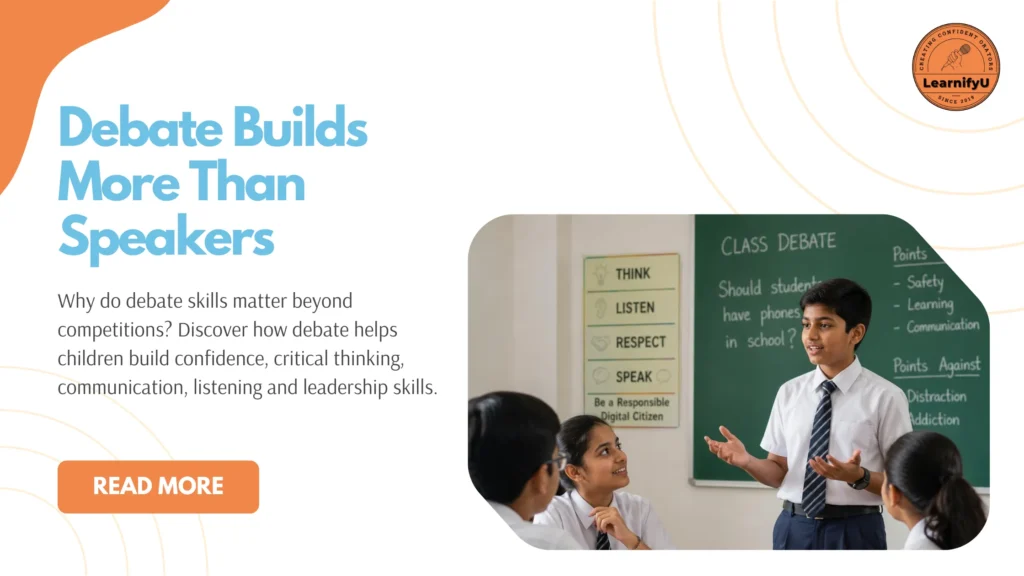
A simple prompt for debate could be like:
Should students be allowed to use mobile phones in school?
could lead a child to think about:
“Why do I think that?”
What evidence do I have?
Is there another point of view?
How could I counter them, politely?
This process helps children to develop critical thinking skills, as well as reasoning, listening, speaking, vocabulary, confidence and respect.
These are valuable communication skills for kids whether or not they ever participate in a formal debate competition.
Debate Teaches Children to Think Before They Speak
Speaking confidently is not the same as speaking fast.
In my experience one of the things that children learn from doing debates is waiting before they speak.
They can’t always use the same phrases in different arguments. They need to decide what they think, identify supporting reasons and organise those thoughts into a response.
This creates an important connection between thinking and speaking.
Instead of simply saying:
“I agree.”
the child begins to think:
“I agree because…”
That small difference matters.
It encourages children to move from giving an immediate reaction to explaining their reasoning.
Over time, this can make classroom answers, presentations and everyday conversations more meaningful.
Debate Builds Confidence Without Requiring Children to Be Naturally Outgoing
Parents often feel that debate is a sport only for naturally vocal children.
This, however, is not true.
While a naturally chatty child may have an easier time with speaking out loud, debate can actually give the more shy kids something to speak up about.
They are not being asked to “just talk.”
They have a topic.
They have a position to consider.
They have reasons to present.
They know that other people are listening.
This structure is extremely beneficial to support that idea.
A shy child, who could have once used that idea to speak his plan to the class, would become more confident in his presentation abilities if he used that strategy often.
Of course we don’t expect every introvert to turn into an outspoken preacher in our classrooms, instead, it is to ensure that the child feels his opinion holds value and he has the ability to share it effectively.
Parents who feel the need to guide their child to acquire such skills would find these Debate Classes for Kids in India offer a more structured platform to do so. This is a place where a child can learn to voice out their opinion, engage in conversations, counter opposing views and even speak up more clearly.
Debate Strengthens Critical Thinking
Critical thinking is often treated as an advanced academic skill.
Children actually practise it in everyday situations.
They ask:
“Why?”
“How do we know?”
“What if…?”
“Is that always true?”
Debate gives these questions a practical context.
A child may begin with one opinion and discover that the issue is more complicated than expected.
For example, consider the question:
“Should children have homework every day?”
A child might initially say yes because homework helps them practise.
Then they may consider another perspective: too much homework could reduce time for play, family activities or rest.
The child has now encountered something important.
An issue can have more than one reasonable perspective.
That is a valuable lesson.
Critical thinking does not mean teaching children to disagree with everything. It means helping them examine an idea before accepting or rejecting it.
Children Learn That Disagreement Doesn't Have to Become an Argument
This is most likely one of the most valuable lessons that debate can teach.
Kids disagree with siblings, friends, classmates, and adults,
and what matters is how they handle it
Debate can teach kids how to separate a person from an idea.
Instead of telling them they are wrong
they could say I see it differently because…
and instead of going head first into an arguement because they have a different opinion on something then you could ask them why they see it that way
This can help the kid later on in life because it gives them the chance to defend their belief while also respecting others beliefs
So it is important that a child learns to distinguish between a person and their ideas because as they get older they will meet many other people with many other ideas.
Listening Is Just as Important as Speaking
A debate can sometimes highlight a certain misconception about communication: that talking is half the battle, but listening to what someone else has to say is the other half.
Children need to listen to another person in order to understand what that person is talking about.
Otherwise, they could be misinterpreting a statement.
Debate teaches children to listen for:
- each others claim
- their reasoning
- examples
- weaknesses
- areas where they agree.
This will help them develop listening capabilities that are essential to communicating effectively.
A child who is able to listen effectively could possibly perform better in the classroom setting; for instance, in following directions in a class or being able to work well with others in group settings.
In essence, debating develops communication skills in children by not only allowing them to speak more, but by teaching them to develop listening skills as well.
Debate Helps Children Organise Their Ideas
Many children know what they are going to say, but they can not say it well or clearly.
Their ideas tend to flow all over the place.
They state what happened before they say why.
They forget their reason in the middle of a thought and move on to another idea.
They give the ending of their idea but forget the beginning.
Debate is a wonderful way to teach children how they might organize their thoughts in to something someone else can understand and follow along with.
A simple structure can be:
Point → Reason → Example → Conclusion
For example,
“I think school uniforms are useful. They can make students feel part of the same school community. For example, everyone follows the same basic dress expectations. So, while uniforms may have disadvantages, they can help create a sense of belonging.”
Debate Can Improve Public Speaking Skills
Public speaking is not just about making speeches on a large scale.
Children are often faced with the need to deliver speeches to others.
They may be required to
– deliver a school project,
– give an explanation,
– participate in a class,
– give a presentation,
– introduce yourself,
– share your thoughts,
– give an opinion,
– debate in an assembly.
Debating helps children with many aspects of public speaking. Children learn how to project their voices, articulate words, think through a topic logically, stay on topic, and defend against challenges to their arguments. These skills can be further developed with other Public Speaking Classes for Kids in India where children can gain confidence and skills in public speaking in more varied contexts outside of debating.
Debate Encourages Children to Ask Better Questions
Good communicators are people who have many answers to offer, but also know how to ask good questions.
If there is any debate, then the kids can ask themselves some questions, such as:
“Can you clarify yourself?”
“Do you have an example of your reasoning?”
“Is this true in all circumstances?”
“What happens when you think about this problem the other way around?”
These are stimulating questions.
Also, these questions make the children understand that asking for help is not necessarily indicative of their ignorance on a certain topic.
Sometimes, it could be even the beginning of their understanding.
This ability can easily be applied in class as well.
The child who is free enough to ask his/her teacher questions is going to participate actively in class, and not suffer in silence.
Debate and English Communication
For many Indian parents, communication skills and the ability to speak English go hand in hand.
Argument is one such context in which kids can learn to speak English, as opposed to learning vocabulary or set phrases without any purpose.
They are speaking English to express a real thought of their own.
They require the vocabulary in order to give a reason, compare two things, give an opinion without offending anyone, argue respectfully and counter the arguments of someone else.
This gives them a real purpose for using language skills.
A kid might be aware of the word ‘important’.
An argument will help him/her use it:
“I think reading is very important because…”
It’s a transition from knowing the vocabulary to actually using the vocabulary for communication.
Families that wish to improve their children’s English speaking skills could try Spoken English Classes for Kids in India.
Debate Can Introduce Children to Leadership
It is not always the case that leaders have to be the people who say a lot.
Leaders should also be good listeners, decision-makers, speakers, think about others’ perspectives and be communicative.
By debating, one practices all the skills above mentioned.
By learning how to:
- state his/her point of view properly,
- express his/her justification for having taken certain position,
- listen to alternative points of view,
- change his/her opinion,
- show respect no matter how hard he/she gets pushed,
- the child acquires skills needed for leadership directly.
That’s why this activity is beneficial even for those children who won’t ever debate.
This skill is developing an environment where the children learn to voice their opinions and at the same time to consider others around them.
Debate Doesn't Mean Teaching Children to Win Every Argument
This difference is key for parents.
The goal of debating between kids should not be:
“Show my kid how to argue better and win.”
Rather, it should be:
“Show my kid how to think, speak and argue respectfully.”
Sometimes a kid will realize their initial position was flawed.
Sometimes they will see another point of view and will decide to change their mind.
That doesn’t mean failure.
It can actually be a sign of sound reasoning.
When a kid says, “I didn’t see it that way before,” they have shown something.
They have heard.
They have reconsidered.
They have learned.
To change their mind in response to sound arguments is much more valuable than to simply win the argument.
Debate Helps Children Become More Comfortable With Different Perspectives
Children naturally see the world from their own experiences.
Debate gives them opportunities to consider situations they may not have thought about before.
A topic might require them to argue one side today and the opposite side tomorrow.
That can initially feel strange.
Why should I argue for something I don’t personally believe?
Because it teaches an important intellectual habit: understanding a viewpoint does not necessarily mean agreeing with it.
Children can learn to ask:
“Why might someone believe this?”
“What experiences could lead them to this conclusion?”
“What is reasonable about their argument?”
This develops empathy alongside critical thinking.
The Benefits Extend Beyond School
The strongest argument for debate isn’t a trophy, certificate or competition result.
It is what children carry with them afterwards.
A child who becomes comfortable organising ideas and expressing opinions may use those skills while:
- participating in university discussions
- working on team projects
- giving presentations
- interviewing for opportunities
- leading a group
- explaining a proposal
- resolving disagreements
- communicating with people from different backgrounds
Of course, debate alone cannot guarantee these outcomes.
But it gives children a structured way to practise several underlying abilities.
That practice can become valuable as the situations around them become more complex.
How Parents Can Encourage Debate Skills at Home
Parents don’t need to turn the dining table into a debating competition.
Small conversations are enough to begin.
Instead of asking only:
“How was school?”
try:
“What is one thing you agreed with today?”
“Did anyone have a different opinion from yours?”
“What would you have done differently?”
“Can you think of a reason someone might disagree with you?”
The objective isn’t to challenge every answer.
It is to encourage children to explain their thinking.
Parents can also introduce simple age-appropriate topics:
- Should children have homework every day?
- Should pets be allowed in every school?
- Is it better to read a book or watch its movie?
- Should children get pocket money?
- Should schools have longer breaks?
Let the child choose a side, explain why and then switch sides.
That last activity can be particularly interesting because it teaches children to consider another perspective rather than simply defend their first reaction.
What If My Child Is Too Young for Formal Debate?
There need not be a pre-established procedure for debate.
Young children might even be capable of developing such basic things through storytelling, “would you rather” games, sharing opinions, and debating about choices made in daily life.
Like:
“Which would you choose – a school without homework or a school without examinations? Why?”
The child takes his stand.
He explains his reasons.
Then he listens to what the other person want to say.
This is the start of logical thinking.
As they grow older, this could possibly transform into debates.
Debate Is About More Than Speaking
One of the major myths about debate is that it is mainly about speaking.
But it is not.
Effective debating involves a number of abilities:
Think. Listen. Organize. Question. Explain. Answer.
Speaking is what everyone sees.
The thinking and listening going on behind the scenes are just as crucial.
It is for this reason that debate seamlessly dovetails with an overall program for Communication Skills for Kids in India and Soft Skills for Kids in India.
Kids don’t require communication skills only when they are standing on stage.
They require them when they are interacting with other people.
FAQs - Frequently Asked Questions
The fact is that a child may not even participate in a debate competition once in life, but debate will definitely benefit the child in the organization of their thoughts, presenting their viewpoints, and listening to others’ views politely.
A shy child could find themselves very hesitant to speak in a debate. But an age-appropriate debate is something that provides the children with a subject matter as well as something to talk about, which will make things easier for them. With time and practice in such an environment, some children learn to overcome shyness.
That is right. In this manner, the child will get a chance to arrange his/her thoughts and share the reason for believing so. Due to constant practice, the child learns how to express his/her opinion out loud and not to keep it to himself/herself. There may be a lot of reasons for this behavior of the child during the classes, and this is just one of them.
Provided that it is done right. Debate among kids should be focused on critical reasoning and polite disagreement, not on winning the debate. The children learn how to debate about their reasons for disagreement, and how to listen to the opposing opinion and recognize the fact that disagreement needn’t turn into a fight.
No. The children are able to master the art of debating irrespective of the level of proficiency in the English language. What should be noted is just whether the exercises are appropriate for a particular level of communicative skills possessed by the child. Debating is the best way to use the language for expression of one’s thoughts for children mastering the English language.
There is no particular age that is perfect for all children. Children of younger ages can start building the basics through opinion-based discussions, story-telling, and “why” questions. As the children start getting comfortable talking, such discussions can evolve into more formal debates that will suit their age levels.
Indeed, debating can help develop public speaking skills. Children learn how to speak clearly, organize their thoughts, concentrate on one topic and react to various points of view. All these skills can be used while giving presentations, speeches or participating in class discussions and other similar activities at school.
Yes. It allows children to explore a subject from multiple perspectives on a consistent basis. Through debate, they develop the ability to question, reason, provide evidence, look at underlying assumptions, and understand why someone could think differently from them.
Final Thoughts
Debate competition could last a few minutes.
But the skills children develop in the course of this activity might stay with them for many years.
Having learned how to support the chosen standpoint with well-built arguments, consider someone else’s position, formulate adequate questions and voice disagreement in a polite way, children learn how to do all these things outside the debate hall as well.
Children learn how to think before speaking.
Children learn how to listen before answering.
Children learn how to change their opinion – which is considered to be an advantage, not a flaw.
And, maybe most importantly, children learn that having an alternative viewpoint doesn’t necessarily mean rejecting someone else’s opinion.
That’s why the real value of the debates shouldn’t be measured in the number of competitions the children win.
The real value lies in the ability to develop independently and to be able to voice one’s opinion and respect the contradictory views.
Thus, for parents, this kind of activity becomes much more than simply yet another extracurricular pursuit.
It becomes a helpful means of preparing children for classroom discussions and collaboration.