Why Some Children Participate More Actively in Class Than Others
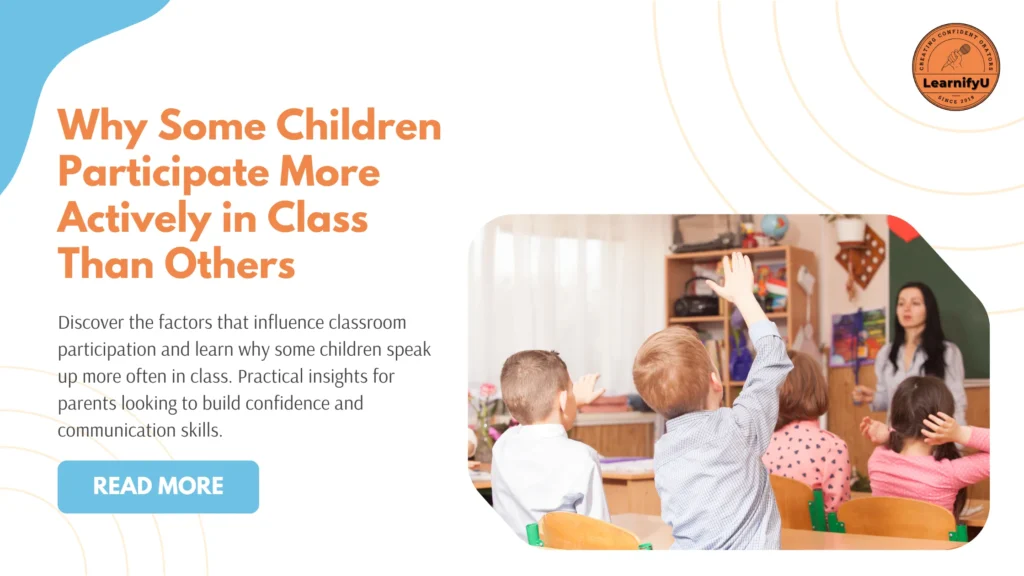
Walk into any classroom and you will notice something interesting.
When a teacher asks a question – participation rarely happens evenly across the room.
A few children are ready to answer before the question is even finished. Some raise their hands after thinking for a few moments. Others know the answer –but choose not to respond at all.
This difference is often misunderstood.
Parents sometimes assume that children who participate frequently are more knowledgeable. At the same time – quieter children may be seen as less confident, less interested or less prepared.
Classroom reality is usually more complicated than that.
Many children who rarely speak during lessons have strong ideas, good understanding and thoughtful opinions. The challenge is not always knowledge. Sometimes it is “hesitation”. Sometimes it is fear of “being wrong”. Sometimes it is difficulty “organising thoughts quickly” enough before another student answers.
Understanding why some children participate more actively than others can help parents support communication development in a practical way –– rather than simply telling a child to “speak up more.
Participation Starts Before a Child Raises a Hand
Most people think classroom participation begins the moment a child decides to answer a question.
In reality – participation starts much earlier.
Before speaking, a child is constantly processing information:
- Do I understand the question?
- Do I know the answer?
- Can I explain it clearly?
- What if I make a mistake?
- What will others think?
- Is someone else about to answer first?
These thoughts may take only a few seconds, but they influence whether a child contributes or stays silent.
Children who participate regularly often move through this internal process quickly. Other children spend more time evaluating their response and may miss the opportunity to –– contribute altogether.
The Difference Between Thinking Quickly and Thinking Deeply
Teachers often notice two different types of learners.
Some children respond immediately.
Others take longer to organise their thoughts before speaking.
The second group is sometimes mistaken for being less engaged –even though they may be processing information more deeply.
A child who pauses before speaking is not necessarily lacking confidence.
Sometimes they are simply considering multiple possibilities before choosing a response.
Parents should remember that participation styles vary naturally.
The goal is not to turn every child into the fastest responder in the classroom. The goal is to help children –– feel comfortable contributing when they have something meaningful to say.
Why Fear of Being Wrong Keeps Many Children Quiet
One of the most common participation barriers has little to do with ability.
It is the fear of being incorrect.
Many children become cautious after experiencing situations where:
- An answer was corrected publicly
- Classmates laughed at a mistake
- They struggled to explain an idea clearly
- Someone else gave a “better” answer immediately afterward
Over time, some children develop a habit of staying silent unless –– they feel completely certain.
The problem is that learning rarely works that way.
Classrooms are designed for exploration, discussion and questioning.
Children who believe they must always be correct before speaking often participate less frequently than – those who are comfortable learning through conversation.
Language Comfort Influences Participation
Participation is often linked to language confidence.
A child may understand a lesson perfectly –but still hesitate because they are unsure how to express their thoughts.
Parents frequently notice this pattern at home.
The child can explain an idea comfortably in a familiar environment –but struggles to do the same in front of classmates.
This is one reason communication development matters.
As children become more comfortable organising thoughts and expressing themselves –– classroom participation often becomes easier as well.
For families looking to strengthen verbal expression –– structured programs such as Spoken English Classes for Kids in India can help children become more comfortable sharing ideas in academic and social settings.
Reading Confidence Often Appears Before Speaking Confidence
Teachers regularly observe a connection between reading and participation.
Children who are comfortable reading aloud often become more willing to contribute verbally.
This does not happen because reading automatically creates confidence.
Instead, reading aloud provides repeated opportunities to:
- Use the voice publicly
- Practise pronunciation
- Become familiar with language patterns
- Develop sentence flow
- Reduce hesitation while speaking
Over time, this comfort with language can influence classroom participation.
This is one reason parents often explore Reading Fluency & Reading Aloud Classes for Kids in India when children hesitate during classroom speaking activities.
Participation Is Not Just About Speaking
Many people associate participation with answering questions.
Teachers see participation differently.
Participation can include:
- Asking thoughtful questions
- Sharing observations
- Contributing during group discussions
- Reading aloud
- Presenting projects
- Helping classmates
- Explaining reasoning
A child who does not raise a hand frequently may still be participating in “meaningful ways”.
The goal should be broad communication development rather than –– measuring success solely by how often a child speaks.
Why Group Activities Reveal Hidden Confidence
Some children who remain quiet during whole-class discussions become highly engaged in smaller groups.
This often surprises parents.
The difference usually comes down to audience size.
Speaking to three classmates feels very different –from speaking to thirty.
Group activities create lower-pressure opportunities for communication.
Children learn how to:
- Share opinions
- Listen to others
- Explain ideas
- Resolve disagreements
- Build confidence gradually
These skills later support larger classroom participation as well.
Many of the same abilities are developed through Soft Skills for Kids in India programs where interaction, collaboration, and communication are encouraged in structured settings.
Children Often Need Time to Find Their Voice
Parents sometimes become concerned when comparing participation levels between children.
One child seems naturally expressive.
Another appears reserved.
Development rarely follows identical timelines.
Some children become confident communicators early.
Others need more opportunities and encouragement before feeling comfortable speaking publicly.
What matters most is steady progress.
A child who contributes one idea this month and three ideas next month is –– “moving forward”.
Growth in communication often happens “gradually” rather than “dramatically”.
How Teachers Encourage Active Participation
Experienced teachers rarely force children to speak.
Instead, they create environments where participation feels safer.
Common approaches include:
- Small group discussions before whole class sharing
- Open ended questions
- Positive reinforcement
- Encouraging multiple viewpoints
- Reducing fear of mistakes
Parents can use similar approaches at home by creating conversations –– where children feel heard rather than evaluated.
Why Public Speaking Skills Influence Classroom Participation
Many parents associate public speaking with stages, competitions and formal presentations.
The foundation is much simpler.
Public speaking begins when children become comfortable expressing thoughts in front of other people.
Classroom participation is often one of the earliest forms of public speaking.
As children gain confidence speaking in small groups, discussions and presentations –– they become more willing to contribute academically.
This connection explains why many families explore Public Speaking for Kids in India as a way to strengthen communication confidence beyond – formal speech delivery.
FAQs - Frequently Asked Questions
Many children hesitate because they worry about –– making mistakes, speaking incorrectly or attracting attention. This hesitation is often related to confidence rather than academic understanding.
Yes. Participation usually improves when children become more comfortable –– expressing ideas, asking questions, and communicating in different settings.
Many teachers notice that children who read aloud regularly become more comfortable using their voice in front of others –– which can support classroom participation.
Not necessarily. Some children are naturally reflective and prefer to think before speaking. Confidence & personality are not always the same thing.
Communication skills, listening ability, reading confidence, verbal expression & comfort speaking in groups –– all contribute to active participation.
Common Questions Parents Ask
This is more common than many parents realise. Home is a familiar environment where children know – they will not be judged for making mistakes. School is different. There are teachers, classmates and social situations to navigate. A child who speaks freely at home may still feel hesitant about sharing thoughts in a larger group –– until they become more comfortable doing so.
The first step is usually building comfort with speaking –– rather than focusing on classroom performance itself. Encourage your child to –– explain ideas, tell stories, ask questions & share opinions during everyday conversations. Participation often improves when children become more confident expressing themselves in “low pressure situations”.
For many children, yes. A child may understand a lesson –but still hesitate if they are unsure how to express thoughts clearly. As language comfort improves, children often find it easier to answer questions, join discussions & contribute during classroom activities.
Many parents think public speaking is only about speeches and competitions. In reality, the skills involved –– speaking clearly, organising thoughts and expressing ideas confidently—are the same skills children use when answering questions or participating in discussions at school.
Avoid putting pressure on them to speak immediately. Instead – focus on creating opportunities for communication in everyday life. When children experience positive speaking situations regularly, fear often starts reducing naturally. Progress is usually seen in small steps rather than overnight changes.
Key Takeaway
Children participate in classrooms for different reasons and they stay silent for different reasons too.
The child who answers every question & the child who waits quietly may both be learning equally well.
The difference often lies in –– communication confidence, language comfort & willingness to express ideas publicly.
When children gradually develop stronger communication skills, participation tends to become easier. Not because they are forced to speak, but because they become more comfortable sharing what they already know.