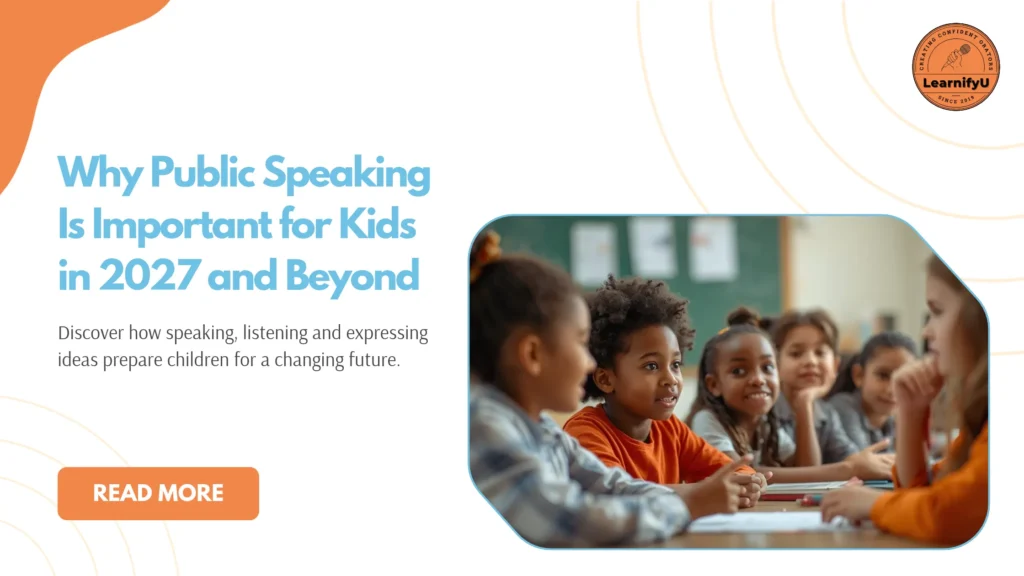
Why Public Speaking Will Be an Important Skill for Kids in 2027 and Beyond
Today’s children will experience a world that is continually evolving; information is now easily available, there are new ways of working and also Artificial Intelligence is affecting the way we learn, and share and develop our ideas.
Whilst children can benefit from AI and apply it to their learning by researching, developing ideas, creating a presentation and even refining writing, merely having knowledge does not always mean that children fully understand something. Nor does simply knowing the correct response necessarily mean that a child can then effectively convey this.
Independent thinking, expression of ideas and consideration and reflective evaluation of alternative points of view will become increasingly important for children.
This is where public speaking for kids becomes particularly valuable.
Alongside presenting in front of an audience, public speaking can help children to structure their thinking, express their views and engage in two-way communication. Children can also utilise these skills to answer queries.
As we head into and beyond 2027, such skills can be applied within educational, social and even later career settings.
Why Are Skills Like Public Speaking Becoming More Important?
Children require new skills in line with technological development.
According to The World Economic Forum’s Future of Jobs Report 2025, up to 39% of people’s skill set may change or even become redundant between 2025 and 2030. Alongside this, key transferable skills include problem solving, adaptability, leadership and social skills.
Whilst these reflect what employers are seeking within the workforce, it is not necessarily a precise depiction of children’s future requirements. Nonetheless, it does emphasise key skills which are of importance.
In addition, the OECD has recognised the importance of additional skills including problem solving, creativity and teamwork as well as communication in our AI era.
Technology should not be discounted; rather, both technological and personal skills should continue to further develop in tandem.
Children should learn how to use technology, but they should also learn how to:
- Understand information rather than simply repeat it.
- Ask questions when something is unclear.
- Explain their thoughts using their own words.
- Listen to different perspectives.
- Share opinions with reasons and examples.
- Work with others to solve problems.
- Respond thoughtfully when someone challenges an idea.
Public speaking creates opportunities – to practise many of these abilities together.
7 Reasons Public Speaking Will Matter for Kids in 2027 and Beyond
1. Children Need to Explain What They Know, Not Just Memorise Answers
Even though a child can often identify a correct answer, they may find it difficult to then justify their answer.
If a teacher asked:
‘Why is it important that we look after forests?’
A child could reply:
A child might respond:
“Because trees are important.”
Whilst this is correct, through experience a child can build upon this answer and provide further information. For example,
‘It is important that we look after forests as trees offer homes for animals. ‘In addition, trees contribute towards a good environment and aid the natural equilibrium. Many organisms are impacted if forests are not looked after.’
Whilst initially the disparity between both answers is based on the amount of detail provided, the child is also developing their skills at justifying their point of view.
Through public speaking, children can effectively structure and convey information.
Such skills are applicable to a variety of situations including class debates, showcasing work, group work and general chat.
2. Children Need to Think Independently in an AI-Driven World
AI has the ability to create, advise and explain.
Children must then analyse and assess information and recognise if they support it.
For instance a child may be creating a presentation on whether school uniforms should be enforced.
Whilst an AI could give both pro and against points on school uniforms, children need to analyse these points and come to their own view on the topic. They can then explain the reasoning behind this view.
They might say:
“I think school uniforms are useful because they reduce pressure to wear expensive clothes. However, students should also have some freedom to express themselves through their appearance.”
This is more complex than simply re-iterating information.
It necessitates that children formulate their own views and analyse multiple perspectives.
Children can then put these into practice by delivering a presentation. This promotes individual thought and means that children are not wholly reliant on pre-prepared responses.
3. Clear Communication Helps Children Participate More Actively in School
Although children learn mainly from books and are tested on this, they are also often asked to:
- Ask questions
- Discuss topics
- Describe and present their work
- Exchange views.
Whilst some children grasp the material taught in school, they can be reluctant to speak up.
Children may fear that they will get things wrong and/or find it difficult to formulate their points in a timely manner. In addition, some children can feel self-conscious about being under scrutiny.
Developing a skill for public speaking can aid in overcoming these issues.
Over time children can then:
- Give well structured, full responses
- Describe their viewpoints
- Contribute to class discussions
- Deliver presentations without reciting word-for-word.
- Answer queries put to them by both teachers and other children.
Whilst it is not the goal to create the most vocal member of a class, we want to enable children to feel more confident in voicing their views where appropriate.
4. Listening Is Just as Important as Speaking
Good communication is not just about talk.
It is also concerned with good listening skills.
Whilst taking part in a presentation, children may need to analyse a question, recognise audience responses and/or acknowledge alternative views.
For instance, in a class debate on whether children should have daily homework, some will agree with homework as it allows for further practice.
However, others may argue that excessive amounts of homework does not leave enough time for leisure and outdoor pursuits.
It is important for children to analyse both points of view and then form a response.
They are shown that good communication entails more than just speaking.
As well as listening, people must comprehend and then appropriately reply to what has been said.
Such behaviours can all enhance relationships, encourage involvement in lessons and improve group and future team working.
5. Children Learn to Respond to Unexpected Questions
Whilst using a script is a way of communicating, conversations are often less structured.
Teachers can ask further questions, people within the group can challenge your views and members of the audience can request examples and information.
Pupils can struggle if they have no other knowledge besides that which they have learnt off by heart.
Speaking in front of people can therefore offer scope for pupils to develop and demonstrate their ability to both think and reply spontaneously.
Following a brief presentation on healthy eating, for instance, a pupil could be asked:
“Can someone eat healthy food without giving up their favourite snacks?”
Pupils must then analyse this and produce a reply.
They might say:
“Yes. I think eating healthy means having a balanced diet. You can still enjoy your favourite snacks sometimes, as long as you also eat nutritious food regularly.”
Whilst there may not be a single ‘right’ answer to such a question,
it is key that individuals can stop, comprehend the question and then effectively address it.
6. Expressing Ideas Helps Children Develop Leadership Skills
Leadership can also include conveying information, active listening, motivating and guiding groups so that they can achieve common aims.
Children can display these skills in group work, in lessons and when presenting information.
Within a group, one child may devise a way of structuring information. Another can advise on suitable examples to include and a further child can suggest how to share out talking responsibilities.
Good communication is essential within a group so that individuals can convey and receive information.
Speaking in public can be an effective way of enabling children to practice communicating.
Whilst this doesn’t necessarily create a leader, it does allow children to further develop some of the communication skills which are vital in good leadership.
Those wishing to further investigate this aspect of a child’s development may also want to look at Leadership Skills for Kids in India.
7. Confidence Helps Children Express Their Ideas Across Different Situations
Children do not necessarily need to be extrovert to be able to communicate effectively.
Whilst some are happy to present information to others, others like to listen, watch and analyse before then sharing their own thoughts.
Both can enhance a child’s communication skills.
Through building up experience, a child can learn to introduce themselves, voice their opinions, present information relating to school work and respond to questions.
Such situations can in turn influence a child’s attitude towards communicating.
Self confidence is not solely linked to volume and frequency of speech.
Advancing communication skills may also be shown when a child can articulate a point without solely referring to notes, or can reply to a query without instantly seeking assistance from an adult.
It is important that we support children so that they can communicate in a manner which is true to themselves.
What Does Public Speaking Teach Children Beyond Giving Speeches?
One common misunderstanding is that – public speaking is mainly about preparing speeches for school competitions.
In reality – it can involve a much wider range of communication experiences.
Public speaking activity | Skills children practise |
Short presentations | Organising and explaining ideas |
Storytelling | Sequencing, expression and creativity |
Group discussions | Listening and sharing opinions |
Question and answer sessions | Thinking and responding |
Impromptu speaking | Organising thoughts quickly |
Persuasive speaking | Supporting opinions with reasons |
Role play activities | Expression and audience awareness |
Children can then use their communication skills in a variety of settings.
Those that have experience of presenting are often able to participate more effectively within a group.
Those that regularly answer ‘on-the-spot’ questions can often feel more confident in participating in class discussions.
Although the activities can be varied, there are links between these communication skills.
Does AI Make Public Speaking Less Important for Children?
No. AI changes how children can access and prepare information – but it does not remove the need to understand & communicate that information.
In fact – using AI responsibly requires children to develop judgement.
They need to consider questions such as:
- Is this information accurate?
- Do I understand what the answer means?
- Does this response address the actual question?
- Can I explain this idea in my own words?
- Do I agree with the conclusion? Why or why not?
The 2026 ‘Empowering Learners for the Age of AI’ guidance produced by both the OECD and the European Commission recognises the value of children comprehending, analysing and applying AI appropriately and innovatively.
Undeniably, this is significant.
Whilst children should not be led to believe that using AI is inherently bad and should therefore be avoided; they should be encouraged to utilise it in a considered manner and further hone their knowledge and skills.
A child may for instance use an AI application to aid their research for a school project.
Nevertheless, post-research there should still be opportunities for the child to:
- Articulate their knowledge on a subject area.
- Analyse and establish key ideas within that subject area.
- Provide relevant examples.
- Respond to queries.
AI can assist with preparing information. Children still need to understand, evaluate and communicate it.
How Can Parents Help Children Develop Public Speaking Skills?
Children do not have to give formal speeches to groups of people.
Normal chats can be a good way to begin.
Below are some methods which parents can use to promote their children’s speech skills at home.
Encourage Children to Explain Their Opinions
Alongside yes/no questions, encourage children to articulate how they have reached conclusions.
For example:
- Why did you enjoy this book?
- What aspects of school would you alter?
- Which character in the text made the most appropriate choice?
- What would you have done in a different way?
Allow children to consider these types of question and reflect on them.
Let Children Tell Stories
Ask children to talk about events that have occurred throughout the day.
Children can then talk about the order of events and also what happened as a result.
This assists with both ordering and articulating information.
Introduce Short Speaking Challenges
Ask your child to talk for a minute on a simple topic.
possible topics are:
- Place I like best.
- Person I look up to.
- Invention that I would produce.
- Reasons for conserving animals.
- Something that I would like to learn to do.
Content is more important than eloquence.
Make Family Discussions Interactive
Pick an easy subject and ask everybody for their views on it.
For example:
“Should children choose their own weekend activities?”
Ask the children to justify their point of view and also to hear other people’s differing views.
Ask Follow-Up Questions
Ask a further question when your child is expressing an opinion.
Why do you believe this?
Could you provide an example?
What could somebody else argue?
These are all great ways to prompt thinking and prevent children from simply providing one response.
For further, more hands-on suggestions, explore 10 Public Speaking Activities for Kids at home.
What Should Children Learn in Public Speaking Classes?
In addition to learning and rehearsing speech, a good public speaking scheme involves various communication methods.
There are many forms of communication which can be used and these should be suitable for the child’s age and self-confidence.
Depending on their stage of development, learning can include:
Speaking with clarity
They practise in order to speak in an intelligible manner, at a suitable speed and with good articulation.
Organising ideas
They are taught how to open a subject, highlight key areas and structure their thinking.
Storytelling and expression
Children convey their messages using narrative and vivid language along with relevant examples.
Presentations
They practise conveying information to an audience, rather than just reading from a source.
Discussion and opinions
They are encouraged to express their own views and to back these up. They also analyse and evaluate alternative points of view.
Question-and-answer practice
They practise both understanding and then providing considered answers to questions.
Spontaneous speaking
Children are encouraged to discuss new subjects and do not merely rely solely on pre-prepared material.
As children advance in age, so too should the range of communication methods they are exposed to.
Initially, young children may only engage in basic description, narration and reply. As they progress, they can then move on to more complex methods such as formal presentation, discussion, argument and advanced question answering.
Public Speaking Is Not the Same as Spoken English
Sometimes, parents conflate public speaking with spoken English.
Whilst there is connection between the two, they focus on differing elements of communication.
Spoken English deals with a person’s knowledge of language, word choice and sentence structure and their conversational skills.
Public speaking is used to convey messages – which can include; structuring information, expressing views and narration. An individual will also need to be perceptive about their audience and be able to answer questions.
A child may have fluent English, yet struggle to structure a presentation.
Furthermore, even if a child has good ideas, they may require further help with both their English words and sentences.
Appropriate methods of teaching a child should be based around their specific requirements for development.
For further information on how public speaking and spoken English differ, explore our page Public Speaking vs Spoken English.
How LearnifyU Helps Children Become Confident Communicators
At LearnifyU, we believe that children learn to communicate successfully through suitable activity, advice and self-expression.
LearnifyU provides a fun, interactive and real-time online ‘kids’ public speaking’ service which aims to improve children’s communication in a number of ways.
Through age appropriate speaking activities, children can practise:
- Expressing ideas in their own words.
- Organising thoughts before speaking.
- Delivering short speeches and presentations.
- Participating in discussions.
- Developing storytelling and expression.
- Listening and responding to questions.
- Speaking with greater confidence in front of others.
Whilst encouraging more successful communication, we do not aim to make all children identical or create mini-actors!
Instead, our goal is to enable children to communicate in an improved manner and still maintain their distinctive self.
To see how structured speaking can further your child’s communication, explore our LearnifyU Public Speaking for Kids Programme.
FAQs - Frequently Asked Questions
Children can develop their communication skills through public speaking. Skills such as conveying information, structuring thoughts, and both listening and answering questions are transferrable to many areas of life including school and the future.
Yes. Children can improve at communicating, reasoning and sharing and discussing views. Alongside this, digital and technology related skills are also becoming ever more important and so public speaking can therefore further develop a child’s skill set.
Yes. Although AI can be used by children to both search for and create information, they also have to be able to comprehend, analyse and discuss this information. Again, public speaking can be used to further develop such skills.
Children will analyse, structure and justify information when preparing and presenting a topic. Children can also analyse information further by debating and answering questions which allow them to explore many points of view.
Yes. Although extrovert children are often those that enjoy speaking, there are ways to encourage shy children to express themselves at their own pace.
From a young age, children can work on their speech and communication. Younger children can tell stories and describe things, and older children can then move on to giving presentations, engaging in discussion and free speech.
It can help children practise leadership-related communication behaviours, including explaining ideas, listening, contributing to discussions and responding respectfully to others. Leadership also involves other abilities that develop through different experiences.
Communication skills cover a broad range of interactions, including speaking, listening and everyday conversations. Public speaking focuses more specifically on communicating ideas to an audience. Public speaking practice can strengthen several parts of communication.
Common Questions Parents Ask
Children can participate in public speaking which then enables them to present, and justify, their knowledge. It can therefore be used to further a child’s education.
Indeed, alongside using AI, children can learn how to analyse and then develop their own views about information and in turn present their findings.
No. Competitions are optional. Children can develop speaking abilities through presentations, storytelling, discussions, classroom participation and everyday communication.
Children can often benefit from continual, encouraging opportunities to speak. Children will progress at differing rates and confidence is built up over time.
Preparing Children for a Future Where Their Ideas Matter
Technology and society will continue to evolve so too will the methods of education and our requirements.
Alongside our ability to access and even provide accurate information, our children must also be able to analyse, articulate and engage with others even if they hold differing views.
Public speaking can effectively support the development of these competencies.
Whilst it is not the aim to train all children to become professionals, we wish to enable children to confidently express themselves and their views and to engage within society.
Our knowledge is enriched when we are able to not only understand but also articulate and engage in conversation about this knowledge.
At LearnifyU, we support children in doing exactly this by providing a supportive environment in which to develop their public speaking skills alongside engaging and relevant activities.
Find out more about our Public Speaking for Kids Programme and support your child in developing vital communication skills which will support them in education, life and beyond.