
Spoken English for Kids Ages 10–12
Spoken English Classes for Kids Ages 10–12 can help children move beyond basic conversations and become clearer, more confident speakers.
By this age, many children have already studied English for several years. They may understand classroom instructions, read English books and answer questions at school, but speaking can still be a different experience. A child may know “what they want to say but struggle to explain it clearly, use repetitive words or lose confidence when speaking in front of others.”
LearnifyU’s live online classes focus on giving children regular opportunities to express ideas, explain their thoughts, participate in discussions, tell stories and speak in complete responses.
Through guided conversations, vocabulary activities, storytelling, picture based speaking, role play and presentation practice –– children gradually learn to use English more independently.
The goal is not simply to teach children more English. It is to help them –– communicate their ideas clearly and comfortably in English.
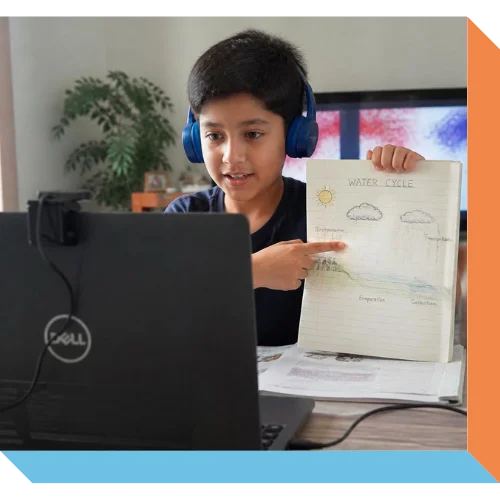
Is Your Child Ready for Spoken English Classes at Ages 10–12?
Children between 10 and 12 are ready for more structured communication – than younger learners
They can begin – discussing familiar topics, explaining their opinions, describing experiences & speaking for longer periods.
Your child may benefit from additional spoken English practice if they:
- Understand English but struggle to express their thoughts
- Speak in very short or repetitive sentences
- Have difficulty finding the right words while speaking
- Feel nervous when answering questions in front of classmates
- Avoid speaking because they are worried about making mistakes
- Want to improve their vocabulary and sentence structure
- Need more confidence for school presentations
- Want to become better at storytelling or elocution
- Can speak English but want to communicate more naturally
- Need more opportunities to practise speaking outside school
The purpose of a spoken English programme at this stage is not to – make every child speak in exactly the same way. It is to help them develop their own ability to express ideas with –– greater clarity and confidence.
What Should Children Be Able to Do at Ages 10–12?
There is no single level that every child should reach by a particular age.
However children at this stage can gradually work towards communicating more independently.
This may include being able to:
- Talk about familiar experiences in greater detail
- Describe people, places and situations
- Explain how something works
- Retell a story in their own words
- Share an opinion and give a simple reason
- Ask relevant follow up questions
- Participate in group conversations
- Speak for longer without relying heavily on prompts
- Give short presentations
- Choose more appropriate vocabulary for different situations
- Listen to others and respond meaningfully
These skills develop gradually. A child who is comfortable answering questions may still need support when asked to explain an opinion or speak for two or three minutes.
That is why speaking practice at this age should gradually become more structured and more independent.
What Will Children Learn in Spoken English Classes?
At ages 10–12, spoken English can go beyond basic vocabulary & everyday expressions.
Expressing Ideas Clearly
Children learn to explain what they think rather than simply give an answer.
For example, instead of saying they like a particular book – they can practise explaining what they liked about it and why.
This helps them develop both “language and communication skills.”
Vocabulary in Context
Children can expand their vocabulary – through conversations, stories, discussions and real life situations.
The emphasis is on understanding how words are used & encouraging children to use them while speaking.
Learning ten new words is not particularly useful “if a child never uses them.” The objective is to help vocabulary become part of their active communication.
Longer Conversations
Children can move beyond short question and answer exchanges and begin maintaining conversations for longer.
Teachers can use follow up questions and prompts to encourage children to – elaborate, explain and respond to what someone else has said.
Opinion Sharing
At this age, children are increasingly able to form & express opinions.
Speaking activities can introduce topics that are appropriate for their age & encourage them to explain their point of view.
The emphasis is not on having the “right” opinion. It is on being able to express an idea and give a reason for it.
Storytelling
Storytelling helps children organise their thoughts and communicate events in a logical sequence.
They can – describe characters, explain what happened, predict outcomes & create their own stories.
Presentation Practice
Short presentations can help children become more comfortable speaking continuously instead of answering one question at a time.
They may present a familiar topic, describe a picture, explain a process or share information – they have learned.
Pronunciation & Speech Clarity
Children can continue developing clearer pronunciation & becoming more aware of how they speak.
The goal is understandable, confident communication – rather than copying a particular accent.
How We Teach Spoken English to Ages 10–12
At this stage – children need opportunities to think as well as speak.
LearnifyU’s live online classes use structured activities that encourage children to formulate their own responses rather than simply repeat what the teacher says.
Guided Discussions
Teachers introduce age appropriate topics and ask questions - that encourage children to share their thoughts. Follow-up questions can help children move from a short response to a more complete explanation.
Storytelling and Retelling
Children listen to or work with stories and then practise describing events in their own words. They may also create alternative endings, describe characters or build their own stories around a picture.
Picture-Based Speaking
Pictures can be used as prompts for observation, description and creative thinking. Children can - explain what they see, make predictions, describe what might have happened before the picture or imagine what could happen next.
Role Play
Role play gives children an opportunity to practise English in situations - that require them to respond rather than memorise a fixed script. This can include everyday conversations, problem solving situations or imagined scenarios.
Opinion-Based Activities
Children can discuss simple topics and explain their preferences or viewpoints. These activities encourage them to use language for a purpose and listen to "what other people have to say."
Presentation Practice
Short speaking tasks help children practise organising their ideas before speaking. They learn to introduce a topic, explain their main points and bring their response to a "clear conclusion."
Teachers can guide children on vocabulary, sentence formation, pronunciation and clarity while encouraging them to keep speaking.
Feedback should help children understand how they can improve, not make them afraid of making mistakes.
Explore our main Spoken English Classes for Kids in India page to see how spoken English learning varies across age groups.
What Happens in a Typical Class?
A class for this age group – can combine conversation, language development and extended speaking practice.
Warm-up conversation
Children begin by “answering questions or discussing a familiar topic.”
Vocabulary and expression
New words, phrases or useful sentence structures – are introduced in context.
Guided speaking activity
Children describe, explain or respond to a topic using prompts from the teacher.
Storytelling, discussion or role play
An interactive activity encourages children to use English more independently.
Extended speaking
Children may give a longer response, share an opinion, retell a story or present a short topic.
Feedback and reflection
The teacher highlights strengths and areas that the child can continue working on.
The exact lesson structure can vary, but children should consistently have opportunities to –– think, speak, listen & respond.
What If My Child Can Speak English but Struggles to Express Ideas?
This is an important distinction.
A child may be able to communicate basic needs and answer everyday questions – but still find it difficult to “explain an idea in detail.”
For example, they might say:
“I liked the story.”
But when asked why, they may struggle to continue.
That does not necessarily mean they don’t know English. They may simply need more practice with explaining, describing, connecting ideas and giving reasons.
Speaking activities can gradually encourage children to move from:
Answer → Explain → Describe → Give a reason → Share an opinion → Discuss
This is one of the important shifts that can happen between basic spoken English and stronger communication.
Can Spoken English Help With School Presentations?
Yes. Regular speaking practice can give children a useful foundation for school presentations.
Presenting in front of classmates – requires more than knowing English vocabulary. Children also need to organise their thoughts, form sentences, speak clearly and continue speaking – even when they feel nervous.
Spoken English practice can help them work on these underlying skills through activities such as:
- Short presentations
- Picture descriptions
- Storytelling
- Topic-based speaking
- Opinion sharing
- Question-and-answer activities
- Group discussions
The objective is not to turn every spoken English class into a public speaking course. Instead –– presentation activities can be introduced naturally as children become ready for them.
Can Online Spoken English Classes Work for 10–12-Year-Olds?
Yes, especially when children are actively involved throughout the class.
At this age – children can participate in live conversations, discussions, storytelling, role play and presentation activities through an online format.
However, an online class should not simply involve watching a teacher explain English.
Children need opportunities to:
- Answer questions
- Ask questions
- Discuss ideas
- Describe situations
- Present short topics
- Listen to others
- Respond to what they hear
- Receive feedback
The more purposeful speaking opportunities a class provides – the more useful the online format can be.
How Can Parents Encourage Better English Speaking at Home?
Parents don’t need to conduct “formal lessons at home.”
Instead – encourage your child to explain, describe and discuss everyday things.
Ask “Why?” and “How?”
When your child gives an answer, occasionally ask them to explain "why they think that way or how they reached their conclusion."
Discuss Stories and Books
Instead of asking only what happened, "ask which character they liked, what they would have done differently or what they think might happen next."
Encourage Opinion Sharing
Ask your child about age appropriate topics & allow them to explain their point of view. The purpose isn't to test them. It is to give them a reason to speak.
Ask Them to Teach You Something
Children can explain - "how a game works, how to make something or how to do an activity they enjoy." This naturally encourages sequencing, vocabulary and longer responses.
Talk About Their Day
Go beyond “How was school?” Ask "what they enjoyed, what surprised them, what they learned or what they would change about their day."
What Progress Can Look Like at Ages 10–12
At this age, progress can become more noticeable in how children organise and express their thoughts.
You may gradually see a shift from:
Short answers → Complete responses → Explanations → Opinions → Discussions → Presentations
Progress may include your child:
- Giving more detailed answers
- Using a wider range of vocabulary
- Explaining ideas more clearly
- Asking relevant questions
- Retelling stories with better structure
- Sharing opinions with reasons
- Speaking for longer without constant prompts
- Taking Part more actively in discussions
- Feeling more comfortable giving presentations
- Becoming less worried about making mistakes
Progress will not look exactly the same for every child.
Some children may become more confident quickly – while others may need more time and encouragement. Consistent speaking opportunities are what allow these skills to develop.
Why Age Appropriate Learning Matters
The communication needs of a ten year old are different from those of a five year old.
At ages 10–12 – children can begin handling more complex conversations and expressing ideas that go beyond familiar vocabulary.
That means – spoken English activities can gradually include discussions, opinion sharing, storytelling, explanations and short presentations.
At the same time, children are still developing their confidence and communication habits. Activities should therefore remain engaging and supportive rather than becoming overly formal.
The aim is to challenge children without making them feel that every speaking activity is a test.
Why Choose LearnifyU for Ages 10–12?
LearnifyU focuses on helping children use English to express what they think, not simply reproduce what they have learned.
Our live online classes combine conversation, vocabulary, storytelling, role play, pronunciation and structured speaking activities – to give children regular opportunities to communicate.
For ages 10–12, children can work on:
- Everyday conversation
- Sentence formation
- Vocabulary in context
- Storytelling
- Picture description
- Opinion sharing
- Guided discussions
- Presentation practice
- Pronunciation and speech clarity
- Listening & responding
- Confidence while speaking
Small group learning can also give children more opportunities to participate – while teacher guidance helps them understand how they can improve.
The goal is to help children gradually move from knowing English to expressing themselves more clearly in English.
What Do Parents Say About Us
Posted on Google
 Raina Kumar
Trustindex verifies that the original source of the review is Google.
Very elaborative course structure! They really work hard and deliver what they commit.Posted on Google Indra DeviGreat experience with English speaking course for my child.Posted on Google
 Sanjay ParasharMy daughter joined LearnifyU a few weeks back. Her teacher is Ms Jerline Thomas. We can already see a remarkable difference in her communication skills. She is more open and enthusiastic to talk to people and already much more confident. The best part about the curriculum is that it focuses on spoken english and not all that bookish learning. That should be best left for the schools. Great job LearnifyU!! And Thank You!!Posted on Google
 Manorama SinghBeing a professional teacher myself, I joined LearnifyU as a student with the aim of enhancing my teaching skills and exploring new approaches to learning. My experience has been extremely positive and rewarding. LearnifyU provided structured guidance, practical strategies, and valuable insights that helped me grow both personally and professionally. The mentors were supportive, knowledgeable, and always willing to address doubts with patience. What I appreciated the most was that the learning experience was practical and directly applicable to real classroom situations. Even as an experienced teacher, I discovered new techniques, improved my communication skills, and gained fresh perspectives on student engagement. I would highly recommend LearnifyU to educators and learners who are looking for meaningful learning experiences and continuous professional growth.Posted on Google
 Udit RanaWe enrolled our nephew in LearnifyU to improve communication and public speaking skills, and the transformation has been amazing. The sessions are interactive, engaging, and designed in a way that keeps children comfortable while encouraging them to speak confidently. My nephew has become more expressive, confident while speaking in English, and much more active in school presentations and conversations. The mentors are supportive, patient, and give personal attention to every child. What we really appreciate is that the classes focus not only on speaking English but also on confidence building, stage presence, vocabulary, and overall communication skills. Highly recommended for parents looking for online public speaking and communication classes for kids.Posted on Google
 Vasudha RathiA very unique blend of classes - where one can learn, have fun activities and improve your speaking skills.
FAQs –– Spoken English for Kids Ages 10–12
A ten year old may be able to take part in conversations talk about things – that are familiar answer questions & share simple opinions. However, language ability varies considerably between children. The focus should be on helping the child communicate increasingly clearly & independently – rather than meeting a rigid checklist.
Give your child “regular opportunities” to explain, describe and discuss things. Ask about – books, school experiences, hobbies and interests. Encourage storytelling, opinion sharing and longer responses – rather than focusing only on vocabulary memorisation.
Start with situations where your child feels comfortable and gradually introduce more challenging speaking tasks. Guided conversations, storytelling, picture descriptions and short presentations – can provide opportunities to practise without immediately putting the child “under pressure.”
Regular speaking practice is important. Encourage your child to talk about – familiar subjects, retell stories, explain ideas & participate in conversations. Fluency develops gradually as children become more comfortable finding words and forming responses while speaking.
They can be. Spoken English practice can help children develop sentence formation, vocabulary, pronunciation & confidence while speaking. Activities such as storytelling, topic based speaking and short presentations – can also help them become more comfortable speaking continuously.
Spoken English focuses primarily on – “communicating comfortably in everyday situations.” Public speaking involves presenting ideas to an audience and includes additional skills – such as presentation structure, voice modulation and audience awareness. Spoken English can provide a useful foundation for developing these skills later.
Interactive online classes can provide useful speaking practice when children actively participate. Conversations, discussions, storytelling, presentations and teacher feedback can help children practise communicating – rather than simply “studying English.”
Look at how comfortably your child uses English – rather than only their school marks. If they understand English but hesitate to speak, give very short answers, struggle to explain ideas or feel nervous during speaking activities – additional guided practice may be useful.
Help Your Child Express Ideas With Confidence
At ages 10–12, knowing English is only part of the journey.
Children also need opportunities to explain – what they think, tell stories, share opinions, participate in conversations & speak in front of others.
With regular practice and supportive guidance – they can gradually become more comfortable expressing themselves in English.
Book a Free Demo Class with LearnifyU and give your child an opportunity to experience interactive spoken English learning.