
Public Speaking Classes for High School Students in the USA
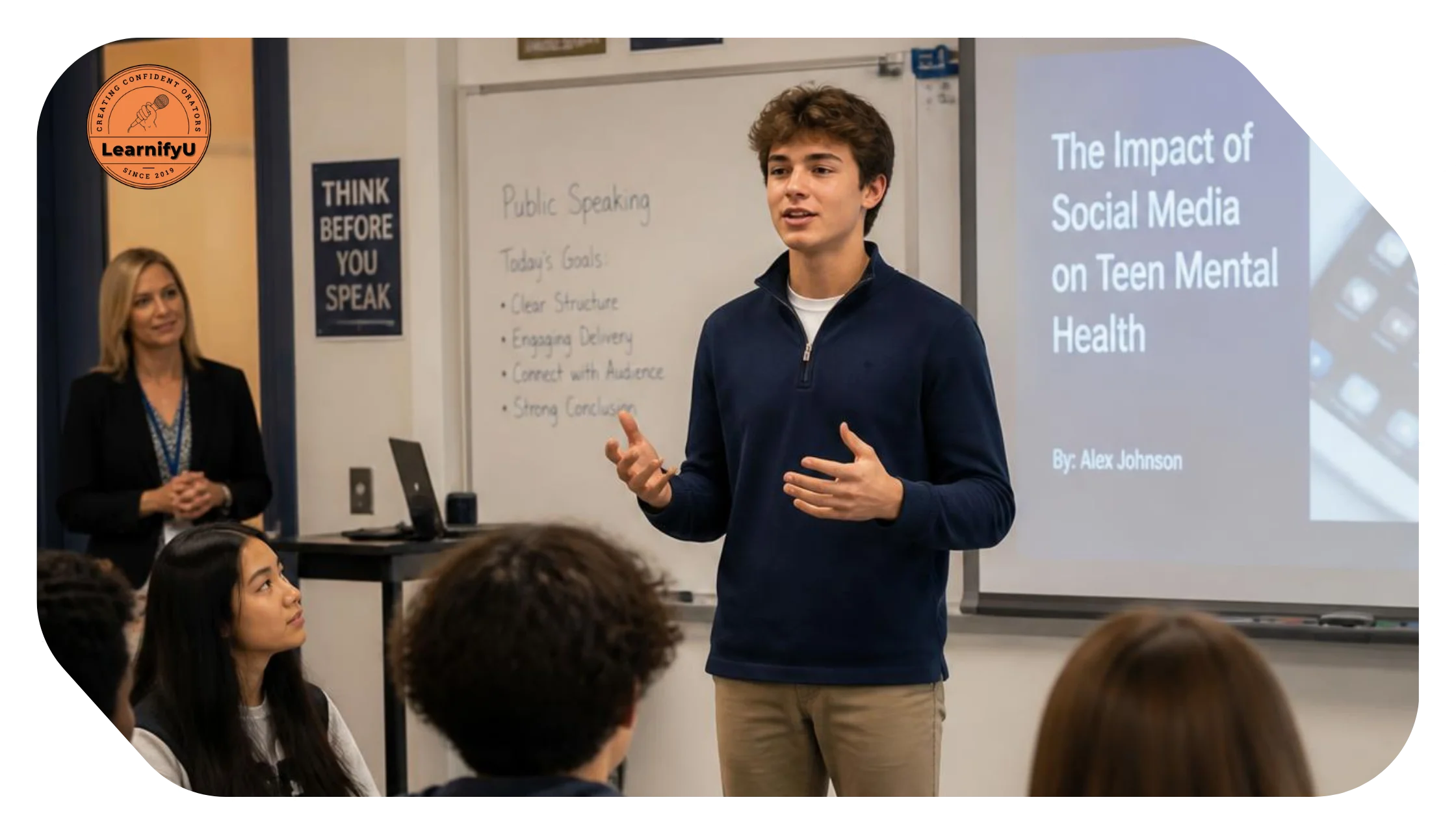
Public Speaking Classes for High School Students in the USA can help teenagers become more confident, articulate, and effective –– when communicating in classrooms, presentations, interviews, panel discussions, & other real world situations.
By high school, students are no longer only being asked to answer questions or give short presentations. They may need to –– “present research, defend an opinion, participate in discussions, explain projects, deliver speeches, work in teams, interview for opportunities, & communicate with adults.”
For some students, these situations feel natural. For others –– knowing what to say is easier than saying it in front of an audience.
Public speaking is a skill that can be developed through practice.
At LearnifyU, the focus is on helping high school students move beyond simply “speaking in front of people” & develop the ability to organize ideas, understand an audience, present information clearly, respond to questions, use their voice effectively, and communicate with greater confidence.
Why Public Speaking Matters in High School
High school is an important stage for developing communication skills – because students encounter increasingly complex academic & social situations.
A student may be expected to:
- Deliver a classroom presentation
- Explain a research project
- Participate in a seminar or group discussion
- Present a science or academic project
- Defend an opinion
- Speak persuasively
- Answer questions after a presentation
- Engage in extracurricular activities
- Interview for internships or other opportunities
- Introduce themselves confidently
- Communicate with teachers and other adults
Speaking & listening are also embedded in academic expectations. For example – “the Common Core State Standards for high school English Language Arts include presenting information and findings clearly & appropriately, adapting speech to different contexts, & participating effectively in collaborative discussions”. Standards differ across U.S. states and school systems – but the broader communication demands remain relevant.
Public speaking classes give students a space to practise these skills before they encounter “high pressure situations.”
What Are Public Speaking Classes for High School Students?
Public speaking classes for high school students are structured communication programs that help teenagers develop the ability to –– speak clearly, confidently, & purposefully before an audience.
At this stage, training can become more sophisticated than the storytelling and basic presentation activities commonly used with younger children.
Students can begin working with:
- Formal presentations
- Convincing speeches
- Spontaneous speaking
- Structured discussions
- Audience awareness
- Speech organization
- Presentation delivery
- Question-and-answer techniques
- Voice modulation
- Body language
- Interview communication
- Leadership communication
The goal is not to make every teenager sound identical.
A strong public speaker still sounds like themselves.
The purpose is to help students understand –– what they want to communicate, organize their ideas effectively, and deliver those ideas in a way an audience can understand and remember.
What Students Learn in High School Public Speaking Classes
1️⃣ How to Structure a Speech
A strong presentation usually needs more than good information.
Students can learn how to create a logical flow –
Opening → Main Message → Supporting Points → Evidence or Examples → Conclusion
This structure can be adapted for classroom presentations, persuasive speeches, academic projects, & other speaking situations.
2️⃣ Presentation Skills
High school students often have to present information rather than simply recite it.
Presentation skills can include:
- Preparing speaking notes
- Creating an effective introduction
- Explaining information logically
- Using examples
- Transitioning between points
- Maintaining audience engagement
- Concluding clearly
- Answering questions
Students can also learn to reduce their dependence on reading directly from slides or notes.
3️⃣ Persuasive Speaking
Persuasive communication becomes increasingly useful during the teenage years.
Students may need to argue a position – in class, participate in a debate, write and present an argument, or convince an audience to consider a particular viewpoint.
Public speaking practice can help students distinguish between:
“This is what I believe.”
and
“This is what I believe, and here is why.”
The second requires reasoning, supporting evidence, examples, organization, & awareness of the audience.
4️⃣ Spontaneous Speaking
Real conversations rarely follow a prepared script.
A teacher may ask an unexpected question. An interviewer may ask something the student has not rehearsed. A group discussion may suddenly move in a different direction.
Spontaneous speaking activities help students practise – thinking, organizing a response, and speaking without excessive preparation.
They do not need to have a perfect answer immediately.
They need to learn “how to think and communicate under a reasonable amount of pressure.”
5️⃣ Voice, Pace and Delivery
A well written speech can lose its impact – if it is delivered too quickly, too quietly, or without variation.
Students can practise:
- Pace
- Volume
- Pauses
- Emphasis
- Tone
- Pronunciation
- Vocal expression
The objective is not theatrical performance. It is helping the speaker make the meaning easier for the audience to follow.
6️⃣ Body Language & Audience Awareness
Students can become more conscious of – posture, facial expression, gestures, eye contact, & physical presence.
They can also learn that – communication should change depending on the audience.
Speaking to classmates is different from – speaking to a teacher, interviewer, competition judge, or professional audience.
7️⃣ Handling Questions
The end of a presentation is often not the end of the communication.
A student may be asked:
- “Why did you choose this topic?”
- “What evidence supports your argument?”
- “What would you say to someone who disagrees?”
Question and answer practice can help students listen carefully, pause before answering, and respond directly rather than – becoming dependent on memorized material.
Public Speaking Activities for High School Students
High school public speaking activities should challenge students intellectually as well as verbally.
Useful activities can include:
Persuasive Speeches 🗣️
Students choose — a topic, establish a position, develop supporting arguments, & present their case.
Impromptu Speaking⚡
Students receive a topic with limited preparation time and organize a short response.
Mock Interview 💼
Students practise – introducing themselves, answering questions, describing their strengths, & communicating professionally.
Presentation Challenges 📊
Students prepare short presentations with a defined purpose and audience.
Group Discussions 💬
Students practise — contributing ideas, listening actively, asking questions, and disagreeing respectfully.
Opinion and Evidence Exercises 📚
Students distinguish between an – unsupported opinion & a position supported by reasons, examples, or credible information.
Storytelling and Personal Speaking 📖
Personal experiences can help students practise – structure, description, reflection, & audience connection.
Question and Answer Sessions❓
Students learn to handle questions after prepared presentations without losing composure.
These activities make public speaking more practical – because they reflect situations students are likely to encounter outside a formal speech competition.
Can Public Speaking Classes Help a Nervous High School Student?
Yes, public speaking practice can help students become more comfortable with speaking situations – although it should not promise to eliminate nervousness completely.
High school students may worry about — making mistakes, forgetting their words, being judged by peers, or sounding different from other students.
These concerns can make even capable speakers hesitate.
A useful approach is progressive exposure to speaking situations.
A student might begin with:
Short response → small-group speaking → prepared presentation → impromptu response → longer presentation
The level of challenge can increase as the student becomes more comfortable.
The aim is not to tell a nervous student, “There is nothing to be afraid of.”
Instead, the student can learn:
“I know what to do when I feel nervous.”
That is a much more practical form of speaking confidence.
Public Speaking and College Readiness
High school communication skills can also support situations students may encounter as they move toward college and other post-secondary opportunities.
Students may eventually need to:
- Engage in seminars
- Present projects
- Explain research
- Work in teams
- Interview
- Introduce themselves
- Speak with professors or professionals
- Advocate for an idea
- Communicate in unfamiliar environments
Public speaking classes do not guarantee admission to a college, internship, or program.
However – developing communication skills can give students another useful tool as they prepare for environments where independent communication becomes increasingly important.
Public Speaking and Career Readiness
Communication does not stop being important after school.
Teenagers preparing for internships, part time employment, extracurricular leadership, or future careers may benefit from learning – how to introduce themselves, explain their ideas, answer questions, & communicate professionally.
For this reason, high school public speaking can extend beyond traditional speech-making.
It can become a broader form of communication training for teenagers.
Students can begin connecting their speaking skills with real situations:
“Who am I?”
“What do I know?”
“What do I think?”
“Why do I think this?”
“How can I explain it to someone else?”
These are foundational questions for “effective communication.”
Who Can Benefit from High School Public Speaking Classes?
Public speaking isn’t only for students who want to become “professional speakers.”
Students Who Fear Presentations
They can practise presentation situations in a “structured environment.”
Students Who Struggle to Organize Their Thoughts
Speech structure can help them turn multiple ideas into a “clear message.”
Students Who Speak Too Quickly
They can work on “pacing, pauses, and deliberate delivery.”
Students Who Have Strong Opinions
They can learn how to support their opinions with reasoning and evidence.
Students Who Are Already Confident
They can develop more advanced skills such as — “persuasion, audience awareness, impromptu speaking, & leadership communication.”
Students Preparing for “College and Future Opportunities”
They can practise communication situations that may become increasingly important after high school.
Students who want to continue developing communication and leadership skills can also explore LearnifyU’s “Public Speaking & Leadership Skills for Teens in the USA program.”
What Should Parents Look for in a High School Public Speaking Class?
A good program should offer more than speech memorization.
Parents can ask:
Will my teenager actually speak during the sessions?
Practice is essential. A student cannot develop public speaking skills by only watching demonstrations.
Does the program cover different types of speaking?
Look for a combination of prepared presentations, impromptu speaking, discussion, persuasive communication, & question and answer practice.
Is feedback constructive?
Teenagers need clear feedback about what to improve without feeling personally criticized.
Does the program encourage independent thinking?
Students should have opportunities to develop their own ideas & communicate them rather than – simply repeating prepared material.
Is the content appropriate for high school students?
Teenagers should be challenged without being treated like either “young children or corporate professionals.”
Does the program connect speaking skills with real situations?
Presentation skills, interviews, discussions, and everyday communication can all provide useful contexts.
How LearnifyU Approaches Public Speaking for High School Students
LearnifyU approaches public speaking as a skill that can be developed through structured practice, feedback, and increasingly challenging communication situations.
For high school students, that can mean moving from basic confidence toward more purposeful speaking.
A student may learn to:
- Structure a presentation
- Express an opinion with supporting reasons
- Speak without depending entirely on a script
- Respond to questions
- Use voice and body language intentionally
- Adapt communication to an audience
- Participate more effectively in discussions
- Approach interviews with greater preparation
The goal is not perfection.
A strong outcome may simply be a student who can – stand before a group, collect their thoughts, communicate their message, and recover when something does not go exactly as planned.
That is a practical communication skill.
FAQs About Public Speaking Classes for High School Students in the USA
High school generally covers students around ages 14–18 in the USA, although grade structures vary. Public speaking instruction can be adapted according to the student’s age, experience, confidence, & communication needs.
Students may learn –– speech organization, presentation skills, persuasive speaking, impromptu speaking, audience awareness, voice modulation, body language, question and answer techniques, discussion skills, and interview communication.
They can give students structured practice with — organizing ideas, preparing presentations, delivering information clearly, using notes effectively, & answering audience questions. Students should still follow the “specific requirements” of their school or teacher.
Public speaking classes can help students practise transferable skills such as — introducing themselves, organizing responses, speaking clearly, listening to questions, and communicating confidently. They should not be viewed as a guarantee of success in a particular college interview.
Yes. A shy teenager does not need to become highly extroverted to become a capable speaker. Gradual practice can help students –– become more comfortable expressing themselves in front of others.
Public speaking can contribute to leadership communication by helping students explain ideas, listen to others, persuade responsibly, participate in discussions, and communicate with groups. Leadership itself involves additional skills beyond speaking.
Questions Parents Often Ask Before Enrolling
It can be. Informal conversation & formal presentation require different communication behaviors. A student may feel comfortable with familiar peers – but become self conscious when attention is focused on them. Structured presentation practice can help bridge that gap.
Memorization can be useful for certain parts of a presentation – but relying on it entirely can make it harder to respond naturally when something changes. Students should ideally understand their message well enough to communicate it without depending on every word being memorized.
It can provide practice in organizing thoughts before and during speaking. Activities that require students to explain reasoning, compare viewpoints, answer questions, and build arguments can encourage more structured verbal thinking.
Yes. Effective public speaking includes listening. Question and answer sessions, discussions, peer feedback, & collaborative activities can help students practise responding to what other people actually say.
No. Competition speaking is only one application. Presentation, discussion, interviews, group projects, classroom participation, & everyday communication can all benefit from stronger speaking skills.
Help Your High School Student Speak With Greater Confidence
LearnifyU’s Public Speaking Classes for High School Students in the USA are designed to help teenagers develop practical presentation, communication, persuasive speaking, and confidence-building skills in an age-appropriate learning environment.
For students at an earlier stage, explore Public Speaking Classes for Middle School Students in the USA. For teenagers who want to combine communication development with leadership skills, explore Public Speaking & Leadership Skills for Teens in the USA.
The objective is simple: help students become better prepared to express their ideas clearly, listen thoughtfully, and communicate with confidence — at school and in the situations that come after it.