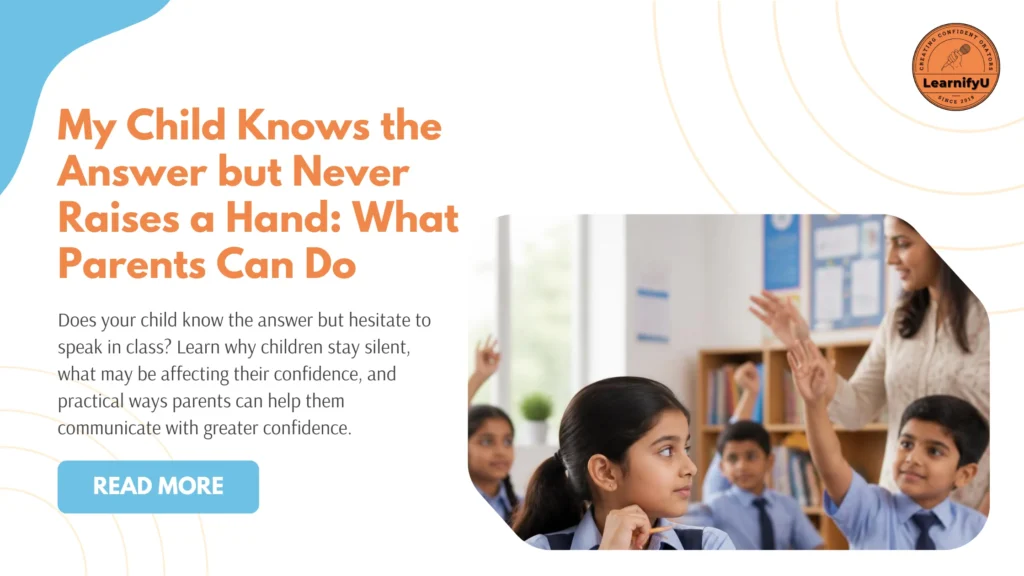
My Child Knows the Answer but Never Raises a Hand
If you’ve ever attended a parent-teacher meeting –– you’ve probably heard something similar to this:
“Your child understands the lessons well, but rarely participates in class.”
For many parents – that single sentence raises more questions than answers.
At home –– your child solves maths problems without help, explains how a volcano erupts, remembers every dinosaur’s name or tells you interesting facts they learned in school. Yet the same child sits quietly in class when the teacher asks a question.
It’s confusing because the knowledge is clearly there.
So why doesn’t your child speak?
Many parents immediately assume the child is shy. Others think it is a confidence issue. Some even worry that their child isn’t interested in learning.
In reality, speaking in a classroom depends on much more than “knowing the correct answer”.
Children often think about –– whether they’ll make a mistake, whether classmates will laugh, whether their pronunciation sounds right or whether someone else will answer before they do.
Understanding these reasons helps parents respond with patience – instead of pressure.
Knowing Something and Saying It Are Different Skills
Schools measure learning in different ways. Written tests show one side of a child’s understanding – while classroom participation reveals another.
It is common for two children with similar academic ability to behave very differently during lessons.
One raises a hand almost every time.
The other quietly thinks of the answer but chooses not to speak.
The difference is rarely intelligence.
Teachers often notice children whispering the correct answer to a friend after someone else has already responded. Some children confidently explain the entire lesson during lunch break even though –– they stayed silent throughout the class.
This tells us something important.
The challenge isn’t always learning.
Quite often, it’s expressing what they know in front of other people.
Why Some Children Stay Quiet in Class
Parents search for questions like:
- My child doesn’t speak in class.
- My child is shy.
- My child has stage fear.
- How can I improve my child’s confidence?
- My child knows the answer but never raises a hand.
Although these concerns sound different, they often have similar causes.
Fear of Getting It Wrong
Some children would rather stay silent than risk giving an incorrect answer.
Maybe they once answered confidently and realised they misunderstood the question.
Maybe someone giggled.
Maybe they simply felt embarrassed.
Adults often move on from these moments quickly.
Children sometimes remember them for months.
They Need More Time to Think
Every child processes information differently.
Some children answer almost immediately.
Others like to think before speaking.
By the time they’ve organised their thoughts, another student has already answered.
After experiencing this repeatedly – many children stop trying to participate because they feel they’re always too late.
Speaking Feels Like Being on Stage
Adults often see classroom participation and public speaking as different situations.
Children rarely do.
Imagine thirty classmates looking in your direction while you answer a question.
For many children, that feels surprisingly similar to standing on a stage.
This is one reason parents searching for “my child has stage fear” often notice the same hesitation during ordinary classroom discussions.
As children gradually become comfortable speaking in front of small groups, classroom participation usually becomes easier too. That’s why many parents later choose structured Public Speaking for Kids in India programmes –– where children practise expressing ideas without worrying about being judged for every answer.
"My Child Understands English but Doesn't Speak"
This is another concern many parents share.
Children may watch English cartoons, complete English homework and understand classroom instructions perfectly.
Yet when someone asks them a question in English – they respond in Hindi or remain silent.
This doesn’t always mean they lack language skills.
More often, they lack confidence in using those skills.
Understanding a language happens quietly.
Speaking requires children to think, choose words, arrange sentences and pronounce them clearly—all within a few seconds.
That feels like a lot when they already worry about making mistakes.
Parents often notice that children become more willing to speak when conversations at home feel relaxed –– instead of corrective.
Children who receive regular opportunities to speak naturally also tend to become more comfortable using English outside the home. Many families support this journey through –– Spoken English Classes for Kids in India, where the emphasis is on communication rather than memorising perfect grammar.
Small Experiences Build Big Confidence
Confidence rarely appears overnight.
Instead, it grows through ordinary moments.
A child reads one paragraph aloud.
Answers one classroom question.
Introduces themselves to a new teacher.
Shares an opinion during a discussion.
None of these experiences seem remarkable on their own.
Together, they slowly change how children think about speaking.
Instead of wondering,
“What if I make a mistake?”
they begin thinking,
“I’ve done this before.”
That shift is where confidence begins.
Reading Aloud Often Changes More Than Reading
Many parents think reading aloud is only useful for – improving pronunciation.
Teachers often notice something else.
Children who regularly read aloud become familiar with hearing their own voice.
They learn where to pause, how loudly to speak and how sentences flow naturally.
More importantly – speaking in front of others starts feeling normal.
This is one reason guided Reading Fluency & Reading Aloud Classes for Kids in India often support communication development beyond reading itself.
Children aren’t only improving fluency.
They’re becoming comfortable expressing themselves.
What Parents Can Do at Home
Parents don’t need expensive resources to help children become –– more confident speakers.
Small daily habits often make a bigger difference than occasional motivational talks.
Instead of asking questions that invite one word answers –– try questions that encourage conversation.
Instead of:
“How was school?”
try asking:
- “What made you laugh today?”
- “What was the most interesting thing your teacher explained?”
- “If you were the teacher for one day – what would you do differently?”
Questions like these help children organise thoughts before speaking.
Another simple habit is allowing children to answer questions themselves.
Whether someone asks theirname,favourite subject or what they would like to eat –– resist the temptation to answer for them.
Those few extra seconds help children realise their voice matters.
Reading together also creates opportunities for natural conversation. After finishing a story –– ask your child what they liked about the ending or whether they would change anything about the characters. These discussions gradually strengthen thinking as well as speaking. Activities such as Storytelling Classes for Kids in India build on the same idea by helping children organise their thoughts before sharing them with others.
Parents should also remember that communication isn’t about speaking. Listening carefully, asking thoughtful questions and responding with confidence –– are equally important. These abilities develop together and form the foundation of broader Soft Skills for Kids in India that children use throughout school and later in life.
When Should Parents Consider Additional Support?
Every child develops communication skills at a different pace. Some naturally enjoy sharing ideas while others need more time before –– they feel comfortable speaking in front of people.
A quieter personality is not something that needs to be –– “fixed.” However, there are situations where additional support can be helpful.
You may want to pay closer attention if your child:
- Regularly avoids answering questions in class despite knowing the answers.
- Refuses to participate in presentations or reading activities.
- Becomes anxious when asked to introduce themselves.
- Understands English well but avoids speaking it.
- Starts believing they are “not good at speaking.”
- Lets fear stop them from expressing ideas they genuinely want to share.
The earlier children receive opportunities to practise speaking in a supportive environment, –– the easier it often becomes to replace hesitation with confidence.
Every Child Deserves to Be Heard
Not every child is naturally expressive.
Some children think quietly before they speak.
Some observe first and participate later.
Others need a little encouragement before they begin sharing their thoughts.
There is nothing wrong with any of these personalities.
The concern begins only –– when hesitation prevents children from participating, asking questions or expressing what they already know.
Parents often focus on improving confidence.
In reality, confidence is usually the outcome, and not the starting point.
Children become confident because they experience success.
They answer one question.
They complete one presentation.
They read one page aloud.
They tell one story.
Each experience quietly teaches them,
“I can do this.”
Over time, those small moments shape the way children see themselves.
A child who once avoided raising a hand may gradually begin “volunteering answers”.
A child who hesitated to speak in English may begin participating in conversations without “overthinking” every sentence.
These changes rarely happen overnight –– but they do happen with regular opportunities to communicate.
At LearnifyU, we believe communication is not about creating the loudest speaker in the room. It is about helping every child feel comfortable expressing ideas, asking questions & participating with confidence –– whether in a classroom, during a presentation or in everyday conversations.
FAQs - Frequently Asked Questions
Not necessarily. Many children understand their lessons well but hesitate to speak because –– they worry about making mistakes or attracting attention. Rather than assuming a lack of confidence – observe whether the same hesitation appears in other situations too. If it begins affecting participation regularly, gentle practice and encouragement can help.
Yes. Confidence is not a fixed personality trait. Most children become more comfortable speaking when they regularly experience situations –– where their ideas are heard without criticism. The goal isn’t to change who they are but to help them feel more comfortable expressing themselves.
Home feels familiar and predictable. A classroom is different. Children may worry about classmates’ reactions – giving the wrong answer or speaking in front of a larger group. This change in behaviour is quite common and often improves with gradual exposure to speaking opportunities.
Reading aloud helps children hear their own voice, improve sentence flow and become more comfortable speaking –– in front of others. While it isn’t the only activity that develops communication skills –– it is often an effective starting point.
Absolutely. Children who communicate clearly often find it –– easier to make friends, participate in group activities, explain their ideas, handle interviews and adapt to new situations. These skills continue to benefit them long after school years.
PAA – People Also Ask
Create regular opportunities for your child to –– express opinions at home, encourage independent conversations and appreciate the effort to participate rather than expecting perfect answers. Confidence usually develops through repeated positive experiences.
Some children worry about making mistakes –while others feel uncomfortable being the centre of attention. A single embarrassing experience can also make children reluctant to participate. Understanding the reason behind the hesitation is the –– first step towards helping them.
Yes. Many children develop listening and reading skills before they feel comfortable speaking. Speaking requires –– children to think quickly, choose words and express ideas at the same time. Regular conversation and patient encouragement usually help them become more confident.
It often does. Public speaking activities allow children to organise their thoughts, express opinions and become familiar with speaking in front of others. As their comfort level increases –– many children begin participating more actively during everyday classroom discussions as well.
Communication skills begin developing from early childhood. Children as young as four or five years old benefit from age-appropriate activities that –– encourage conversation, storytelling, reading aloud and expressing opinions. Starting early allows these habits to develop naturally over time.
Key Takeaway
Knowing the right answer and feeling confident enough to say it are two different skills. If your child understands lessons but stays quiet in class, the issue may not be knowledge—it may be hesitation, fear of making mistakes, or a lack of speaking confidence.
With regular opportunities to express ideas, supportive encouragement, and consistent practice, children gradually become more comfortable using their voice.
Building communication skills early helps them participate more confidently not only in the classroom, but also in presentations, friendships, interviews, and everyday life.