How Communication Skills Help Children Succeed in Canadian Classrooms
A teacher asks a question.
Five children immediately raise their hands.
Several others know the answer too –but remain silent.
This scene plays out every day in schools across Canada.
When parents think about academic success – they often focus on reading, mathematics, science, and test results. Those subjects matter. Yet there is another skill quietly influencing classroom experiences every single day.
Communication.
A child may understand a lesson perfectly but struggle to explain an idea. Another child may have strong opinions –but hesitate to share them in front of classmates. Some students avoid asking questions even when – they are confused because speaking up feels uncomfortable.
Communication skills affect far more than conversations. They influence – participation, confidence, collaboration and learning itself.
Canadian Classrooms Are Built Around Participation
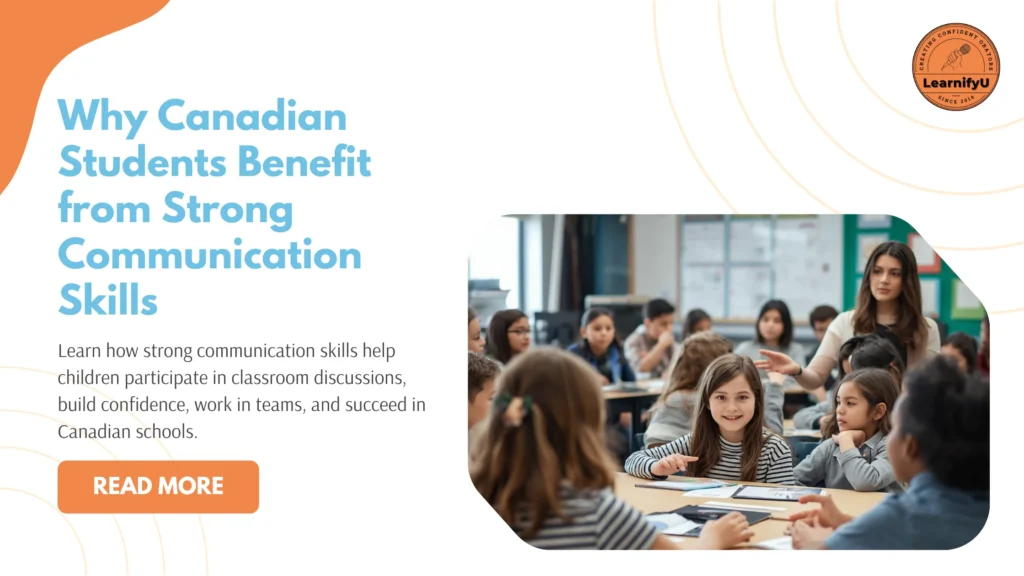
Many classrooms today look “different” from those of previous generations.
Students are often encouraged to –
- Discuss ideas
- Work in teams
- Present projects
- Share viewpoints
- Solve problems together
- Ask questions during lessons
In this type of learning environment – communication becomes part of the learning process.
Children who feel comfortable speaking often find it easier to contribute during lessons, join discussions & engage with classmates.
This does not mean that –– quiet children cannot succeed.
It simply means that “communication skills” can make many classroom experiences easier to navigate.
Knowing an Answer and Saying an Answer Are Different Things
Parents sometimes assume that a child who remains quiet lacks understanding.
That is not always true.
Many children know exactly what they want to say.
The challenge is saying it.
Some children worry about choosing the wrong words.
Others become nervous when attention shifts toward them.
A few prefer to stay silent – because they fear making mistakes in front of classmates.
The result is the same.
Good ideas remain unspoken.
Communication development helps children bridge the gap between thinking & expressing.
Classroom Discussions Reward More Than Knowledge
Knowledge matters.
But discussions require something additional.
Children need to:
- Listen carefully
- Organise thoughts quickly
- Respond appropriately
- Respect different viewpoints
- Speak clearly enough to be understood
These abilities rarely appear overnight.
They improve through regular practice & exposure.
A child who contributes one sentence today may contribute three tomorrow.
Eventually participation begins to feel normal rather than intimidating.
Group Projects Depend on Communication
Teachers frequently assign collaborative activities.
Group work sounds simple until children actually sit together.
One student talks constantly.
Another says almost nothing.
Someone disagrees but keeps quiet.
A task that should take twenty minutes suddenly becomes frustrating.
Communication skills help children navigate these situations.
They learn how to:
- Share ideas respectfully
- Listen to others
- Ask questions
- Explain opinions
- Reach agreements
These experiences extend beyond school and often influence friendships, sports teams & community activities.
Asking Questions Is an "Academic Skill"
Many students assume that asking questions reveals weakness.
In reality – asking thoughtful questions often demonstrates engagement.
Children who seek clarification tend to stay connected to lessons.
They understand expectations more clearly.
They avoid confusion before it becomes a larger problem.
Yet many children hesitate to ask questions because they worry about standing out.
Developing speaking confidence helps children become more comfortable seeking information when they need it.
Communication Shapes First Impressions
Teachers meet dozens of students every year.
Children who communicate clearly often find it easier to build – “positive relationships”.
This does not mean becoming the loudest person in the room.
It means being able to:
- Introduce yourself comfortably
- Explain ideas clearly
- Participate appropriately
- Interact respectfully
Strong communication skills help children represent themselves more accurately.
Without them, confidence and ability sometimes remain hidden.
Presentations Are Becoming More Common
School presentations are no longer limited to older students.
Children may be asked to:
- Share projects
- Present research
- Explain assignments
- Participate in assemblies
- Discuss reading activities
For some students, these moments are enjoyable.
For others, they create significant stress.
What often surprises parents is that – presentation confidence rarely develops during the presentation itself.
It develops through everyday communication habits built over time.
Children who regularly share ideas, participate in discussions and speak comfortably with others –– usually find presentations less overwhelming.
Communication & Friendships Are Closely Connected
School is not only about academics.
Children also spend years building social relationships.
Friendships often begin with communication.
Children need opportunities to:
- Start conversations
- Join group activities
- Resolve disagreements
- Share experiences
- Express opinions
Strong communication skills do not guarantee friendships.
However they often make social interactions smoother and more comfortable.
Listening Is Often Overlooked
Many communication articles focus entirely on speaking.
That approach misses an important point.
“Good communicators” are usually – “good listeners” first.
Children who listen carefully often understand situations better.
They respond more appropriately.
They pick up social cues more effectively.
They contribute more thoughtfully during discussions.
Listening deserves the same attention as speaking because – both skills work together.
What Parents Often Notice First
Communication growth usually appears in small ways.
Parents might notice that a child:
- Answers questions with more detail
- Volunteers information without prompting
- Speaks more clearly
- Participates more actively in class
- Reads aloud with greater comfort
- Introduces themselves more confidently
These changes may seem minor.
Over time – they often become significant.
Small shifts in confidence can influence many areas of a child’s school experience.
Building Communication Skills Outside School
Classrooms help children practise communication –but many opportunities exist beyond school.
Parents can encourage communication by:
Letting Children Explain Things
When a child tells a story – resist the urge to finish sentences for them.
Allow them time to organise thoughts independently.
Asking Questions That Require – More Than One Word
Questions such as –
“What was the most interesting part of your day?”
often generate richer conversations than simple –– yes or no questions.
Encouraging Reading Aloud
Reading aloud helps children become comfortable using their voice while – improving pronunciation and speaking confidence.
Creating Family Discussion Time
Simple conversations during meals often provide valuable communication practice.
Why Early Communication Development Matters
Children use communication skills every day.
They use them during lessons.
They use themwith friends.
They use them during activities, presentations and group work.
As they grow older – these same skills continue to appear in interviews, leadership roles, higher education, and professional environments.
This is why many families choose to strengthen communication skills early rather than waiting until – confidence becomes a challenge.
Parents seeking structured support can explore our Online Communication & Public Speaking Classes for Kids in Canada – where children learn practical speaking, listening, and presentation skills in an age-appropriate environment.
FAQs - Frequently Asked Questions
Often it has little to do with knowledge. Some children worry about making mistakes –– while others feel uncomfortable being the centre of attention. Confidence and communication ability do not always develop at the same pace.
Children who feel comfortable expressing themselves are generally –– more willing to answer questions, contribute to discussions, and participate in group activities.
Communication does not replace academic knowledge –but it often helps children engage more actively with learning. Students who ask questions, share ideas, and participate in discussions frequently gain more from –– classroom experiences.
Communication begins developing from early childhood. However children continue refining these skills throughout their school years –– as they encounter new social and academic situations.
Yes. Communication influences friendships, teamwork, leadership opportunities, interviews and many everyday interactions –– throughout life.
Common Questions Parents Ask
Home feels familiar and predictable. School introduces social dynamics, larger groups, and performance pressure that may make –– some children more reserved.
Yes – in many cases. Reading aloud encourages –– voice use, improves sentence flow, strengthens pronunciation. It helps children become more comfortable expressing themselves.
Rather than focusing on one skill – children benefit from developing listening, speaking, questioning, and conversation skills together.
Absolutely. Confidence does not require a child to become highly outgoing. Many strong communicators are naturally quiet –– but know how to express themselves effectively when needed.
Regular conversations, patient listening, storytelling, reading together and allowing children time to express thoughts – often help more than constant correction.
Key Takeaway
Success in Canadian classrooms is influenced by more than – academic ability.
Children are increasingly expected to –– discuss ideas, collaborate with classmates, ask questions, and share their thinking.
Communication skills support each of these experiences.
When children become comfortable expressing themselves –– classroom participation often feels less intimidating, friendships become easier to build and learning becomes more interactive.
The goal is not to create perfect speakers.
The goal is –– to help children feel comfortable contributing what they already know.